Results by title
60 books match the query 'Critique' and 7 start with a
A Critique of Political Science
A History of the Caucus for a New Political ScienceClyde W. Barrow
University of Michigan Press, 2026
A Critique of Political Science distinguishes between the discipline of political science (methods and concepts) and the profession of political science (persons and institutions) to move disciplinary history beyond its current form as intellectual history toward a politics of political science. The book argues that understanding the development of a discipline requires the same type of theoretical analysis that political scientists apply to other political institutions. By examining universities and professional associations as political institutions, this approach puts political struggles and ideological conflict at the very core of disciplinary history. In reviewing 50 years of debate, controversy, and in-fighting in the political science profession, the book serves as a critique of the profession and the discipline of political science, which remains woefully disengaged from the concerns of ordinary citizens, particularly the working class and the poor throughout the world.

A Critique of the Study of Kinship
David M. Schneider
University of Michigan Press, 1984
The critique uses a novel device in that the same set of ethnographic “facts” are looked at through different theories. This reveals a good deal about the different theories. By the same token, of course, this critique goes into the question of what a “fact” of “kinship” might be and how to recognize one either at home or in the field.
Schneider’s critique also uses history to raise cogent questions about how kinship has been studied. But it is not as 20/20 hindsight that history is used. Due respect is paid to the climate of the time, as well as the climatic changes and the ways in which these helped to create the emperor’s clothes. Right, wrong, or indifferent, Schneider’s study of how the emperor “kinship” was dressed and then redressed as the winds of change threatened disarray, proves challenging to the theories by which anthropology lives, as well as to the specifically privileged domain of “kinship.” The implications of this study for a wide range of problems within theoretical anthropology are striking.

Abysmal
A Critique of Cartographic ReasonGunnar Olsson
University of Chicago Press, 2007
People rely on reason to think about and navigate the abstract world of human relations in much the same way they rely on maps to study and traverse the physical world. Starting from that simple observation, renowned geographer Gunnar Olsson offers in Abysmal an astonishingly erudite critique of the way human thought and action have become deeply immersed in the rhetoric of cartography and how this cartographic reasoning allows the powerful to map out other people’s lives.
A spectacular reading of Western philosophy, religion, and mythology that draws on early maps and atlases, Plato, Kant, and Wittgenstein, Thomas Pynchon, Gilgamesh, and Marcel Duchamp, Abysmal is itself a minimalist guide to the terrain of Western culture. Olsson roams widely but always returns to the problems inherent in reason, to question the outdated assumptions and fixed ideas that thinking cartographically entails. A work of ambition, scope, and sharp wit, Abysmal will appeal to an eclectic audience—to geographers and cartographers, but also to anyone interested in the history of ideas, culture, and art.
AmBushed
A Critique of Machtpolitik, Volume 105Dana D. Nelson
Duke University Press, 0
One essay argues that the Left has ceded its political vision—forgoing active political organization in favor of simply voicing political criticism of the president—allowing its activist sensibilities and abilities to atrophy. Others explore the Bush administration, its masterful machtpolitik (power politics), its strategic feminization of its opposition, its aggressive expansion of executive-branch powers, and its flirtation with what some have labeled American fascism or totalitarianism; still others reflect on how the Left has insulated itself from both reality and politics. A contributor from South Africa draws parallels between apartheid proponents and their tactics and President Bush. Others analyze “Bush II” as the leader of the Christian Right, as a skillful exploiter and manipulator of the mainstream media, as the chief spokesman for “evangelical capitalism,” and as the world’s most powerful lobbyist for corporate interests.
Contributors. Wendell Berry, Michael Bérubé, Timothy Brennan, Sharad Chari, Matthew A. Crenson, Ariel Dorfman, Thomas L. Dumm, Keya Ganguly, Benjamin Ginsberg, Pierre Guerlain, Stephen Hartnett, Dana D. Nelson, Chris Newfield, Melissa A. Orlie, Stanley G. M. Ridge, Larry Schehr, Nikhil Singh, Neil Smith, Laura Ann Stengrim
Amalgamation Schemes
Antiblackness and the Critique of MultiracialismJared Sexton
University of Minnesota Press, 2008
Despite being heralded as the answer to racial conflict in the post–civil rights United States, the principal political effect of multiracialism is neither a challenge to the ideology of white supremacy nor a defiance of sexual racism. More accurately, Jared Sexton argues in Amalgamation Schemes, multiculturalism displaces both by evoking long-standing tenets of antiblackness and prescriptions for normative sexuality.
In this timely and penetrating analysis, Sexton pursues a critique of contemporary multiracialism, from the splintered political initiatives of the multiracial movement to the academic field of multiracial studies, to the melodramatic media declarations about “the browning of America.” He contests the rationales of colorblindness and multiracial exceptionalism and the promotion of a repackaged family values platform in order to demonstrate that the true target of multiracialism is the singularity of blackness as a social identity, a political organizing principle, and an object of desire. From this vantage, Sexton interrogates the trivialization of sexual violence under chattel slavery and the convoluted relationship between racial and sexual politics in the new multiracial consciousness.
An original and challenging intervention, Amalgamation Schemes posits that multiracialism stems from the conservative and reactionary forces determined to undo the gains of the modern civil rights movement and dismantle radical black and feminist politics.
Jared Sexton is assistant professor of African American studies and film and media studies at the University of California, Irvine.
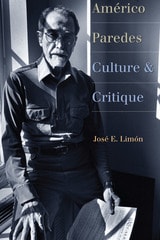
Américo Paredes
Culture and CritiqueBy José E. Limón
University of Texas Press, 2012
Several biographies of Américo Paredes have been published over the last decade, yet they generally overlook the paradoxical nature of his life’s work. Embarking on an in-depth, critical exploration of the significant body of work produced by Paredes, José E. Limón (one of Paredes’s students and now himself one of the world’s leading scholars in Mexican American studies) puts the spotlight on Paredes as a scholar/citizen who bridged multiple arenas of Mexican American cultural life during a time of intense social change and cultural renaissance.
Serving as a counterpoint to hagiographic commentaries, Américo Paredes challenges and corrects prevailing readings by contemporary critics of Paredes’s Asian period and of such works as the novel George Washington Gómez, illuminating new facets in Paredes’s role as a folklorist and public intellectual. Limón also explores how the field of cultural studies has drifted away from folklore, or “the poetics of everyday life,” while he examines the traits of Mexican American expressive culture. He also investigates the scholarly paradigm of ethnography itself, a stimulating inquiry that enhances readings of Paredes’s best-known study, “With His Pistol in His Hand,” and other works. Underscoring Paredes’s place in folklore and Mexican American literary production, the book questions the shifting reception of Paredes throughout his academic career, ultimately providing a deep hermeneutics of widely varied work. Offering new conceptions, interpretations, and perspectives, Américo Paredes gives this pivotal literary figure and his legacy the critical analysis they deserve.

Ashes Taken for Fire
Aesthetic Modernism and the Critique of IdentityKevin M. Bell
University of Minnesota Press, 2007