Results by title
7 books match the query 'Crossing Borders'

Building Bridges, Crossing Borders
One Young Deaf Woman’s EducationAnn Darby Getty
Gallaudet University Press, 2014
As soon as they realized that their daughter was deaf, Kyler’s parents, who were hearing, immediately began to learn sign language. They also engaged Darby, a parent/infant educator employed by the state school for the deaf, to work with Kyler. From the age of 13 months until Kyler’s college graduation 22 years later, Darby was involved in her education and development.
Despite living in a rural area, Kyler enjoyed an array of services, including parent/infant education, sign language interaction/modeling, speech and language therapy, and also a cochlear implant. At the same time that she developed her speech skills, sign language continued to be a critically important facet of her communication. In grade school, she learned with other deaf students, while in high school, she worked successfully in mainstream classrooms with interpreters and notetakers. As a college graduate, gifted artist, and veterinarian’s assistant today, Kyler exemplifies how a balanced approach to deaf education, using all resources at hand, can achieve remarkable results. Her story serves as a model for parents of other deaf children and the professionals who work with them.
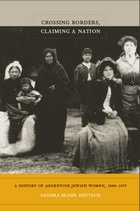
Crossing Borders, Claiming a Nation
A History of Argentine Jewish Women, 1880–1955Sandra McGee Deutsch
Duke University Press, 2010
Drawing on extensive archival research and original oral histories, Deutsch tells the stories of individual women, relating their sentiments and experiences as both insiders and outsiders to state formation, transnationalism, and cultural, political, ethnic, and gender borders in Argentine history. As agricultural pioneers and film stars, human rights activists and teachers, mothers and doctors, Argentine Jewish women led wide-ranging and multifaceted lives. Their community involvement—including building libraries and secular schools, and opposing global fascism in the 1930s and 1940s—directly contributed to the cultural and political lifeblood of a changing Argentina. Despite their marginalization as members of an ethnic minority and as women, Argentine Jewish women formed communal bonds, carved out their own place in society, and ultimately shaped Argentina’s changing pluralistic culture through their creativity and work.
Crossing Borders, Drawing Boundaries
The Rhetoric of Lines across AmericaBarbara Couture
Utah State University Press, 2016
With growing anxiety about American identity fueling debates about the nation’s borders, ethnicities, and languages, Crossing Borders, Drawing Boundaries provides a timely and important rhetorical exploration of divisionary bounds that divide an Us from a Them. The concept of “border” calls for attention, and the authors in this collection respond by describing it, challenging it, confounding it, and, at times, erasing it.
Motivating us to see anew the many lines that unite, divide, and define us, the essays in this volume highlight how discourse at borders and boundaries can create or thwart conditions for establishing identity and admitting difference. Each chapter analyzes how public discourse at the site of physical or metaphorical borders presents or confounds these conditions and, consequently, effective participation—a key criterion for a modern democracy. The settings are various, encompassing vast public spaces such as cities and areas within them; the rhetorical spaces of history books, museum displays, activist events, and media outlets; and the intimate settings of community and classroom conversations.
Crossing Borders, Drawing Boundaries shows how rich communication can be when diverse cultures intersect and create new opportunities for human connection, even while different populations, cultures, age groups, and political parties adopt irreconcilable positions. It will be of interest to scholars in rhetoric and literacy studies and students in rhetorical analysis and public discourse.
Contributors include Andrea Alden, Cori Brewster, Robert Brooke, Randolph Cauthen, Jennifer Clifton, Barbara Couture, Vanessa Cozza, Anita C. Hernández, Roberta J. Herter, Judy Holiday, Elenore Long, José A. Montelongo, Karen P. Peirce, Jonathan P. Rossing, Susan A. Schiller, Christopher Schroeder, Tricia C. Serviss, Mónica Torres, Kathryn Valentine, Victor Villanueva, and Patti Wojahn.
Crossing Borders, Reinforcing Borders
Social Categories, Metaphors, and Narrative Identities on the U.S.-Mexico FrontierBy Pablo Vila
University of Texas Press, 2000
Along the U.S.-Mexico frontier, where border crossings are a daily occurrence for many people, reinforcing borders is also a common activity. Not only does the U.S. Border Patrol strive to "hold the line" against illegal immigrants, but many residents on both sides of the border seek to define and bound themselves apart from groups they perceive as "others."
This pathfinding ethnography charts the social categories, metaphors, and narratives that inhabitants of El Paso and Ciudad Juárez use to define their group identity and distinguish themselves from "others." Pablo Vila draws on over 200 group interviews with more than 900 area residents to describe how Mexican nationals, Mexican immigrants, Mexican Americans, African Americans, and Anglos make sense of themselves and perceive their differences from others.
This research uncovers the regionalism by which many northern Mexicans construct their sense of identity, the nationalism that often divides Mexican Americans from Mexican nationals, and the role of ethnicity in setting boundaries among Anglos, Mexicans, and African Americans. Vila also looks at how gender, age, religion, and class intertwine with these factors. He concludes with fascinating excerpts from re-interviews with several informants, who modified their views of other groups when confronted by the author with the narrative character of their identities.
Crossing Borders
Changing Social Identities in Southern MexicoKimberly M. Grimes
University of Arizona Press, 1998
Crossing Borders
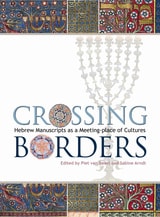
Hebrew Manuscripts as a Meeting-place of CulturesEdited by Piet van Boxel and Sabine Arndt
Bodleian Library Publishing, 2010
Crossing Borders tells the intriguing but largely unfamiliar story of the exchange of culture and knowledge between Jews and non-Jews in the Muslim and Christian worlds during the late Middle Ages as part of the preparation of Hebrew manuscripts. The book is composed of ten narratives, each of which brings to light a different aspect of Jewish life in a non-Jewish medieval society—highlighting the practical cooperation, social interaction, and religious toleration that was surprisingly common between the groups involved in the early enterprise of book production.
Alongside the narratives, Crossing Borders is beautifully illustrated with images from the Hebrew holdings at the Bodleian Library—one of the largest and most important collections of Hebrew manuscripts worldwide. The art includes Christian codex fragments from the third century, a copy of Moses Maimonides’ Mishneh Torah signed by Maimonides himself, a thirteenth century German Jewish prayer book, and lavishly illuminated Spanish Bible manuscripts from the fifteenth century. This exquisitely illustrated book takes a fascinating look at the often-ignored role of Jews in the written transmission of culture and science throughout medieval Europe.
Crossing Borders
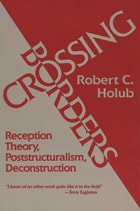
Reception Theory, Poststructuralism, DeconstructionRobert C. Holub
University of Wisconsin Press, 1992
Robert C. Holub critically investigates the histories of reception theory, poststructuralism, and deconstruction in postwar Germany and the United States. He looks at how imported theories assume a place in the political discourse of a country, and how indigenous intellectual traditions and prejudices affect, modify, or even distort foreign theories.
Holub addresses many timely questions: Why did reception theory, so prominent in Germany in the 1960s and 1970s, fail to have an impact on American academics until the 1980s? Why did postructuralism, and specifically the writings of Michel Foucault, fail to find a home in German academia while becoming an important theoretical voice in the United States? How did deconstruction, originally considered by American scholars as merely a sophisticated tool for analysis, get taken up by leftists who argued for an affinity between the critique of language and the critique of capitalism? And finally, how have American intellectuals responded to revelations of fascism in the pasts of Paul de Man and Martin Heidegger?
Crossing Borders effectively demonstrates the extent to which theoretical work needs to be understood in cultural, intellectual, and institutional contexts. Holub argues that the praxis of theories is determined not only by their content and style, but also by the environment in which they must function. The success of a transplanted theory, he contends, is due less to its inherent merits than to the hospitability of the environment on to which it is grafted.