Results by title
3 books match the query 'Crowds'
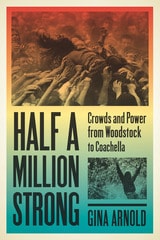
Half a Million Strong
Crowds and Power from Woodstock to CoachellaGina Arnold
University of Iowa Press, 2018
From baby boomers to millennials, attending a big music festival has basically become a cultural rite of passage in America. In Half a Million Strong, music writer and scholar Gina Arnold explores the history of large music festivals in America and examines their impact on American culture. Studying literature, films, journalism, and other archival detritus of the countercultural era, Arnold looks closely at a number of large and well-known festivals, including the Newport Folk Festival, Woodstock, Altamont, Wattstax, the New Orleans Jazz and Heritage Festival, Hardly Strictly Bluegrass, and others to map their cultural significance in the American experience. She finds that—far from being the utopian and communal spaces of spiritual regeneration that they claim for themselves— these large music festivals serve mostly to display the free market to consumers in its very best light.

The Crowd in Rome in the Late Republic
Fergus Millar
University of Michigan Press, 2002
In this important study, Fergus Millar explores the development of the Roman Republic, which, as it drew to a close in the middle decades of the first century B.C.E., had come to cover most of Italy. There were nearly a million adult male voters in the time of Cicero, but there were no constituencies, and no absentee ballots. To exercise their rights, voters had to come in person to Rome and to meet in the Forum. Millar takes the period from the dictatorship of Sulla to Caesar's crossing of the Rubicon and shows how the politics of the crowd was central to the great changes that took place year after year, and altered the Republic forever.
The originality of Millar's highly accessible work lies first in its serious treatment of the importance of open-air oratory in Roman public life, and second, in its use of the narratives of events that evidence provides. Third, it refuses to interpret these narratives in the light of modern theories about the importance of the client-patron system, or the domination of the Senate. This work questions how we should understand the Roman Republic: as a network of aristocratic families dominating the people, or an erratic and volatile democracy in which power was exercised by the tiny proportion of citizens who actually came to listen to speeches and to vote.
This work speaks to those interested in ancient history and its consequences in the modern world.
Fergus Millar is Camden Professor of Ancient History, Brasenose College, Oxford University.

Virality
Contagion Theory in the Age of NetworksTony D. Sampson
University of Minnesota Press, 2012
In this thought-provoking work, Tony D. Sampson presents a contagion theory fit for the age of networks. Unlike memes and microbial contagions, Virality does not restrict itself to biological analogies and medical metaphors. It instead points toward a theory of contagious assemblages, events, and affects. For Sampson, contagion is not necessarily a positive or negative force of encounter; it is how society comes together and relates.
Sampson argues that a biological knowledge of contagion has been universally distributed by way of the rhetoric of fear used in the antivirus industry and other popular discourses surrounding network culture. This awareness is also detectable in concerns over too much connectivity, such as problems of global financial crisis and terrorism. Sampson’s “virality” is as established as that of the biological meme and microbe but is not understood through representational thinking expressed in metaphors and analogies. Rather, Sampson interprets contagion theory through the social relationalities first established in Gabriel Tarde’s microsociology and subsequently recognized in Gilles Deleuze’s ontological worldview.
According to Sampson, the reliance on representational thinking to explain the social behavior of networking—including that engaged in by nonhumans such as computers—allows language to overcategorize and limit analysis by imposing identities, oppositions, and resemblances on contagious phenomena. It is the power of these categories that impinges on social and cultural domains. Assemblage theory, on the other hand, is all about relationality and encounter, helping us to understand the viral as a positively sociological event, building from the molecular outward, long before it becomes biological.