Results by title
5 books match the query 'Crumbley, Paul'
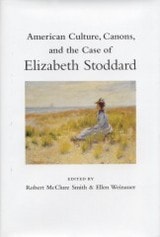
American Culture, Canons, and the Case of Elizabeth Stoddard
Robert McClure Smith
University of Alabama Press, 2003
Elizabeth Stoddard was a gifted writer of fiction, poetry, and journalism; successfully published within her own lifetime; esteemed by such writers as William Dean Howells and Nathaniel Hawthorne; and situated at the epicenter of New York’s literary world. Nonetheless, she has been almost excluded from literary memory and importance. This book seeks to understand why. By reconsidering Stoddard’s life and work and her current marginal status in the evolving canon of American literary studies, it raises important questions about women’s writing in the 19th century and canon formation in the 20th century.
Essays in this study locate Stoddard in the context of her contemporaries, such as Dickinson and Hawthorne, while others situate her work in the context of major 19th-century cultural forces and issues, among them the Civil War and Reconstruction, race and ethnicity, anorexia and female invalidism, nationalism and localism, and incest. One essay examines the development of Stoddard’s work in the light of her biography, and others probe her stylistic and philosophic originality, the journalistic roots of her voice, and the elliptical themes of her short fiction. Stoddard’s lifelong project to articulate the nature and dynamics of woman’s subjectivity, her challenging treatment of female appetite and will, and her depiction of the complex and often ambivalent relationships that white middle-class women had to their domestic spaces are also thoughtfully considered.
The editors argue that the neglect of Elizabeth Stoddard’s contribution to American literature is a compelling example of the contingency of critical values and the instability of literary history. This study asks the question, “Will Stoddard endure?” Will she continue to drift into oblivion or will a new generation of readers and critics secure her tenuous legacy?
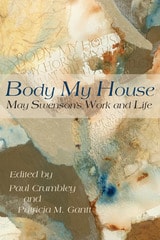
Body My House
May Swenson's Work and Lifeedited by Paul Crumbley and Patricia M. Gantt
Utah State University Press, 2000
The first collection of critical essays on May Swenson and her literary universe, Body My House initiates an academic conversation about an unquestionably major poet of the middle and late twentienth century. Includes many previously unpublished Swenson poems.
Essays here address the breadth of Swenson's literary corpus and offer varied scholarly approaches to it. They reference Swenson manuscripts---poems, letters, diaries, and other prose---some of which have not been widely available before. Chapters focus on Swenson's work as a nature writer; the literary and social contexts of her writing; her national and international acclaim; her work as a translator; associations with other poets and writers (Bishop, Moore, and others); her creative process; and her profound explorations of gender and sexuality. The first full volume of scholarship on May Swenson, Body My House suggests an ambitious agenda for further work.

Dickinson's Fascicles
A Spectrum of PossibilitiesPaul Crumbley and Eleanor Elson Heginbotham
The Ohio State University Press, 2014
The collection opens with a central portion of Sharon Cameron’s 1992 book that was the first to abandon the until-then popular search for a single unifying narrative to explain the fascicles, inaugurating a new era of fascicle scholarship. Eight prominent Dickinson scholars contribute essays to this volume and respond vigorously and variously to Cameron's argument, proposing, for instance, that the fascicles represent Dickinson's engagement with the world around her, particularly with the Civil War, and that they demonstrate her continued experimentation with poetic form.
Dickinson’s Fascicles is edited by Paul Crumbley and Eleanor Elson Heginbotham. Other contributors include Paula Bernat Bennett, Martha Nell Smith, Domhnall Mitchell, Ellen Louise Hart, Melanie Hubbard, and Alexandra Socarides who assess what constitutes a vast final frontier in the Dickinson literary landscape. Susan Howe provides a coda.
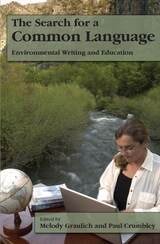
Search for a Common Language
Environmental Writing and Educationedited by Melody Graulich & Paul Crumbley
Utah State University Press, 2005
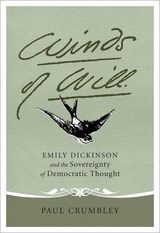
Winds of Will
Emily Dickinson and the Sovereignty of Democratic ThoughtPaul Crumbley
University of Alabama Press, 2010
A sophisticated literary analysis positioning Emily Dickinson’s poetry within the framework of democratic thought and individual sovereignty.
In this study, Paul Crumbley asserts that, contrary to popular opinion, Emily Dickinson consistently communicated political views through her poetry. Dickinson’s life of self-isolation—today her most notable personal characteristic—by no means extended into the political sphere, he argues. While she rarely addressed political issues directly and was curiously disengaged from the liberal causes and female reform movements of her time, Dickinson’s poems are deeply rooted both in matters of personal sovereignty and reader choice. The significant choices Dickinson extends to the reader underscore the democratic dimensions of reading her work, and of reading itself as a political act.
Crumbley employs close readings of Dickinson’s poems and letters, highlighting the many changing—and often contradictory—voices in her work, both throughout her oeuvre and in individual poems themselves. In Dickinson’s letters Crumbley finds just as many unique and conflicting voices; thus, both her personal correspondence and the poems make political demands by placing the burden of interpretation on the reader.
Rather than reflecting explicit political values, Dickinson’s work chronicles an ongoing decision-making process that magnifies the role of individual choice, not the advocacy of specific outcomes. In the end, Dickinson’s readers must either accept an isolated lyric subjectivity or invest that subjectivity with the substance necessary for engagement with the larger world.