Results by title
9 books match the query 'Crypto-Jews'
A Network of Converso Families in Early Modern Toledo
Assimilating a MinorityLinda Martz
University of Michigan Press, 2003
Linda M. Martz focuses on families that were immersed in the worlds of business and finance. They formed the backbone of the trade industry and, during the economic expansion of the sixteenth century, enjoyed a high degree of affluence. The seventeenth century, however, brought harder times. How these families rose to positions of commercial eminence and then adapted to this economic downturn is one of the questions addressed in this insightful book.
A Network of Converso Families in Early Modern Toledo relies heavily on archival evidence--notarial, parish, and city records--that offers new insights into the families' histories. Business endeavors, marriage alliances, involvement in local politics, and the pursuit of improved social status are all subjected to Martz's keen analysis.
These families appear to have been well integrated into their contemporary society; aside from their business and financial activities, many were members of the city's governing council. But how well did they integrate with the lower classes? Assimilating minorities in the majority culture is a task that confronts most modern societies, so the experience of Spain and this particular minority may serve as an example of how earlier societies viewed and confronted this challenge.
This book will appeal to historians of medieval and Renaissance Spain and those interested in the Inquisition's effect on Renaissance Spain. It will also prove to be indispensable for those interested in the history of the Jewish race, as well as for those pursuing the question of marginalization.
Linda M. Martz is an independent historian as well as a freelance editor and writer.
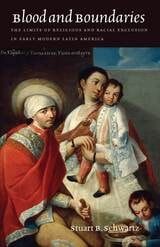
Blood and Boundaries
The Limits of Religious and Racial Exclusion in Early Modern Latin AmericaStuart B. Schwartz
Brandeis University Press, 2020
In Blood and Boundaries, Stuart B. Schwartz takes us to late medieval Latin America to show how Spain and Portugal’s policies of exclusion and discrimination based on religious origins and genealogy were transferred to their colonies in Latin America. Rather than concentrating on the three principal divisions of colonial society—Indians, Europeans, and people of African origins—as is common in studies of these colonial societies, Schwartz examines the three minority groups of moriscos, conversos, and mestizos. Muslim and Jewish converts and their descendants, he shows, posed a special problem for colonial society: they were feared and distrusted as peoples considered ethnically distinct, but at the same time their conversion to Christianity seemed to violate stable social categories and identities. This led to the creation of “cleanliness of blood” regulations that explicitly discriminated against converts. Eventually, Schwartz shows, those regulations were extended to control the subject indigenous and enslaved African populations, and over time, applied to the growing numbers of mestizos, peoples of mixed ethnic origins. Despite the efforts of civil and church and state institutions to regulate, denigrate, and exclude, members of these affected groups often found legal and practical means to ignore, circumvent, or challenge the efforts to categorize and exclude them, creating in the process the dynamic societies of Latin America that emerged in the nineteenth century.
Conversos, Inquisition, and the Expulsion of the Jews from Spain
Norman Roth
University of Wisconsin Press, 2002
The Jewish community of medieval Spain was the largest and most important in the West for more than a thousand years, participating fully in cultural and political affairs with Muslim and Christian neighbors. This stable situation began to change in the 1390s, and through the next century hundreds of thousands of Jews converted to Christianity. Norman Roth argues here with detailed documentation that, contrary to popular myth, the conversos were sincere converts who hated (and were hated by) the remaining Jewish community. Roth examines in depth the reasons for the Inquisition against the conversos, and the eventual expulsion of all Jews from Spain.
“With scrupulous scholarship based on a profound knowledge of the Hebrew, Latin, and Spanish sources, Roth sets out to shatter all existing preconceptions about late medieval society in Spain.”—Henry Kamen, Journal of Ecclesiastical History
“Scholarly, detailed, researched, and innovative. . . . As the result of Roth’s writing, we shall need to rethink our knowledge and understanding of this period.”—Murray Levine, Jewish Spectator
“The fruit of many years of study, investigation, and reflection, guaranteed by the solid intellectual trajectory of its author, an expert in Jewish studies. . . . A contribution that will be particularly valuable for the study of Spanish medievalism.”—Miguel Angel Motis Dolader, Annuario de Estudios Medievales
Suddenly Jewish
Jews Raised as Gentiles Discover Their Jewish RootsBarbara Kessel
Brandeis University Press, 2007

The Faith of Fallen Jews
Yosef Hayim Yerushalmi and the Writing of Jewish HistoryEdited by David N. Myers and Alexander Kaye
Brandeis University Press, 2013
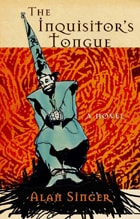
The Inquisitor's Tongue
A NovelAlan Singer
University of Alabama Press, 2012
Alan Singer’s riveting new novel, The Inquisitor’s Tongue, reimagines the Spanish Inquisition as a world in which spiritual horrors and acts of violence are the birth pangs of otherwise unimaginable identities.
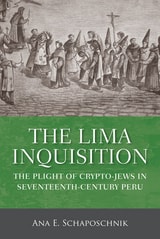
The Lima Inquisition
The Plight of Crypto-Jews in Seventeenth-Century PeruAna E. Schaposchnik
University of Wisconsin Press, 2017
Delving into the records of the tribunal, Schaposchnik brings to light the experiences of individuals on both sides of the process. Some prisoners, she discovers, developed a limited degree of agency as they managed to stall trials or mitigate the most extreme punishments. Training her attention on the accusers, Schaposchnik uncovers the agendas of specific inquisitors in bringing the condemned from the dungeons to the 1639 Auto General de Fe ceremony of public penance and execution. Through this fine-grained study of the tribunal's participants, Schaposchnik finds that the Inquisition sought to discipline and shape culture not so much through frequency of trials or number of sentences as through the potency of individual examples.
The Long Journey of Gracia Mendes
Marianna D. Birnbaum
Central European University Press, 2003
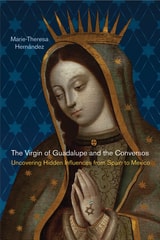
The Virgin of Guadalupe and the Conversos
Uncovering Hidden Influences from Spain to MexicoHernández, Marie-Theresa
Rutgers University Press, 2014
The terms converso and judaizante are often used for descendants of Spanish Jews (the Sephardi, or Sefarditas as they are sometimes called), who converted under duress to Christianity in the fourteenth and fifteenth centuries. There are few, if any, archival documents that prove the existence of judaizantes after the Spanish expulsion of the Jews in 1492 and the Portuguese expulsion in 1497, as it is unlikely that a secret Jew in sixteenth-century Spain would have documented his allegiance to the Law of Moses, thereby providing evidence for the Inquisition.
On a Da Vinci Code – style quest, Hernández persisted in hunting for a trove of forgotten manuscripts at the New York Public Library. These documents, once unearthed, describe the Jewish/Christian religious beliefs of an early nineteenth-century Catholic priest in Mexico City, focusing on the relationship between the Virgin of Guadalupe and Judaism. With this discovery in hand, the author traces the cult of Guadalupe backwards to its fourteenth-century Spanish origins. The trail from that point forward can then be followed to its interface with early modern conversos and their descendants at the highest levels of the Church and the monarchy in Spain and Colonial Mexico. She describes key players who were somehow immune to the dangers of the Inquisition and who were allowed the freedom to display, albeit in a camouflaged manner, vestiges of their family's Jewish identity.
By exploring the narratives produced by these individuals, Hernández reveals the existence of those conversos and judaizantes who did not return to the “covenantal bond of rabbinic law,” who did not publicly identify themselves as Jews, and who continued to exhibit in their influential writings a covert allegiance and longing for a Jewish past. This is a spellbinding and controversial story that offers a fresh perspective on the origins and history of conversos.