Results by title
5 books match the query 'Cultural Context'
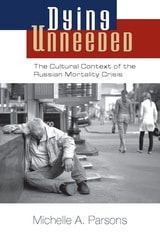
Dying Unneeded
The Cultural Context of the Russian Mortality CrisisMichelle A. Parsons
Vanderbilt University Press, 2014
Middle-aged Muscovites talk about being unneeded (ne nuzhny), or having little to give others. Considering this concept of "being unneeded" reveals how political economic transformation undermined the logic of social relations whereby individuals used their position within the Soviet state to give things to other people. Being unneeded is also gendered--while women are still needed by their families, men are often unneeded by state or family. Western literature on the mortality crisis focuses on a lack of social capital, often assuming that what individuals receive is most important, but being needed is more about what individuals give. Social connections--and their influence on health--are culturally specific.
In Soviet times, needed people helped friends and acquaintances push against the limits of the state, crafting a sense of space and freedom. When the state collapsed, this sense of bounded freedom was compromised, and another freedom became deadly.
This book is a recipient of the annual Norman L. and Roselea J. Goldberg Prize for the best project in the area of medicine.
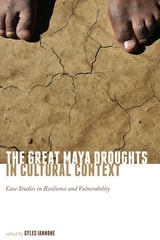
Great Maya Droughts in Cultural Context
Case Studies in Resilience and VulnerabilityGyles Iannone
University Press of Colorado, 2014
The Great Maya Droughts in Cultural Context offers new insights into the complicated series of events that impacted the decline of Maya civilization. This significant contribution to our increasingly comprehensive understanding of ancient Maya culture will be of interest to students and scholars of archaeology, anthropology, geography, and environmental studies.
Resonant Dissonance
The Russian Joke in Cultural ContextSeth Graham
Northwestern University Press, 2009
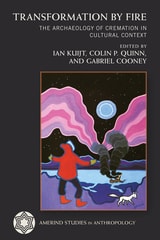
Transformation by Fire
The Archaeology of Cremation in Cultural ContextEdited by Ian Kuijt, Colin P. Quinn, and Gabriel Cooney
University of Arizona Press, 2014
Editors Ian Kuijt, Colin P. Quinn, and Gabriel Cooney’s volume examines cremation by documenting the material signatures of cremation events and processes, as well as its transformative impact on social relations and concepts of the body. Indeed, examining why and how people chose to cremate their dead serves as an important means of understanding how people in the past dealt with death, the body, and the social world.
The contributors develop new perspectives on cremation as important mortuary practices and social transformations. Varying attitudes and beliefs on cremation and other forms of burial within the same cultural paradigm help us understand what constitutes the body and what occurs during its fiery transformation. In addition, they explore issues and interpretive perspectives in the archaeological study of cremation within and between different cultural contexts.
The global and comparative perspectives on cremation render the book a unique contribution to the literature of anthropological and mortuary archaeology.
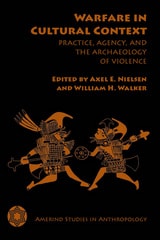
Warfare in Cultural Context
Practice, Agency, and the Archaeology of ViolenceEdited by Axel E. Nielsen and William H. Walker
University of Arizona Press, 2009
However, contributors argue, this model-and-evidence approach has given rise to multiple competing hypotheses and ambiguity rather than to full, coherent explanations of what turns out to be surprisingly complex acts of war. The chapters in Warfare in Cultural Context contend that agency and culture, inherited values and dispositions (such as religion and other cultural practices), beliefs, and institutions are always woven into the conduct of war.
This revealing book focuses on the ways that specific people construed their interests and life projects, and their problems and possibilities, and consequently chose among alternative courses of action. Using archaeological and ethnohistorical data from various parts of the world, the contributors explore the multiple avenues for the cultural study of warfare that these ideas make possible. Contributions focus on cultural aspects of warfare in Mesoamerica, South America, North America, and Southeast Asia. Case studies include warfare among the Maya, Inca, southwestern Pueblos, Mississippian cultures, and the Enga of Papua New Guinea.