Results by title
9 books match the query 'Cultural Memory'
Constructing Communities in Vergil's Aeneid
Cultural Memory, Identity, and IdeologyTedd A. Wimperis
University of Michigan Press, 2024
Where previous studies of identity and memory in the Aeneid have focused on the poem’s constructions of Roman identity, Constructing Communities turns the spotlight onto the characters themselves to show how the world inside the poem is replicating, as if in miniature, real forms of contemporary political and cultural discourse, reflecting an historical milieu where appeals to Roman identity were vigorously asserted in political rhetoric. The book applies this evidence to a broad literary analysis of the Aeneid, as well as a reevaluation of its engagement with Roman imperial ideology in the Age of Augustus.
Critical Perspectives on Cultural Memory and Heritage
Construction, Transformation and DestructionEdited by Veysel Apaydin
University College London, 2020
Cultural Memory and Biodiversity
Virginia D. Nazarea
University of Arizona Press, 1998
Cultural Memory
Resistance, Faith, and IdentityBy Jeanette Rodriguez and Ted Fortier
University of Texas Press, 2007

Deja Vu
Aberrations Of Cultural MemoryPeter Krapp
University of Minnesota Press, 2004
The pitfalls of cultural memory and forgetting, understood through the genealogy of the phenomenon called déjà vu
Referring to a past that never was, déjà vu shares a structure not only with fiction, but also with the ever more sophisticated effects of media technology. Tracing the term from the end of the nineteenth century, when it was first popularized in the pages of the Revue philosophique, Peter Krapp examines the genealogy and history of the singular and unrepeatable experience of déjà vu. This provocative book offers a refreshing counterpoint to the clichéd celebrations of cultural memory and forces us do a double take on the sanctimonious warnings against forgetting so common in our time.
Disturbances of cultural memory—screen memories, false recognitions, premonitions—disrupt the comfort zone of memorial culture: strictly speaking, déjà vu is neither a failure of memory nor a form of forgetting. Krapp’s analysis of such disturbances in literature, art, and mass media introduces, historicizes, and theorizes what it means to speak of an economy of attention or distraction. Reaching from the early psychoanalytic texts of Sigmund Freud to the plays of Heiner Müller, this exploration of the effects of déjà vu pivots around the work of Walter Benjamin and includes readings of kitsch and aura in Andy Warhol’s work, of cinematic violence and certain exaggerated claims about shooting and cutting, of the memorial character of architecture, and of the high expectations raised by the Internet.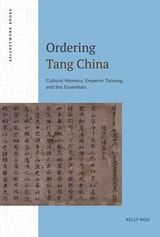
Ordering Tang China
Cultural Memory, Emperor Taizong, and the EssentialsKelly Ngo
Lever Press, 2024
By connecting the textual discourse with an analysis of its use and reception across the region, Ngo demonstrates that the Essentials was a key source of Confucian political thought and practice during the early Tang dynasty. In accounting for the place of the Essentials in political advice literature, Ngo illustrates how it drew from the ancient Confucian heritage and was still responsive to contemporaneous political concerns, suggesting that the Essentials played a part in the success of Zhenguan political practice.
Ordering Tang China also includes the first English-language translations of portions of the seventh-century anthology, with reference to partial translations published in nine languages. Utilizing the theory of cultural memory to study the Essentials not only opens a fresh approach to learning about the imperial consumption of literature, as well as the theory and practice of emperorship, but also offers a case study for how to study Chinese governance literature, including its “mirror for princes” genre.
Philosophical Imagination and Cultural Memory
Appropriating Historical TraditionsPatricia Cook, ed.
Duke University Press, 1993
Unlike analytic philosophy, a discipline supposedly liberated from any manifestation of cultural memory, the movement represented by these essays demonstrates how the inquiries, narratives, traditions, and events of our cultural past can mediate some of the most interesting exercises of the present-day philosophical imagination. Attesting to the power of historical tradition to enhance and redirect the prospects of philosophy these essays exemplify a new mode of doing philosophy.
The product of a National Endowment for the Humanities Summer Institute in 1990, it is the task of this book to show that history can be reclaimed by philosophy and resurrected in postmodernity.
Contributors. George Allan, Eva T. H. Brann, Arthur C. Danto, Lynn S. Joy, George L. Kline, George R. Lucas, Jr., Alasdair MacIntyre, Robert C. Neville, John Rickard, Stanley Rosen, J. B. Scheenwind, Donald Phillip Verene
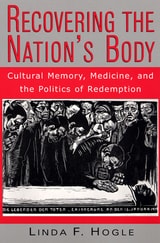
Recovering the Nation's Body
Cultural Memory, Medicine, and the Politics of RedemptionLinda F Hogle
Rutgers University Press, 1999
The body is both a site for medical practice and a source of therapeutic and scientific tools. As such, there are a variety of meanings ascribed to the body which both affect and are affected by cultural, economic, political and legal complexities. In order to access and use body parts, Linda F. Hogle states, transformative scientific and cultural processes are brought into play. Nowhere is this more evident than present-day Germany, where the spectre of Nazi medical experimentation still plays a large role in national policies governing the use of body parts and the way these policies are put into practice. In their efforts to be perceived as not repeating atrocities of the past, German medical practitioners and policy-makers reformulate ideas of bodily violation. To further confuse the issue, the reunification of East and West Germany has engendered new questions about the relationship between individuals’ bodies, science, and the state.
Hogle shows how “universal” medicine is reinterpreted through the lens of national and transnational politics and history, using comparative examples from her research in the United. States. Recovering the Nation’s Body is the first book to analyze the actual practices involved in procuring human tissue, and the first to examine how the German past and the unique present-day situation within the European Union are key in understanding the form that medical practices take within various contexts.
Shaping Losses
CULTURAL MEMORY AND THE HOLOCAUSTEdited by Julia Epstein and Lori Hope Lefkovitz
University of Illinois Press, 2001
This eloquent volume examines how memoirs, films, photographs, art, and literature, as well as family conversations and personal remembrances, embody the impulse to preserve what is destroyed. The contributors -- all distinguished women scholars, most of them survivors or daughters of survivors--examine classic memorializations such as Claude Lanzmann's film Shoah and Roman Vishniac's photographs of prewar Jews as well as several less-well-known works. They also address ways in which children of survivors of the Holocaust--and of other catastrophic traumas--struggle with inherited or vicarious memory, striving to come to terms with losses that centrally define them although they experience them only indirectly.
Shaping Losses considers the limitations of Holocaust representations and testimonies that capture shards of the experience but are necessarily selective and reductive. Contributors discuss artistic efforts to "preserve the rawness" of memory, to resist redemptive closure in Holocaust narratives and public memorials, and to prevent the Holocaust from being sealed in "the cold storage of history." The authors probe the nature of memory and of trauma, studying the use of language within and outside a traumatic context such as Auschwitz and pinpointing the qualities that make traumatic memory ineffable, untransmittable, and perhaps unreliable. Within the "haunted terrain of traumatized memory" that all Holocaust testimonies inhabit, the impulse to give form to emptiness--to shape loss--emerges as a necessary betrayal, a vital effort to bridge the gap between history and memory.