Results by title
5 books match the query 'Cultural Origins'
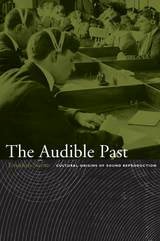
The Audible Past
Cultural Origins of Sound ReproductionJonathan Sterne
Duke University Press, 2003
Blending cultural studies and the history of communication technology, Sterne follows modern sound technologies back through a historical labyrinth. Along the way, he encounters capitalists and inventors, musicians and philosophers, embalmers and grave robbers, doctors and patients, deaf children and their teachers, professionals and hobbyists, folklorists and tribal singers. The Audible Past tracks the connections between the history of sound and the defining features of modernity: from developments in medicine, physics, and philosophy to the tumultuous shifts of industrial capitalism, colonialism, urbanization, modern technology, and the rise of a new middle class.
A provocative history of sound, The Audible Past challenges theoretical commonplaces such as the philosophical privilege of the speaking subject, the visual bias in theories of modernity, and static descriptions of nature. It will interest those in cultural studies, media and communication studies, the new musicology, and the history of technology.

The Cultural Origins of the French Revolution
Roger Chartier
Duke University Press, 1991
Chartier has set himself two important tasks. First, while acknowledging the seminal contribution of Daniel Mornet’s Les origens intellectuelles de la Révolution française (1935), he synthesizes the half-century of scholarship that has created a sociology of culture for Revolutionary France, from education reform through widely circulated printed literature to popular expectations of government and society. Chartier goes beyond Mornet’s work, not be revising that classic text but by raising questions that would not have occurred to its author.
Chartier’s second contribution is to reexamine the conventional wisdom that there is a necessary link between the profound cultural transformation of the eighteenth century (generally characterized as the Enlightenment) and the abrupt Revolutionary rupture of 1789. The Cultural Origins of the French Revolution is a major work by one of the leading scholars in the field and is likely to set the intellectual agenda for future work on the subject.

The Cultural Origins of the Socialist Realist Aesthetic
1890-1934Irina Gutkin
Northwestern University Press, 1999
In The Cultural Origins of the Socialist Realist Aesthetic, Irina Gutkin brings together the best work written on the subject to argue that socialist realism encompassed a philosophical worldview that marked thinking in the USSR on all levels: political, social, and linguistic. Using a wealth of diverse cultural material, Gutkin traces the emergence of the central tenants of socialist realist theory from Symbolism and Futurism through the 1920s and 1930s.
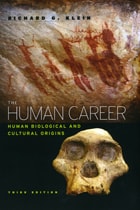
The Human Career
Human Biological and Cultural Origins, Third EditionRichard G. Klein
University of Chicago Press, 2009
Since its publication in 1989, The Human Career has proved to be an indispensable tool in teaching human origins. This substantially revised third edition retains Richard G. Klein’s innovative approach while showing how cumulative discoveries and analyses over the past ten years have significantly refined our knowledge of human evolution.
Klein chronicles the evolution of people from the earliest primates through the emergence of fully modern humans within the past 200,000 years. His comprehensive treatment stresses recent advances in knowledge, including, for example, ever more abundant evidence that fully modern humans originated in Africa and spread from there, replacing the Neanderthals in Europe and equally archaic people in Asia. With its coverage of both the fossil record and the archaeological record over the 2.5 million years for which both are available, The Human Career demonstrates that human morphology and behavior evolved together. Throughout the book, Klein presents evidence for alternative points of view, but does not hesitate to make his own position clear.
In addition to outlining the broad pattern of human evolution, The Human Career details the kinds of data that support it. For the third edition, Klein has added numerous tables and a fresh citation system designed to enhance readability, especially for students. He has also included more than fifty new illustrations to help lay readers grasp the fossils, artifacts, and other discoveries on which specialists rely. With abundant references and hundreds of images, charts, and diagrams, this new edition is unparalleled in its usefulness for teaching human evolution.

The State as a Work of Art
The Cultural Origins of the ConstitutionEric Slauter
University of Chicago Press, 2009
The founding of the United States after the American Revolution was so deliberate, so inspired, and so monumental in scope that the key actors considered this new government to be a work of art framed from natural rights. Recognizing the artificial nature of the state, these early politicians believed the culture of a people should inform the development of their governing rules and bodies. Eric Slauter explores these central ideas in this extensive and novel account of the origins and meanings of the Constitution of the United States. Slauter uncovers the hidden cultural histories upon which the document rests, highlights the voices of ordinary people, and considers how the artifice of the state was challenged in its effort to sustain inalienable natural rights alongside slavery and to achieve political secularization at a moment of growing religious expression.
A complement to classic studies of the Constitution’s economic, ideological, and political origins, The State as a Work of Art sheds new light on the origins of the Constitution and on ongoing debates over its interpretation.