Results by title
9 books match the query 'Culture diffusion'

Bluestocking Feminism and British-German Cultural Transfer, 1750-1837
Alessa Johns
University of Michigan Press, 2014
Crossing Cultures
Essays in the Displacement of Western CivilizationDaniel Segal
University of Arizona Press, 1992
Cultural Transfers in Dispute
Representations in Asia, Europe and the Arab World since the Middle AgesEdited by Jörg Feuchter, Friedhelm Hoffmann, and Bee Yun
Campus Verlag, 2011
Our conception of cultures and cultural change has altered dramatically in recent decades: no longer do we understand cultures as isolated units; rather, we see them as hybrid formations constantly engaged in a multidirectional process of exchange and influence with other cultures. Yet the very process by which we represent these cultural transfers is itself subject to cultural, political, and ideological conditions that affect our understanding, acknowledgment, and representation of them. Built around concrete examples of controversial representations of cultural transfer from Asia, the Arab world, and Europe, Cultural Transfers in Dispute presents a critical self-reflection on the scholarly practices that underpin our attempts to study and describe other cultures.

Fantasies of Hong Kong Disneyland
Attempted Indigenizations of Space, Labor, and ConsumptionJenny Banh
Rutgers University Press, 2025
Mass Media and Free Trade
NAFTA and the Cultural IndustriesEdited by Emile G. McAnany and Kenton T. Wilkinson
University of Texas Press, 1997
As United States television programs, movies, music, and other cultural products make their way around the globe, a vigorous debate over "cultural imperialism" is growing in many countries. This book brings together experts in economics, sociology, anthropology, the humanities, and communications to explore what effects the North American Free Trade Agreement will have on the flow of cultural products among Mexico, the United States, and Canada.
After an overview of free trade and the cultural industries, the book covers the following topics: dominance and resistance, cultural trade and identity in relation to Mexico and to French Canada, and intellectual property rights. Based on present trends, the contributors predict that there will be a steadily increasing flow of cultural products from the United States to its neighbors.
This book grew out of a 1994 conference that brought together leaders of the cultural industries, policy makers, and scholars. It represents state-of-the-art thinking about the global influence of U.S. cultural industries.
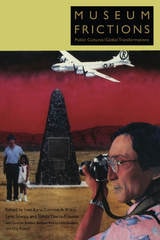
Museum Frictions
Public Cultures/Global TransformationsIvan Karp, Corinne A. Kratz, Lynn Szwaja, and Tomás Ybarra-Frausto With Gustavo Buntinx, Barbara Kirshenblatt-Gimblett, and Ciraj Rassool, eds.
Duke University Press, 2006
Whether contrasting the transformation of Africa’s oldest museum, the South Africa Museum, with one of its newest, the Lwandle Migrant Labor Museum; offering an interpretation of the audio guide at the Guggenheim Bilbao; reflecting on the relative paucity of art museums in Peru and Cambodia; considering representations of slavery in the United States and Ghana; or meditating on the ramifications of an exhibition of Australian aboriginal art at the Asia Society in New York City, the contributors highlight the frictions, contradictions, and collaborations emerging in museums and heritage sites around the world. The volume opens with an extensive introductory essay by Ivan Karp and Corinne A. Kratz, leading scholars in museum and heritage studies.
Contributors. Tony Bennett, David Bunn, Gustavo Buntinx, Cuauhtémoc Camarena, Andrea Fraser, Martin Hall, Ivan Karp, Barbara Kirshenblatt-Gimblett, Corinne A. Kratz, Christine Mullen Kreamer, Joseph Masco, Teresa Morales, Howard Morphy, Ingrid Muan, Fred Myers, Ciraj Rassool, Vicente Razo, Fath Davis Ruffins, Lynn Szwaja, Krista A. Thompson, Leslie Witz, Tomás Ybarra-Frausto
Museum Politics
Power Plays At The ExhibitionTimothy W. Luke
University of Minnesota Press, 2002
The first sustained critique of the ways museum exhibits shape cultural assumptions and political values
Each year the more than seven thousand museums in the United States attract more attendees than either movies or sports. Yet until recently, museums have escaped serious political analysis. The past decade, however, has witnessed a series of unusually acrimonious debates about the social, political, and moral implications of museum exhibitions as varied as the Enola Gay display at the Smithsonian’s Air and Space Museum and the Sensation exhibit at the Brooklyn Museum of Art.
In this important volume, Timothy W. Luke explores museums’s power to shape collective values and social understandings, and argues persuasively that museum exhibitions have a profound effect on the body politic. Through discussions of topics ranging from how the National Holocaust Museum and the Museum of Tolerance in Los Angeles have interpreted the Holocaust to the ways in which the American Museum of Natural History, the Missouri Botanical Gardens, and Tucson’s Arizona-Sonora Desert Museum have depicted the natural world, Luke exposes the processes through which museums challenge but more often affirm key cultural and social realities.
Territories and Trajectories
Cultures in CirculationDiana Sorensen, editor
Duke University Press, 2018
Contributors. Homi Bhabha, Jacqueline Bhabha, Lindsay Bremner, Finbarr Barry Flood, Rosario Hubert, Alina Payne, Kay Kaufman Shelemay, Shu-mei Shih, Diana Sorensen, Karen Thornber, Xiaofei Tian
The Libertine Colony
Creolization in the Early French CaribbeanDoris Garraway
Duke University Press, 2005
Among the texts Garraway analyzes are missionary histories by Jean-Baptiste Du Tertre, Raymond Breton, and Jean-Baptiste Labat; narratives of adventure and transgression written by pirates and others outside the official civil and religious power structures; travel accounts; treatises on slavery and colonial administration in Saint-Domingue; the first colonial novel written in French; and the earliest linguistic description of the native Carib language. Garraway also analyzes legislation—including the Code noir—that codified slavery and other racialized power relations. The Libertine Colony is both a rich cultural history of creolization as revealed in Francophone colonial literature and an important contribution to theoretical arguments about how literary critics and historians should approach colonial discourse and cultural representations of slave societies.