Results by title
8 books match the query 'Curiosity'
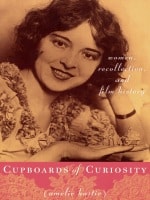
Cupboards of Curiosity
Women, Recollection, and Film HistoryAmelie Hastie
Duke University Press, 2007
Hastie pays particular attention to the actresses Colleen Moore and Louise Brooks and Hollywood’s first female director, Alice Guy-Blaché. From the beginning of her career, Moore worked intently to preserve a lasting place for herself as a Hollywood star, amassing collections of photos, souvenirs, and clippings as well as a dollhouse so elaborate that it drew extensive public attention. Brooks’s short essays reveal how she participated in the creation of her image as Lulu and later emerged as a critic of film stardom. The recovery of Blaché’s role in film history by feminist critics in the 1970s and 1980s was made possible by the existence of the director’s own autobiographical history. Broadening her analytical framework to include contemporary celebrities, Hastie turns to how-to manuals authored by female stars, from Zasu Pitts’s cookbook Candy Hits to Christy Turlington’s Living Yoga. She discusses how these assertions of celebrity expertise in realms seemingly unrelated to film and visual culture allow fans to prolong their experience of stardom.
Curiosity Studies
A New Ecology of KnowledgePerry Zurn
University of Minnesota Press, 2020
The first English-language collection to establish curiosity studies as a unique field
From science and technology to business and education, curiosity is often taken for granted as an unquestioned good. And yet, few people can define curiosity. Curiosity Studies marshals scholars from more than a dozen fields not only to define curiosity but also to grapple with its ethics as well as its role in technological advancement and global citizenship. While intriguing research on curiosity has occurred in numerous disciplines for decades, no rigorously cross-disciplinary study has existed—until now.
Curiosity Studies stages an interdisciplinary conversation about what curiosity is and what resources it holds for human and ecological flourishing. These engaging essays are integrated into four clusters: scientific inquiry, educational practice, social relations, and transformative power. By exploring curiosity through the practice of scientific inquiry, the contours of human learning, the stakes of social difference, and the potential of radical imagination, these clusters focus and reinvigorate the study of this universal but slippery phenomenon: the desire to know.
Against the assumption that curiosity is neutral, this volume insists that curiosity has a history and a political import and requires precision to define and operationalize. As various fields deepen its analysis, a new ecosystem for knowledge production can flourish, driven by real-world problems and a commitment to solve them in collaboration. By paying particular attention to pedagogy throughout, Curiosity Studies equips us to live critically and creatively in what might be called our new Age of Curiosity.
Contributors: Danielle S. Bassett, U of Pennsylvania; Barbara M. Benedict, Trinity College; Susan Engel, Williams College; Ellen K. Feder, American U; Kristina T. Johnson, Massachusetts Institute of Technology; Narendra Keval; Christina León, Princeton U; Tyson Lewis, U of North Texas; Amy Marvin, U of Oregon; Hilary M. Schor, U of Southern California; Seeta Sistla, Hampshire College; Heather Anne Swanson, Aarhus U.
Curiosity and Power
The Politics of InquiryPerry Zurn
University of Minnesota Press, 2021
A trailblazing exploration of the political stakes of curiosity
Curiosity is political. Who is curious, when, and how reflects the social values and power structures of a given society. In Curiosity and Power, Perry Zurn explores the political philosophy of curiosity, staking the groundbreaking claim that it is a social force—the heartbeat of political resistance and a critical factor in social justice. He argues that the very scaffolding of curiosity is the product of political architectures, and exploring these values and architectures is crucial if we are to better understand, and more ethically navigate, the struggle over inquiry in an unequal world.
Curiosity and Power explores curiosity through the lens of political philosophy—weaving in Nietzsche, Foucault, and Derrida in doing so—and the experience of political marginalization, demonstrating that curiosity is implicated equally in the maintenance of societies and in their transformation. Curiosity plays as central a role in establishing social institutions and fields of inquiry as it does in their deconstruction and in building new forms of political community. Understanding curiosity is critical to understanding politics, and understanding politics is critical to understanding curiosity.
Drawing not only on philosophy and political theory but also on feminist theory, race theory, disability studies, and trans studies, Curiosity and Power tracks curiosity in the structures of political marginalization and resistance—from the Civil Rights Movement to building better social relationships. Curiosity and Power insists that the power of curiosity be recognized and engaged responsibly.
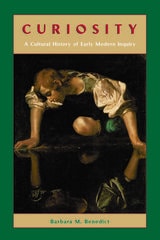
Curiosity
A Cultural History of Early Modern InquiryBarbara M. Benedict
University of Chicago Press, 2001
In this striking social history, Barbara M. Benedict draws on the texts of the early modern period to discover the era's attitudes toward curiosity, a trait we learn was often depicted as an unsavory form of transgression or cultural ambition.
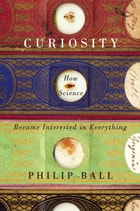
Curiosity
How Science Became Interested in EverythingPhilip Ball
University of Chicago Press, 2013
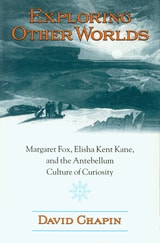
Exploring Other Worlds
Margaret Fox, Elisha Kent Kane, and the Antebellum Culture of CuriosityDavid Chapin
University of Massachusetts Press, 2004
Exploring Other Worlds tells the intertwined stories of the Arctic explorer Elisha Kent Kane and the spiritualist medium Margaret Fox and examines their unlikely relationship. Kane, from a prominent Philadelphia family, became one of the most renowned and honored explorers of the antebellum era. Fox grew up in rural upstate New York and, as one of the Fox Sisters, became a famed and somewhat notorious “spirit raper” whose strange “knocks” were said to be communications from the dead. The two were rumored to have had a love affair, and they may even have been secretly married.
In their separate professional lives, Kane and Fox each revealed something new and strange (though not necessarily true) to their audiences—the unknown worlds of the globe and the spirit. They brought experiences to their listeners that were exotic and delightful. The bourgeoning commercial mass culture of antebellum America provided a natural venue for tales of huge icebergs, fierce polar bears, and messages from the dead. Their public careers bridged the gaps between the scientific investigations of an earlier Enlightenment age and a newer form of sensational inquiry growing up in a democratic marketplace.
Though Kane and Fox began by generating curiosity about geography and the nature of the human soul, in time their personal relationship became the basis for what newspaperman Horace Greeley would call an “impertinent curiosity.” Newspapers printed letters about their supposed romance, and eventually a book purporting to be the famous explorer's love-letters to the notorious spiritualist was published. Curiosity about the Arctic and curiosity about the fate of the soul after death were transformed into curiosity about the private affairs of a new kind of media-driven public celebrity.

Inspired Thinking
Big Ideas to Enrich Yourself and Your CommunityDorothy Stoltz
American Library Association, 2020
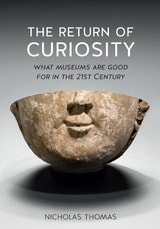
The Return of Curiosity
What Museums are Good For in the 21st CenturyNicholas Thomas
Reaktion Books, 2016
Reflecting on art galleries, science and history institutions, and collections all around the world, Nicholas Thomas argues that, in times marked by incredible insecurity and turbulence, museums help us sustain and enrich society. Moreover, they stimulate us to think in new ways about our world, compelling our curiosity and showing us the importance of understanding one another. Thomas looks at museums not simply as storehouses of old things but as the products of meaningful relationships between curators, the public, history, and culture. These relationships, he shows, don’t always go smoothly, but they do always offer new insights into the many ways we value—and try to preserve—the world we live in.
The result is a refreshing and hopeful look at museums as a cultural force, one that, by gathering together paintings, tropical birds, antiques, or even our own bodies, offers an illuminating reflection of who we are.