Results by title
3 books match the query 'Curry, James M.'
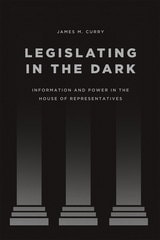
Legislating in the Dark
Information and Power in the House of RepresentativesJames M. Curry
University of Chicago Press, 2015
The answer? They aren’t. With Legislating in the Dark, James M. Curry reveals that the availability of information about legislation is a key tool through which Congressional leadership exercises power. Through a deft mix of legislative analysis, interviews, and participant observation, Curry shows how congresspersons—lacking the time and resources to study bills deeply themselves—are forced to rely on information and cues from their leadership. By controlling their rank-and-file’s access to information, Congressional leaders are able to emphasize or bury particular items, exploiting their information advantage to push the legislative agenda in directions that they and their party prefer.
Offering an unexpected new way of thinking about party power and influence, Legislating in the Dark will spark substantial debate in political science.

The Indispensable Minority
Why Congressional Majorities Cannot Govern AloneAndrew Ballard and James M. Curry
University of Chicago Press, 0
A provocative reevaluation of the power that the minority party in Congress wields beyond obstruction.
In The Indispensable Minority, Andrew Ballard and James M. Curry dispel a common assumption about American politics: that congressional majorities govern and congressional minorities merely obstruct. Drawing on four decades of legislative data, an original database of the most consequential lawmaking efforts since 1987, and candid interviews with veteran Capitol Hill staffers, the authors reveal that minority parties shape major legislation far more often than typically thought—both collectively and through the efforts of individual lawmakers.
As Ballard and Curry show, the key to minority influence lies not in procedural tricks like the filibuster, but in the interplay of raw political forces: how constrained the majority party is as it tries to act on its legislative agenda, how well the minority party can hold together as a cohesive bloc, and whether the minority chooses to engage in legislating rather than electoral posturing. When these conditions align, congressional minority parties don't just block bills—they help write them.
Rich with historical cases and sharp new evidence, The Indispensable Minority reshapes how we understand party power, congressional gridlock, and the health of American democracy itself. Far from a symptom of dysfunction, the authors argue, minority party influence is a vital—and indispensable—feature of how the American system is supposed to work.
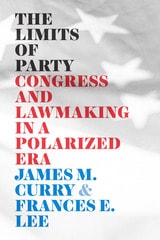
The Limits of Party
Congress and Lawmaking in a Polarized EraJames M. Curry and Frances E. Lee
University of Chicago Press, 2020
In The Limits of Party, James M. Curry and Frances E. Lee challenge this conventional wisdom. By constructing legislative histories of congressional majority parties’ attempts to enact their policy agendas in every congress since the 1980s and by drawing on interviews with Washington insiders, the authors analyze the successes and failures of congressional parties to enact their legislative agendas.
Their conclusions will surprise many congressional observers: Even in our time of intense party polarization, bipartisanship remains the key to legislative success on Capitol Hill. Congressional majority parties today are neither more nor less successful at enacting their partisan agendas. They are not more likely to ram though partisan laws or become mired in stalemate. Rather, the parties continue to build bipartisan coalitions for their legislative priorities and typically compromise on their original visions for legislation in order to achieve legislative success.