Results by title
3 books match the query 'Custom'
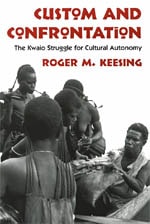
Custom and Confrontation
The Kwaio Struggle for Cultural AutonomyRoger M. Keesing
University of Chicago Press, 1992
"Anthropologists and students of anthropology may read this book because it is a superior ethnography, detailed and enriched by theoretical insights. But at the heart of this book is a moral take, a simple but powerful story about an indigenous people who were wronged, who resisted for more than 100 years, and who may yet prevail. This message, ultimately, lends the book its true meaning and value."—William Rodman, Anthropologica
"A major contribution to the ethnography and history of Malaita and Melanesia, and to the growing literature on cultural resistance. But above all, his humane and painful analysis of the meeting of peoples living in different worlds and constructing their agendas and moralities on incommensurate—and apparently equally arbitrary—principles, represents a major contribution and challenge to anthropological thought, addressing the basic issue of what it is to be human."—Fredrik Barth
"A major contribution to the ethnography and history of Malaita and Melanesia, and to the growing literature on cultural resistance. But above all, his humane and painful analysis of the meeting of peoples living in different worlds and constructing their agendas and moralities on incommensurate—and apparently equally arbitrary—principles, represents a major contribution and challenge to anthropological thought, addressing the basic issue of what it is to be human."—Fredrik Barth
[more]
The Age of Sex
Custom, Law, and Ritual in Twentieth-Century East AfricaCorrie Decker
University of Wisconsin Press, 2025
As in much of the world, societies in precolonial East Africa—what is now Kenya, Tanzania, and Uganda—used rites of passage to chart an individual’s social and developmental progress toward adulthood. Under European colonialism, from the 1890s to the 1960s, colonial judicial systems and the emerging genre of ethnography converged to subject African people to standardized definitions of childhood and adulthood. The coexistence of rites of passage and chronological age regulations generated confusion well into the postcolonial era, and the question of when childhood ends sparked extensive debates about gender, race, and development. Corrie Decker argues that ultimately these debates came down to “the age of sex.”
In The Age of Sex, Decker demonstrates how maturation became defined as the hypothetical moment when a girl becomes a woman capable of engaging in heterosexual activity and a boy becomes a man imbued with the right and responsibility to have heterosexual intercourse. Colonial ethnographic studies reduced complex precolonial rites of passage to “puberty rites” fixated on these sexual transformations. The resulting stereotypes influenced, in turn, how colonial and postcolonial court officials decided age-of-consent and other sex crime cases. Court rituals thus legally transformed girls into women by ruling on their sexual maturity and boys into men by sentencing them to corporal punishment, marking their acceptance of heterosexual responsibilities.
In The Age of Sex, Decker demonstrates how maturation became defined as the hypothetical moment when a girl becomes a woman capable of engaging in heterosexual activity and a boy becomes a man imbued with the right and responsibility to have heterosexual intercourse. Colonial ethnographic studies reduced complex precolonial rites of passage to “puberty rites” fixated on these sexual transformations. The resulting stereotypes influenced, in turn, how colonial and postcolonial court officials decided age-of-consent and other sex crime cases. Court rituals thus legally transformed girls into women by ruling on their sexual maturity and boys into men by sentencing them to corporal punishment, marking their acceptance of heterosexual responsibilities.
[more]
The Politics of Custom
Chiefship, Capital, and the State in Contemporary AfricaEdited by John L. Comaroff and Jean Comaroff
University of Chicago Press, 2018
How are we to explain the resurgence of customary chiefs in contemporary Africa? Rather than disappearing with the tide of modernity, as many expected, indigenous sovereigns are instead a rising force, often wielding substantial power and legitimacy despite major changes in the workings of the global political economy in the post–Cold War era—changes in which they are themselves deeply implicated.
This pathbreaking volume, edited by anthropologists John L. Comaroff and Jean Comaroff, explores the reasons behind the increasingly assertive politics of custom in many corners of Africa. Chiefs come in countless guises—from university professors through cosmopolitan businessmen to subsistence farmers–but, whatever else they do, they are a critical key to understanding the tenacious hold that “traditional” authority enjoys in the late modern world. Together the contributors explore this counterintuitive chapter in Africa’s history and, in so doing, place it within the broader world-making processes of the twenty-first century.
This pathbreaking volume, edited by anthropologists John L. Comaroff and Jean Comaroff, explores the reasons behind the increasingly assertive politics of custom in many corners of Africa. Chiefs come in countless guises—from university professors through cosmopolitan businessmen to subsistence farmers–but, whatever else they do, they are a critical key to understanding the tenacious hold that “traditional” authority enjoys in the late modern world. Together the contributors explore this counterintuitive chapter in Africa’s history and, in so doing, place it within the broader world-making processes of the twenty-first century.
[more]