Results by title
6 books match the query 'Customary law'

Bloodtaking and Peacemaking
Feud, Law, and Society in Saga IcelandWilliam Ian Miller
University of Chicago Press, 1990
People in the saga world negotiated a maze of violent possibility, with strategies that frequently put life and limb in the balance. But there was a paradox in striking the balance—one could not get even without going one better. Miller shows how blood vengeance, law, and peacemaking were inextricably bound together in the feuding process.
This book offers fascinating insights into the politics of a stateless society, its methods of social control, and the role that a uniquely sophisticated and self-conscious law played in the construction of Icelandic society.
"Illuminating."—Rory McTurk, Times Literary Supplement
"An impressive achievement in ethnohistory; it is an amalgam of historical research with legal and anthropological interpretation. What is more, and rarer, is that it is a pleasure to read due to the inclusion of narrative case material from the sagas themselves."—Dan Bauer, Journal of Interdisciplinary History
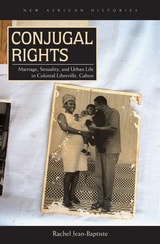
Conjugal Rights
Marriage, Sexuality, and Urban Life in Colonial Libreville, GabonRachel Jean-Baptiste
Ohio University Press, 2014

Folk Law
Essays in the Theory and Practice of Lex Non ScriptaAlison Dundes Renteln
University of Wisconsin Press, 1995
In every culture there exists unwritten law—obligations and prohibitions that are understood and passed on, and transgressions that are punished. Folk Law, a comprehensive two-volume collection of essays, examines this meeting place of folklore and jurisprudence. The contributors explore the historical significance and implications of folk law, its continuing influence around the globe, and the conflicts that arise when folk law diverges from official law.
The collection begins by defining various forms of “folk law,” drawing on examples from many cultures. The second section provides historical profiles of pioneering figures in the study of folk law. Following sections examine field research techniques used to identify folk laws; aspects of folk law within the realm of rituals, songs, and other forms of expressive culture; instances where folk law comes into conflict with national law, and the role of folk law in the international arena. The volumes also include description and analysis of two approaches to folk law—the rule approach, in which scholars dissect the codes that underlie folk law, and the case approach, in which researchers examine specific cases involving folk law.
Valuable for students and scholars of law, folklore, or anthropology, this extensive casebook marks a rare interdisciplinary approach to two important areas of research.
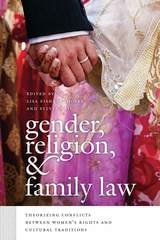
Gender, Religion, and Family Law
Theorizing Conflicts between Women’s Rights and Cultural TraditionsEdited by Lisa Fishbayn Joffe and Sylvia Neil
Brandeis University Press, 2012

The Spirit of the Laws in Mozambique
Juan Obarrio
University of Chicago Press, 2014
Having made the transition from a people’s republic to democratic rule in the 1990s, Mozambique offers a fascinating case of postwar reconstruction, economic opening, and transitional justice, one in which the customary has played a central role. Obarrio shows how its sovereignty has met countless ambiguities within the entanglements of local community, nation-state, and international structures. The postcolonial nation-state emerges as a maze of entangled jurisdictions. Ultimately, he looks toward local rituals and relations as producing an emergent kind of citizenship in Africa, which he dubs “customary citizenship,” forming not a vestige of the past but a yet ill-defined political future.

Trust, Ethnicity, and Identity
Beyond the New Institutional Economics of Ethnic Trading Networks, Contract Law, and Gift-ExchangeJanet Tai Landa
University of Michigan Press, 1995
Trust, Ethnicity, and Identity deals with the economic role of laws and institutions in achieving social order in a decentralized economy. Specifically, this book considers the coordinating role of three major nonprice institutions--ethnic trading networks, contract law, and gift-exchange--in economizing on transaction costs and thus facilitating the process of exchange in decentralized economies in different historical contexts.
The major unifying theme of the book is this: identity matters when traders operate in an environment characterized by contract uncertainty, where the legal framework for the enforcement of contracts is not well developed. This in turn points out the importance of trust embedded in particularistic exchange relations such as kinship or ethnicity.
One unique facet of this book is that the author uses a property rights--public choice approach--part of the New Institutional Economics--to provide a unifying theoretical framework to explain such diverse exchange institutions as contract law, ethnic trading networks, and gift-exchange, In addition, it goes beyond the New Institutional Economics paradigm by incorporating some crucial concepts from sociology, anthropology, and bioeconomics, such as social structure, social norms, culture, reciprocity, and kin-related altruism. This broad interdisciplinary framework gives Landa's work a relevance beyond economics to law, political science, sociology, anthropology, and bioeconomics.