Results by title

3 books match the query 'Customs'
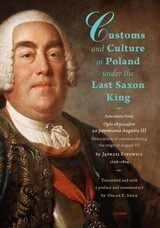
cover of Customs and Culture in Poland under the Last Saxon King: Selections from Opis obyczajów za panowania Augusta III by father Jedrzej Kitowicz, 1728-1804

Customs and Culture in Poland under the Last Saxon King

Selections from Opis obyczajów za panowania Augusta III by father Jedrzej Kitowicz, 1728-1804

Translated and with a preface and commentary by Oscar E. Swan

Central European University Press, 2019
Jedrzej Kitowicz was a parish priest in central Poland with a military and worldly past. In his later years, after putting the affairs of his parish in order, he composed a colorful chronicle of all aspects and walks of life under King August III. He seems to have written mostly from memory, creating in the process the most complete record that exists of society in eighteenth-century Poland. A man with omnivorous tastes, a keen sense of observation, and a wry—at times bawdy—sense of humor, Kitowicz’s realistic and robust literary technique has been compared in its earthiness and evocativeness to Flemish genre painting. A noteworthy example of eighteenth-century writing and narrative talent, his Opis reveals an astounding visual memory and a modern ethnographer’s eye for material culture. The present book consists of fifty-one chapters, including all of the most celebrated ones, from Father Kitowicz’s Opis, complete with a comprehensive introduction. Topics include religious beliefs, customs and institutions, child-rearing, education, the judiciary and the military. Particularly vivid are the descriptions of the lives of the nobility, ranging from cooking through men’s and women’s wear to household entertainments and drinking habits. A commentary by the editor introduces each chapter.
[more]
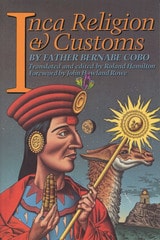
cover of Inca Religion and Customs

Inca Religion and Customs

By Bernabe Cobo

University of Texas Press, 1990
Completed in 1653, Father Bernabe Cobo's Historia del Nuevo Mundo is an important source of information on pre-conquest and colonial Spanish America. Though parts of the work are now lost, the remaining sections which have been translated offer valuable insights into Inca culture and Peruvian history. Inca Religion and Customs is the second translation by Roland Hamilton from Cobo's massive work. Beginning where History of the Inca Empire left off, it provides a vast amount of data on the religion and lifeways of the Incas and their subject peoples. Despite his obvious Christian bias as a Jesuit priest, Cobo objectively and thoroughly describes many of the religious practices of the Incas. He catalogs their origin myths, beliefs about the afterlife, shrines and objects of worship, sacrifices, sins, festivals, and the roles of priests, sorcerers, and doctors. The section on Inca customs is equally inclusive. Cobo covers such topics as language, food and shelter, marriage and childrearing, agriculture, warfare, medicine, practical crafts, games, and burial rituals. Because the Incas apparently had no written language, such postconquest documents are an important source of information about Inca life and culture. Cobo's work, written by one who wanted to preserve something of the indigenous culture that his fellow Spaniards were fast destroying, is one of the most accurate and highly respected.
[more]
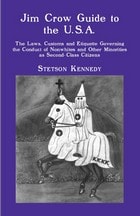
cover of Jim Crow Guide to the U.S.A.: The Laws, Customs and Etiquette Governing the Conduct of Nonwhites and Other Minorities as Second-Class Citizens

Jim Crow Guide to the U.S.A.

The Laws, Customs and Etiquette Governing the Conduct of Nonwhites and Other Minorities as Second-Class Citizens

Stetson Kennedy

University of Alabama Press, 2011

 “A history of the United States that is almost incredible.” —Jean-Paul Sartre, Les Temps Modernes

Jim Crow Guide to the U.S.A. by Stetson Kennedy is a bold exposé of America’s institutionalized racism, originally published in 1959 and hailed as a landmark in civil rights literature. With unflinching clarity, Kennedy documents the laws, customs, and social codes that relegated nonwhite citizens to second-class status under the Jim Crow system. From the mistreatment of Native Americans to the exclusionary immigration policies targeting Asians and Africans, the book maps the presence of race-based politics across every facet of American life—housing, education, employment, and even burial. 

What makes this work especially influential is its international resonance. The famed French existentialist Jean-Paul Sartre championed the book’s publication in Europe, recognizing its power to illuminate the contradictions between American democratic ideals and racial realities. Sartre’s endorsement helped position the book as a global indictment of racial injustice, aligning it with anti-colonial and human rights movements worldwide. Provocative, meticulously researched, and deeply human, Jim Crow Guide to the U.S.A. remains a vital historical document and a call to conscience. It is not merely a guide—it is a mirror held up to a nation, reflecting truths that later generations were called on to address.

[more]