Results by title
3 books match the query 'Cyborgs'

Consuming Youth
Vampires, Cyborgs, and the Culture of ConsumptionRobert Latham
University of Chicago Press, 2002
From the novels of Anne Rice to The Lost Boys, from The Terminator to cyberpunk science fiction, vampires and cyborgs have become strikingly visible figures within American popular culture, especially youth culture. In Consuming Youth, Rob Latham explains why, showing how fiction, film, and other media deploy these ambiguous monsters to embody and work through the implications of a capitalist system in which youth both consume and are consumed.
Inspired by Marx's use of the cyborg vampire as a metaphor for the objectification of physical labor in the factory, Latham shows how contemporary images of vampires and cyborgs illuminate the contradictory processes of empowerment and exploitation that characterize the youth-consumer system. While the vampire is a voracious consumer driven by a hunger for perpetual youth, the cyborg has incorporated the machineries of consumption into its own flesh. Powerful fusions of technology and desire, these paired images symbolize the forms of labor and leisure that American society has staked out for contemporary youth.
A startling look at youth in our time, Consuming Youth will interest anyone concerned with film, television, and popular culture.
[more]
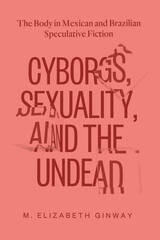
Cyborgs, Sexuality, and the Undead
The Body in Mexican and Brazilian Speculative FictionM. Elizabeth Ginway
Vanderbilt University Press, 2020
Writers in Brazil and Mexico discovered early on that speculative fiction provides an ideal platform for addressing the complex issues of modernity, yet the study of speculative fictions rarely strays from the United States and England. Cyborgs, Sexuality, and the Undead expands the traditional purview of speculative fiction in all its incarnations (science fiction, fantasy, horror) beyond the traditional Anglo-American context to focus on work produced in Mexico and Brazil across a historical overview from 1870 to the present. The book portrays the effects—and ravages—of modernity in these two nations, addressing its technological, cultural, and social consequences and their implications for the human body.
In Cyborgs, Sexuality, and the Undead, M. Elizabeth Ginway examines all these issues from a number of theoretical perspectives, most importantly through the lens of Bolívar Echeverría’s “baroque ethos,” which emphasizes the strategies that subaltern populations may adopt in order to survive and prosper in the face of massive historical and structural disadvantages. Foucault’s concept of biopolitics is developed in discussion with Roberto Esposito’s concept of immunity and Giorgio Agamben’s distinction between “political life” and “bare life.”
This book will be of interest to scholars of speculative fiction, as well as Mexicanists and Brazilianists in history, literary studies, and critical theory.
[more]
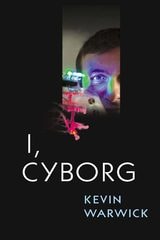
I, Cyborg
Kevin Warwick
University of Illinois Press, 2002
Now available for the first time in America, I, Cyborg is the story of Kevin Warwick, the cybernetic pioneer advancing science by upgrading his own body.
Warwick, the world's leading expert in cybernetics, explains how he has deliberately crossed over a perilous threshold to take the first practical steps toward becoming a cyborg--part human, part machine--using himself as a guinea pig and undergoing surgery to receive technological implants connected to his central nervous system.
Believing that machines with intelligence far beyond that of humans will eventually make the important decisions, Warwick investigates whether we can avoid obsolescence by using technology to improve on our comparatively limited capabilities. Warwick also discusses the implications for human relationships, and his wife's participation in the experiments.
Beyond the autobiography of a scientist who became, in part, a machine, I, Cyborg is also a story of courage, devotion, and endeavor that split apart personal lives. The results of these amazing experiments have far-reaching implications not only for e-medicine, extra-sensory input, increased memory and knowledge, and even telepathy, but for the future of humanity as well.
[more]