Results by title
2 books match the query 'Dávila, Jerry'
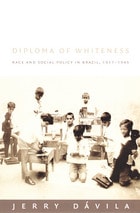
Diploma of Whiteness
Race and Social Policy in Brazil, 1917–1945Jerry Dávila
Duke University Press, 2003
In Brazil, the country with the largest population of African descent in the Americas, the idea of race underwent a dramatic shift in the first half of the twentieth century. Brazilian authorities, who had considered race a biological fact, began to view it as a cultural and environmental condition. Jerry Dávila explores the significance of this transition by looking at the history of the Rio de Janeiro school system between 1917 and 1945. He demonstrates how, in the period between the world wars, the dramatic proliferation of social policy initiatives in Brazil was subtly but powerfully shaped by beliefs that racially mixed and nonwhite Brazilians could be symbolically, if not physically, whitened through changes in culture, habits, and health.
Providing a unique historical perspective on how racial attitudes move from elite discourse into people’s lives, Diploma of Whiteness shows how public schools promoted the idea that whites were inherently fit and those of African or mixed ancestry were necessarily in need of remedial attention. Analyzing primary material—including school system records, teacher journals, photographs, private letters, and unpublished documents—Dávila traces the emergence of racially coded hiring practices and student-tracking policies as well as the development of a social and scientific philosophy of eugenics. He contends that the implementation of the various policies intended to “improve” nonwhites institutionalized subtle barriers to their equitable integration into Brazilian society.
Providing a unique historical perspective on how racial attitudes move from elite discourse into people’s lives, Diploma of Whiteness shows how public schools promoted the idea that whites were inherently fit and those of African or mixed ancestry were necessarily in need of remedial attention. Analyzing primary material—including school system records, teacher journals, photographs, private letters, and unpublished documents—Dávila traces the emergence of racially coded hiring practices and student-tracking policies as well as the development of a social and scientific philosophy of eugenics. He contends that the implementation of the various policies intended to “improve” nonwhites institutionalized subtle barriers to their equitable integration into Brazilian society.
[more]
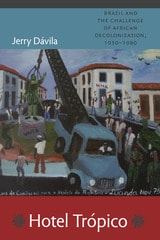
Hotel Trópico
Brazil and the Challenge of African Decolonization, 1950–1980Jerry Dávila
Duke University Press, 2010
In the wake of African decolonization, Brazil attempted to forge connections with newly independent countries. In the early 1960s it launched an effort to establish diplomatic ties with Africa; in the 1970s it undertook trade campaigns to open African markets to Brazilian technology. Hotel Trópico reveals the perceptions, particularly regarding race, of the diplomats and intellectuals who traveled to Africa on Brazil’s behalf. Jerry Dávila analyzes how their actions were shaped by ideas of Brazil as an emerging world power, ready to expand its sphere of influence; of Africa as the natural place to assert that influence, given its historical slave-trade ties to Brazil; and of twentieth-century Brazil as a “racial democracy,” a uniquely harmonious mix of races and cultures. While the experiences of Brazilian policymakers and diplomats in Africa reflected the logic of racial democracy, they also exposed ruptures in this interpretation of Brazilian identity. Did Brazil share a “lusotropical” identity with Portugal and its African colonies, so that it was bound to support Portuguese colonialism at the expense of Brazil’s ties with African nations? Or was Brazil a country of “Africans of every color,” compelled to support decolonization in its role as a natural leader in the South Atlantic? Drawing on interviews with retired Brazilian diplomats and intellectuals, Dávila shows the Brazilian belief in racial democracy to be about not only race but also Portuguese ethnicity.
[more]