Results by title
9 books match the query 'D . H Lawrence'
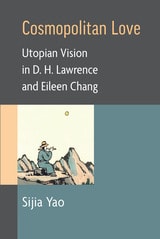
Cosmopolitan Love
Utopian Vision in D. H. Lawrence and Eileen ChangSijia Yao
University of Michigan Press, 2023
Finalist: 2024 Southern Atlantic Modern Language Association (SAMLA) Book Award Finalist | 05/21/2024
Love, and the different manifestations of it, is a common theme in literature around the world. In Cosmopolitan Love, Sijia Yao examines the writings of D. H. Lawrence, a British writer whose literature focused primarily on interpersonal relationships in domestic settings, and Eileen Chang, a Chinese writer who migrated to the United States and explored Chinese heterosexual love in her writing. While comparing the writings of a Chinese writer and an English one, Yao avoids a direct comparison between East and West that could further enforce binaries. Instead, she uses the comparison to develop an idea of cosmopolitanism that shows how the writers are in conversation with their own culture and with each other. Both D. H. Lawrence and Eileen Chang wrote stories that are influenced by—but sometimes stand in opposition to—their own cultures. They offer alternative understandings of societies dealing with modernism and cultural globalization. Their stories deal with emotional pain caused by the restrictions of local politics and economics and address common themes of incestuous love, sexual love, adulterous love, and utopian love. By analyzing their writing, Yao demonstrates that the concept of love as a social and political force can cross cultural boundaries and traditions to become a basis for human meaning, the key to a cosmopolitan vision.

D. H. Lawrence
An Unprofessional StudyAnaïs Nin
Ohio University Press, 1964
In 1932, two years after D. H. Lawrence’s death, a young woman wrote a book about him and presented it to a Paris publisher. She recorded the event in her diary: “It will not be published and out by tomorrow, which is what a writer would like when the book is hot out of the oven, when it is alive within oneself. He gave it to his assistant to revise.” The woman was Anaïs Nin.
Nin examined Lawrence’s poetry, novels, essays, and travel writing. She analyzed and explained the more important philosophical concepts contained in his writings, particularly the themes of love, death, and religion, as well as his attention to primitivism and to women. But what Anaïs Nin brought to the explication of Lawrence’s writing was an understanding of the fusion of imaginative, intuitive, and intellectual elements from which he drew his characters, themes, imagery and symbolism.
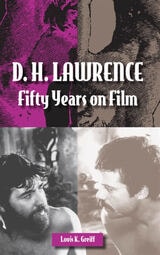
D. H. Lawrence
Fifty Years on FilmLouis K. Greiff
Southern Illinois University Press, 2001
Between 1949 and 1999, the life and works of D. H. Lawrence inspired ten feature films: nine based on works of fiction and one based on biography. In D. H. Lawrence: Fifty Years on Film, Louis K. Greiff examines these films as adaptations, as cultural or historical documents, and as independent works of art.
Significantly, the films were not spread evenly throughout the decades but appeared in three clusters. The first group, or the “black and white,” appeared between 1949 and 1960. With the exception of Marc Allegret’s L’Amant de Lady Chatterley (1955), all celebrate the British common man as a midcentury hero and promote an unmistakable yet never strident postwar ethos that is Marxist in spirit.
The second cluster occurred during the late 1960s and early 1970s. These films show Lawrence’s values as similar to the cultural values of the time—nonconformity, neobohemianism, sexual rebellion, war protest, and the celebration of youth. In his discussion of the third group Greiff explains why, in an un-Lawrentian decade like the 1980s, there was a revival of Lawrence’s works on film.
Greiff also deals with the contributions made by directors Ken Russell and Christopher Miles, both of whom directed Lawrence films of the latter two clusters. He shows how Russell and, to a lesser extent, Miles were responsible for bringing mass audiences in touch with the works of Lawrence.
Greiff’s final and most important goal is to interpret and evaluate the Lawrence films. He looks first at the film as a visual representation of its text, then as an original act of creation and object of art.
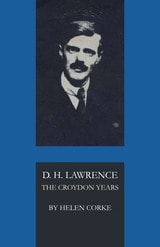
D. H. Lawrence
The Croydon YearsBy Helen Corke, introduction by Warren Roberts
University of Texas Press, 1965
Croydon, England, was the setting of the famous three-way friendship of D. H. Lawrence, Jessie Chambers, and Helen Corke, all of whom made literary records of their association, and all of whom appeared as characters in Lawrence novels. Perhaps the most objective of these records were Helen Corke’s, which became difficult to acquire. Their scarcity and their continuing usefulness were the stimulus for publication of this volume, which contains in four statements Helen Corke’s “major comment on Lawrence the man and Lawrence the artist.”
The “Portrait of D. H. Lawrence, 1909–1910,” a section from Corke’s unpublished autobiography, gives the reader glimpses into the earliest stages of the Lawrence-Corke friendship, when Lawrence worked to bring meaning back into Corke’s life after she had suffered a tragic loss. The “Portrait” tells of conversations before a log fire, German lessons, the reading of poetry, and sessions over Lawrence’s manuscript “Nethermere,” which the publishers renamed The White Peacock. In “Portrait,” Corke tells of working with Lawrence on revising the proofs of this book, of Lawrence’s encouragement of her own literary efforts, of their wandering together in the Kentish hill country, and of her first meeting with Jessie Chambers.
“Lawrence’s ‘Princess’” continues the narrative of the triple friendship, carrying it to its sad ending, but with the focus on Jessie Chambers. Perceptively and sympathetically written, it throws a clarifying light on the psychology of Lawrence and presents with literary charm another human being—Jessie, the Miriam of Sons and Lovers.
In combined narrative-critique method, Corke, in the essay “Concerning The White Peacock,” relates Lawrence’s problems in writing this novel and gives an analysis of its literary quality.
Lawrence and Apocalypse is cast in the form of a “deferred conversation” in which Lawrence and Corke discuss his philosophical ideas as presented in his Apocalypse. Although the book was written to present Lawrence’s ideas, its significance reposes equally in Corke’s reaction to his thought. As a succinct statement of Lawrence’s teachings about the nature of humanity, it has unique value.
D. H. Lawrence
The Failure and the Triumph of ArtEliseo Vivas
Northwestern University Press, 1960
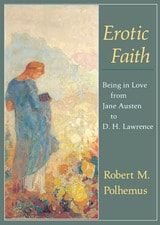
Erotic Faith
Being in Love from Jane Austen to D. H. LawrenceRobert M. Polhemus
University of Chicago Press, 1990
Drawing on a wide range of disciplines, Polhemus shows the reciprocity of love as subject, the novel as form, and faith as motive in important works by Jane Austen, Walter Scott, the Brontës, Dickens, George Eliot, Trollope, Thomas Hardy, Joyce, D. H. Lawrence, Virginia Woolf, and Samuel Beckett. Throughout, Polhemus relates the novelists' representation of love to that of such artists as Botticelli, Vermeer, Claude Lorrain, Redon, and Klimt. Juxtaposing their paintings with nineteenth- and twentieth-century texts both reveals the ways in which novels develop and individualize common erotic and religious themes and illustrates how the novel has influenced our perception of all art.
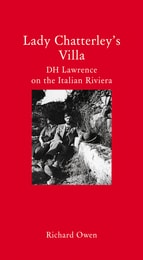
Lady Chatterley's Villa
D. H. Lawrence on the Italian RivieraRichard Owen
Haus Publishing, 2014
But before long Frieda found herself irresistibly attracted to their landlord, a dashing Italian army officer, and the resulting affair served as the background for Lawrence’s writing: while in the villa, he turned out two stories, “Sun” and “The Virgin and the Gypsy,” both prefiguring Lady Chatterley’s Lover in their depiction of women fatally drawn to earthy, muscular men.
Built on the unpublished, and previously unexplored, letters and diaries of Rina Secker, the Anglo-Italian wife of Lawrence’s publisher, and featuring never-before-published letters from Lawrence, Lady Chatterley’s Villa reconstructs the drama of the tempestuous marriage, and the ways it fired Lawrence’s creativity. Along the way, Richard Owen offers a new accounting of Lawrence’s passion for Italy, tracing his travels along the coasts and islands and his deep engagement with Italian culture. This exploration of a little-studied, but crucial period of the writer’s life will be a must for Lawrence’s many fans.

The Short Fiction Of D.H. Lawrence
Harris, Janice H
Rutgers University Press, 1984
The Vital Art of D.H. Lawrence
Vision and ExpressionJack Stewart
Southern Illinois University Press, 1999
D. H. Lawrence, asserts Jack Stewart, expresses a painter’s vision in words, supplementing visual images with verbal rhythms. With the help of twenty-three illustrations, Stewart examines Lawrence’s painterly vision in The White Peacock, Sons and Lovers, The Rainbow, Women in Love, Kangaroo, and The Plumed Serpent. He concludes by synthesizing the themes that pervade this interarts study: vision and expression, art and ontology.