Results by title
3 books match the query 'Daley, Richard M. (Richard Michael)'
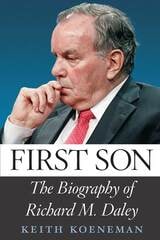
First Son
The Biography of Richard M. DaleyKeith Koeneman
University of Chicago Press, 2013
"Mayor Richard M. Daley dropped the bomb at a routine news conference at City Hall on Tuesday. With no prelude or fanfare, Mr. Daley announced that he would not seek re-election when his term expires next year. 'Simply put, it's time,' he said." New York Times, September 7, 2010
With those four words, an era ended. After twenty-two years, the longest-serving and most powerful mayor in the history of Chicago—and, arguably, America—stepped down, leaving behind a city that was utterly transformed, and a complicated legacy we are only beginning to evaluate.
With Koeneman as our guide, we follow young Daley from his beginnings as an average Bridgeport kid thought to lack his father's talent and charisma to his unlikely transformation into an iron-fisted leader. Daley not only escaped the giant shadow of his father but also transformed Chicago from a gritty, post-industrial Midwestern capital into a beautiful, sophisticated global city widely recognized as a model for innovative metropolises throughout the world.
But in spite of his many accomplishments, Richard M. Daley's record is far from flawless. First Son sets the dramatic improvement of certain parts of the city against the persistent realities of crime, financial stress , failing public housing, and dysfunctional schools. And it reveals that while in many ways Daley broke with the machine politics of his father, he continued to reward loyalty with favors, use the resources of city government to overwhelm opponents, and tolerate political corruption.
A nuanced portrait of a complex man, First Son shows Daley to be sensitive yet tough, impatient yet persistent, a street-smart fighter and detail-driven policy expert who not only ran Chicago, but was Chicago.
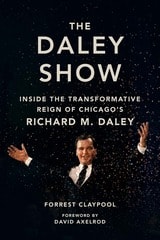
The Daley Show
Inside the Transformative Reign of Chicago's Richard M. DaleyForrest Claypool; Foreword by David Axelrod
University of Illinois Press, 2024
American cities once had mayors who actually governed.
For twenty-two years, Richard M. Daley ran Chicago with the type of authority that is unthinkable today. He reshaped downtown, triggered a jobs boom, delivered the iconic Millennium Park, turned around troubled public schools, and slashed violent crime to 40-year lows. He outfoxed Republican legislators to retain control of O’Hare Airport and expand it into the nation’s premier international aviation hub. Leveraging carefully built national political ties, he sidelined a powerful nemesis to tear down Chicago’s infamous public housing projects.
Rebuilding parts of his father’s legendary political machine through brazen (and illegal) patronage deals, he centralized power to a remarkable degree, cut deals behind closed doors, racked up piles of debt, and made long-term bets whose consequences are still unfolding.
This is not simply a biography. It is a challenge to contemporary urban orthodoxy:
Do cities thrive because of strong, decisive leaders—or despite them?
Through vivid storytelling, this book exposes how Daley consolidated power, aligned business and labor, navigated crises, survived damaging scandals, and imposed discipline on a sprawling city. It dares readers to reconsider what kind of leadership modern American cities truly need.
The Third City
Chicago and American UrbanismLarry Bennett
University of Chicago Press, 2010
Our traditional image of Chicago—as a gritty metropolis carved into ethnically defined enclaves where the game of machine politics overshadows its ends—is such a powerful shaper of the city’s identity that many of its closest observers fail to notice that a new Chicago has emerged over the past two decades. Larry Bennett here tackles some of our more commonly held ideas about the Windy City—inherited from such icons as Theodore Dreiser, Carl Sandburg, Daniel Burnham, Robert Park, Sara Paretsky, and Mike Royko—with the goal of better understanding Chicago as it is now: the third city.
Bennett calls contemporary Chicago the third city to distinguish it from its two predecessors: the first city, a sprawling industrial center whose historical arc ran from the Civil War to the Great Depression; and the second city, the Rustbelt exemplar of the period from around 1950 to 1990. The third city features a dramatically revitalized urban core, a shifting population mix that includes new immigrant streams, and a growing number of middle-class professionals working in new economy sectors. It is also a city utterly transformed by the top-to-bottom reconstruction of public housing developments and the ambitious provision of public works like Millennium Park. It is, according to Bennett, a work in progress spearheaded by Richard M. Daley, a self-consciously innovative mayor whose strategy of neighborhood revitalization and urban renewal is a prototype of city governance for the twenty-first century. The Third City ultimately contends that to understand Chicago under Daley’s charge is to understand what metropolitan life across North America may well look like in the coming decades.