Results by title
7 books match the query 'Dallas (Tex.)'

Adolphe Gouhenant
French Revolutionary, Utopian Leader, and Texas Frontier PhotographerPaula Selzer
University of North Texas Press, 2019
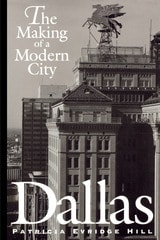
Dallas
The Making of a Modern CityBy Patricia Evridge Hill
University of Texas Press, 1996
From the ruthless deals of the Ewing clan on TV's "Dallas" to the impeccable customer service of Neiman-Marcus, doing business has long been the hallmark of Dallas. Beginning in the 1920s and 1930s, Dallas business leaders amassed unprecedented political power and civic influence, which remained largely unchallenged until the 1970s.
In this innovative history, Patricia Evridge Hill explores the building of Dallas in the years before business interests rose to such prominence (1880 to 1940) and discovers that many groups contributed to the development of the modern city. In particular, she looks at the activities of organized labor, women's groups, racial minorities, Populist and socialist radicals, and progressive reformers—all of whom competed and compromised with local business leaders in the decades before the Great Depression.
This research challenges the popular view that business interests have always run Dallas and offers a historically accurate picture of the city's development. The legacy of pluralism that Hill uncovers shows that Dallas can accommodate dissent and conflict as it moves toward a more inclusive public life. Dallas will be fascinating and important reading for all Texans, as well as for all students of urban development.

Mexican Americans in a Dallas Barrio
Shirley Achor
University of Arizona Press, 1978
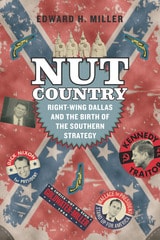
Nut Country
Right-Wing Dallas and the Birth of the Southern StrategyEdward H. Miller
University of Chicago Press, 2015
In Nut Country, Edward H. Miller tells the story of that transformation, showing how a group of influential far-right businessmen, religious leaders, and political operatives developed a potent mix of hardline anticommunism, biblical literalism, and racism to generate a violent populism—and widespread power. Though those figures were seen as extreme in Texas and elsewhere, mainstream Republicans nonetheless found themselves forced to make alliances, or tack to the right on topics like segregation. As racial resentment came to fuel the national Republican party’s divisive but effective “Southern Strategy,” the power of the extreme conservatives rooted in Texas only grew.
Drawing direct lines from Dallas to DC, Miller's captivating history offers a fresh understanding of the rise of the new Republican Party and the apocalyptic language, conspiracy theories, and ideological rigidity that remain potent features of our politics today.
Our Stories
Black Families in Early DallasGeorge Keaton Jr.
University of North Texas Press, 2022

The Dallas Myth
The Making and Unmaking of an American CityHarvey J. Graff
University of Minnesota Press, 2010
In The Dallas Myth, Harvey J. Graff presents a novel interpretation of a city that has proudly declared its freedom from the past. He scrutinizes the city's origin myth and its governance ideology, known as the "Dallas Way," looking at how these elements have shaped Dallas and served to limit democratic participation and exacerbate inequality. Advancing beyond a traditional historical perspective, Graff proposes an original, integrative understanding of the city's urban fabric and offers an explicit critique of the reactionary political foundations of modern Dallas: its tolerance for right-wing political violence, the endemic racism and xenophobia, and a planning model that privileges growth and monumental architecture at the expense of the environment and social justice.
Revealing the power of myths that have defined the city for so long, Graff presents a new interpretation of Dallas that both deepens our understanding of America's urban landscape and enables its residents to envision a more equitable, humane, and democratic future for all.
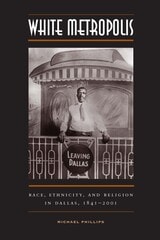
White Metropolis
Race, Ethnicity, and Religion in Dallas, 1841-2001By Michael Phillips
University of Texas Press, 2006
Winner, T. R. Fehrenbach Award, Texas Historical Commission, 2007
From the nineteenth century until today, the power brokers of Dallas have always portrayed their city as a progressive, pro-business, racially harmonious community that has avoided the racial, ethnic, and class strife that roiled other Southern cities. But does this image of Dallas match the historical reality? In this book, Michael Phillips delves deeply into Dallas's racial and religious past and uncovers a complicated history of resistance, collaboration, and assimilation between the city's African American, Mexican American, and Jewish communities and its white power elite.
Exploring more than 150 years of Dallas history, Phillips reveals how white business leaders created both a white racial identity and a Southwestern regional identity that excluded African Americans from power and required Mexican Americans and Jews to adopt Anglo-Saxon norms to achieve what limited positions of power they held. He also demonstrates how the concept of whiteness kept these groups from allying with each other, and with working- and middle-class whites, to build a greater power base and end elite control of the city. Comparing the Dallas racial experience with that of Houston and Atlanta, Phillips identifies how Dallas fits into regional patterns of race relations and illuminates the unique forces that have kept its racial history hidden until the publication of this book.