Results by title
4 books match the query 'Damned'
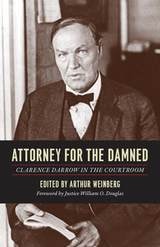
Attorney for the Damned
Clarence Darrow in the CourtroomClarence Darrow
University of Chicago Press, 2012
A famous defender of the underdog, the oppressed, and the powerless, Clarence Darrow (1857–1938) is one of the true legends of the American legal system. His cases were many and various, but all were marked by his unequivocal sense of justice, as well as his penchant for representing infamous and unpopular clients, such as the Chicago thrill killers Leopold and Loeb; Ossian Sweet, the African American doctor charged with murder after fighting off a violent, white mob in Detroit; and John T. Scopes, the teacher on trial in the famous Scopes Monkey Trial.
Published for the first time in 1957, Attorney for the Damned collects Darrow’s most influential summations and supplements them with scene-setting explanations and comprehensive notes by Arthur Weinberg. Darrow confronts issues that remain relevant over half a century after his death: First Amendment rights, capital punishment, and the separation of church and state. With an insightful forward by Justice William O. Douglas, this volume serves as a powerful reminder of Darrow’s relevance today.
Published for the first time in 1957, Attorney for the Damned collects Darrow’s most influential summations and supplements them with scene-setting explanations and comprehensive notes by Arthur Weinberg. Darrow confronts issues that remain relevant over half a century after his death: First Amendment rights, capital punishment, and the separation of church and state. With an insightful forward by Justice William O. Douglas, this volume serves as a powerful reminder of Darrow’s relevance today.
[more]
Ceremonies Of The Damned
PoemsAdrian C. Louis
University of Nevada Press, 1997
The world of acclaimed Native American poet Adrian Louis is harsh and full of pain—the blizzard-blasted plains and dusty towns of the northern Midwest, the hopeless barrenness of the Reservation, and a bleak interior world of loss, illness, and despair. Louis’s poems bring us to a place where ghosts hitchhike and the traditional pow-wow becomes an affirmation of bitter survival, where the lives of the young end too often in acts of meaningless self-destruction, and where his own existence becomes a daily battle with his cherished wife’s decline into the dementia of Alzheimer’s disease. Louis is a writer of extraordinary courage and skill, and these powerful, moving poems, wrested from the harsh experience of the Rez and his own lonely struggle with a merciless illness, will awe their readers with their brilliance and desperate humanity.
[more]
Specters, Monsters, and the Damned
Fantastic Threats to the Social Order in Nineteenth-Century Spanish FictionWan Sonya Tang
Vanderbilt University Press, 2024
Specters, Monsters, and the Damned examines a rich selection of Spanish fantastic literature to illustrate how the language of the supernatural expresses the fears of complex societies beset by dizzying change and perceived decline. Throughout the nineteenth century, amid governmental upheavals and imperial losses, Spain’s dominant political, legal, and scientific voices constructed the prototypical citizen as male, middle‑class, and “ethnically pure.” The role of realist novels by canonical authors like Benito Pérez Galdós, Emilia Pardo Bazán, and Leopoldo Alas in forging this Spanish identity has been meticulously examined over the last half century, to the exclusion of many other genres. This book complements existing scholarship by demonstrating how a neglected corpus of late nineteenth‑ and turn‑of‑the‑century fantastic short fictions, many by the same canonical authors, engages with processes of national identity formation in unexpected and ambiguous ways.
Tang offers innovative readings of eleven fantastic short stories and one novella as they first appeared, some serialized and others illustrated, in Spanish periodicals from the late 1800s and early 1900s. Drawing on original archival research, she demonstrates how these stories—in which the everyday is suddenly and inexplicably disrupted by the supernatural—often employ gothic imagery (specifically that of the specter, the monster, and the curse) to depict as threatening those who deviate from cultural norms in terms of class, gender, and race. Tang argues, however, that these unsettling, open‑ended narratives likewise allow readers to question how and why certain designated groups are privileged by society. She contends that the fantastic depiction of reality as unstable in these works ultimately facilitates an interrogation of those values that are accepted as natural by the reigning social order, gesturing toward the inhumanity not of the marginalized, but of the dominant group.
Tang offers innovative readings of eleven fantastic short stories and one novella as they first appeared, some serialized and others illustrated, in Spanish periodicals from the late 1800s and early 1900s. Drawing on original archival research, she demonstrates how these stories—in which the everyday is suddenly and inexplicably disrupted by the supernatural—often employ gothic imagery (specifically that of the specter, the monster, and the curse) to depict as threatening those who deviate from cultural norms in terms of class, gender, and race. Tang argues, however, that these unsettling, open‑ended narratives likewise allow readers to question how and why certain designated groups are privileged by society. She contends that the fantastic depiction of reality as unstable in these works ultimately facilitates an interrogation of those values that are accepted as natural by the reigning social order, gesturing toward the inhumanity not of the marginalized, but of the dominant group.
[more]
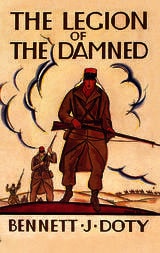
The Legion of the Damned
The Adventures of Bennett J. Doty in the French Foreign Legion as Told by HimselfBennett J. Doty
Westholme Publishing, 2020
The Riveting Memoir of an American Volunteer in the French Foreign Legion during the 1925 Revolt in Syria
“You see there was down South a girl I liked. And she is now married . . . not to me.” So Bennett J. Doty confessed when he sailed for France and enlisted in the French Foreign Legion in 1924. A World War I veteran and University of Virginia student, Doty first trained in Morocco and Algeria before being shipped off to the French-controlled State of Syria. There, he and his fellow “bleus,” who hailed from Belgium, Poland, Italy, Senegal, Spain, Germany, Russia, and other countries, found themselves at the spearhead of the attempt to quell the revolt against French rule in the area. The fighting, mostly against the Druze, was fierce, merciless, and unrelenting. Fought in villages and at isolated outposts, there was no quarter. Entire villages were razed, fields destroyed, and prisoners were not taken by either side. In the engagement where Doty and several other of his “copains”—“buddies”—earned the Croix de Guerre, his unit became isolated and withstood days of attacks which claimed more than half of the Legionnaires until they were finally relieved by a French colonial column. With the immediate fighting over, the Legion was put to heavy manual labor under the hot desert sun. Doty became disillusioned, and with four other soldiers, fled in an attempt to reach British-controlled Jordan. They were caught, tried, and Doty was sentenced to eight years in a French prison. When word reached the United States, diplomatic efforts ultimately gained Doty a pardon and honorable discharge from service.
Originally published in 1928, Legion of the Damned, Doty’s acclaimed account of his time in the Legion, is a remarkable memoir that requires no additional drama to allow the reader to experience the desperation, exhilaration, fear, and disgust of a colonial war. Here, Doty shows how drunken, unruly, vicious veterans would transform into capable, cool, and orderly soldiers as soon as a battle began—the élan that earned the French Foreign Legion its reputation as a legendary fighting unit.
[more]