Results by title

4 books match the query 'Dance criticism'
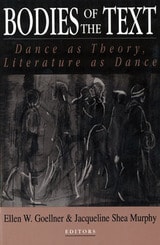
cover of Bodies of the Text: Dance as Theory, Literature as Dance

Bodies of the Text

Dance as Theory, Literature as Dance

Edited by Ellen W Goellner

Rutgers University Press, 1995
Dance and literary studies have traditionally been at odds: dancers and dance critics have understood academic analysis to be overly invested in the mind at the expense of body signification; literary critics and theorists have seen dance studies as anti-theoretical, even anti-intellectual. Bodies of the Text is the first book-length study of the interconnections between the two arts and the body of writing about them. The essays, by scholar-critics of dance and literature, explore dances actual and fictional to offer powerful new insights into issues of gender, race, ethnicity, popular culture, feminist aesthetics, historical "embodiment," identity politics, and narrativity. The general introduction traces the genealogy of dance studies in the academy to suggest why critical and theoretical attention to dance--and dance's challenges to writing--is both compelling and overdue. A milestone in interdisciplinary studies, Bodies of the Text opens both its fields to new inquiry, new theoretical precision, and to new readers and writers. 
[more]
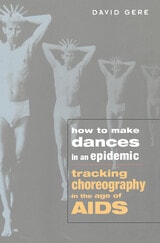
cover of How to Make Dances in an Epidemic: Tracking Choreography in the Age of AIDS

How to Make Dances in an Epidemic

Tracking Choreography in the Age of AIDS

David Gere

University of Wisconsin Press, 2004

    David Gere, who came of age as a dance critic at the height of the AIDS epidemic, offers the first book to examine in depth the interplay of AIDS and choreography in the United States, specifically in relation to gay men. The time he writes about is one of extremes. A life-threatening medical syndrome is spreading, its transmission linked to sex. Blame is settling on gay men. What is possible in such a highly charged moment, when art and politics coincide?
    Gere expands the definition of choreography to analyze not only theatrical dances but also the protests conceived by ACT-UP and the NAMES Project AIDS quilt. These exist on a continuum in which dance, protest, and wrenching emotional expression have become essentially indistinguishable. Gere offers a portrait of gay male choreographers struggling to cope with AIDS and its meanings.

[more]
cover of Jill Johnston in Motion: Dance, Writing, and Lesbian Life

Jill Johnston in Motion

Dance, Writing, and Lesbian Life

Clare Croft

Duke University Press, 2024

Performer, activist, and writer Jill Johnston was a major queer presence in the history of dance and 1970s feminism. She was the first critic to identify postmodernism’s arrival in American dance and was a fierce advocate for the importance of lesbians within feminism. In Jill Johnston in Motion, Clare Croft tracks Johnston’s entwined innovations and contributions to dance and art criticism and activism. She examines Johnston’s journalism and criticism—in particular her Village Voice columns published between 1960 and 1980—and her books of memoir and biography. At the same time, Croft attends to Johnston’s appearances as both dancer and audience member and her physical and often spectacular participation at feminist protests. By bringing together Johnston’s criticism and activism, her writing and her physicality, Croft emphasizes the effect that the arts, particularly dance, had on Johnston’s feminist thinking in the 1970s and traces lesbian feminism’s roots in avant-garde art practice.
[more]
cover of The Essential Jill Johnston Reader

The Essential Jill Johnston Reader

Jill Johnston. Edited by Clare Croft

Duke University Press, 2024

Jill Johnston began the 1960s as an influential dance columnist for the Village Voice and by the start of the next decade she was known as a keen observer of postmodern art and lesbian feminist life who challenged how dance, art, and women can and should be seen. The Essential Jill Johnston Reader collects dozens of pieces of her writing from across her career. These writings—many of which appeared in the Village Voice and the New York Times—survey the breadth of her work, braiding together her thinking, writing, and activism. From personal essays, travel writing, and artist profiles to dance and visual art reviews as well as her infamous series of columns for the Voice in which she came out as a lesbian, these pieces demonstrate the evolution of her philosophies and writing style. Illustrating how Johnston drew on lessons from dance to reconsider what it means to be a woman, this collection brings a fascinating and brilliant voice of American arts criticism, radical feminism, and gay liberation back to contemporary audiences.
[more]