Results by title
18 books match the query 'Dancers'
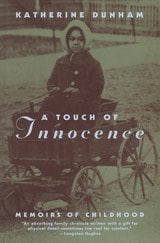
A Touch of Innocence
A Memoir of ChildhoodKatherine Dunham
University of Chicago Press, 1994
In stark prose, she tells of growing up in both black and white households and of the divisions of race and class in Chicago that become the harsh realities of her young life. A riveting narrative of one girl's struggle to transcend the painful confusions of a family and culture in turmoil, Dunham's story is full of the clarity, candor, and intelligence that lifted her above her troubled beginnings.
"A Touch of Innocence is an absorbing family chronicle written with a gift for physical detail sometimes too real for comfort. In quietly graphic prose the growing girl, the slightly older brother, the ambitious father and the kind stepmother are pictured in such human terms that when their lives get tied into harder and harder knots beyond their undoing, one can only continue to read helplessly as doom closes in upon the household."—Langston Hughes, New York Herald Tribune
"A Touch of Innocence is one of the most extraordinary life stories I have ever read . . . . The content of this book is so heartbreaking that only the strongest artistic skills can keep it from leaking out into sobbing self-pity, but Katherine Dunham's art contains it, understands it and refuses to be overwhelmed by its terrors."—Elizabeth Janeway, New York Times
"The first eighteen years of the famous dancer and choreographer's life are brought vividly to the reader in this first volume of her autobiography. She writes of what it is like to be a special, gifted young woman growing up in a racially mixed family in the American Middle West. A beautiful, touching and sometimes discomforting book."—Publishers Weekly
"As writing it is honest, searing, graphic and touching, giving us a rather heartbreaking early view of the young American Negro who was later to make a name for herself as a dancer and choreographer."—Arthur Todd, Saturday Review

A Trade like Any Other
Female Singers and Dancers in EgyptBy Karin van Nieuwkerk
University of Texas Press, 1995
In Egypt, singing and dancing are considered essential on happy occasions. Professional entertainers often perform at weddings and other celebrations, and a host family's prestige rises with the number, expense, and fame of the entertainers they hire. Paradoxically, however, the entertainers themselves are often viewed as disreputable people and are accorded little prestige in Egyptian society.
This paradox forms the starting point of Karin van Nieuwkerk's look at the Egyptian entertainment trade. She explores the lives of female performers and the reasons why work they regard as "a trade like any other" is considered disreputable in Egyptian society. In particular, she demonstrates that while male entertainers are often viewed as simply "making a living," female performers are almost always considered bad, seductive women engaged in dishonorable conduct. She traces this perception to the social definition of the female body as always and only sexual and enticing—a perception that stigmatizes women entertainers even as it simultaneously offers them a means of livelihood.
Drawn from extensive fieldwork and enriched with the life stories of entertainers and nightclub performers, this is the first ethnography of female singers and dancers in present-day Egypt. It will be of interest to a wide audience in anthropology, women's studies, and Middle Eastern culture, as well as anyone who enjoys belly dancing.
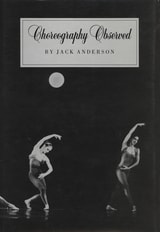
Choreography Observed
Jack Anderson
University of Iowa Press, 1997
In Choreography Observed, Jack Anderson has selected writings that focus most directly on choreographers and choreography in order to illuminate the delights and problems of dance and to reveal the nature of this nonverbal but intensely expressive art form.
His essays and reviews deal with individual choreographers from Bournonville, Petipa, and Fokine to Balanchine, Paul Taylor, Meredith Monk, and Pina Bausch; individual works are also discussed in detail, such as Nijinsky's Afternoon of a Faun,Antony Tudor's Pillar of Fire, Alvin Ailey's Flowers, and Kei Takei's Light. Other pieces focus on the Baroque dance revival, contemporary multimedia dance theatre, choreography for men, the complex relationship between ballet and modern dance, and how—and how not—to revive the classics.
No other book—especially no other selection from the work of a single critic—has dealt with choreography in such an original and focused way. Anderson brings his trained eye and wide experience in the arts to bear on dance while stressing the primacy of the choreographer as auteur. By refusing to get bogged down in highly technical terminology, he makes his insights available to a wide range of readers interested in expanding their understanding of this ever more popular art form.
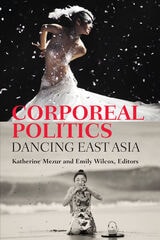
Corporeal Politics
Dancing East AsiaKatherine Mezur and Emily Wilcox, Editors
University of Michigan Press, 2020
Through the lens of “corporeal politics”—the close attention to bodily acts in specific cultural contexts—each study in this book challenges existing dance and theater histories to re-investigate the performer's role in devising the politics and aesthetics of their performance, as well as the multidimensional impact of their lives and artistic works. Corporeal Politics addresses a wide range of performance styles and genres, including dances produced for the concert stage, as well as those presented in popular entertainments, private performance spaces, and street protests.
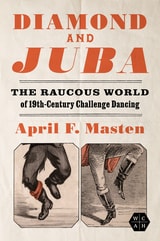
Diamond and Juba
The Raucous World of 19th-Century Challenge DancingApril F. Masten
University of Illinois Press, 2025
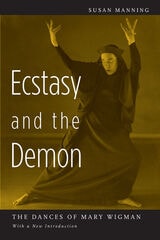
Ecstasy and the Demon
The Dances of Mary WigmanSusan Manning
University of Minnesota Press, 2006
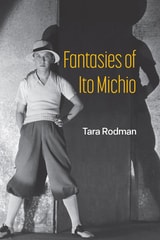
Fantasies of Ito Michio
Tara Rodman
University of Michigan Press, 2024
Winner of the 2025 Dance Studies Association Oscar Brockett Book Prize
Born in Japan and trained in Germany, dancer and choreographer Ito Michio (1893–1961) achieved prominence in London before moving to the U.S. in 1916 and building a career as an internationally acclaimed artist. During World War II, Ito was interned for two years, and then repatriated to Japan, where he contributed to imperial war efforts by creating propaganda performances and performing revues for the occupying Allied Forces in Tokyo. Throughout, Ito continually invented stories of voyages made, artists befriended, performances seen, and political activities carried out—stories later dismissed as false.
Fantasies of Ito Michio argues that these invented stories, unrealized projects, and questionable political affiliations are as fundamental to Ito’s career as his ‘real’ activities, helping us understand how he sustained himself across experiences of racialization, imperialism, war, and internment. Tara Rodman reveals a narrative of Ito’s life that foregrounds the fabricated and overlooked to highlight his involvement with Japanese artists, such as Yamada Kosaku and Ishii Baku, and global modernist movements. Rodman offers “fantasy” as a rubric for understanding how individuals such as Ito sustain themselves in periods of violent disruption and as a scholarly methodology for engaging the past.
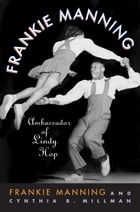
Frankie Manning
Ambassador of Lindy HopFrankie Manning
Temple University Press, 2008
In the early days of swing dancing, Frankie Manning stood out for his moves and his innovative routines; he created the "air step" in the Lindy hop, a dance that took the U.S. and then the world by storm. In this fascinating autobiography, the choreographer and Tony Award winner (Black and Blue) Frankie Manning recalls how his first years of dancing as a teenager at Harlem's Savoy Ballroom led to his becoming chief choreographer and a lead dancer for Whitey's Lindy Hoppers, a group that appeared on Broadway, in Hollywood musicals, and on stages around the globe. Manning brings the Swing Era vividly back to life with his recollections of the crowded ballrooms, and of Lindy hoppers trying to outdo each other in spectacular performances. His memories of the many headliners and film stars, as well as uncelebrated dancers with whom he shared the stage, create a unique portrait of an era in which African American performers enjoyed the spotlight if not a star's prerogatives and salary.
With collaborator Cynthia Millman, Manning traces the evolution of swing dancing from its early days in Harlem through the post-World War II period, until it was eclipsed by rock 'n' roll and then disco. When swing made a comeback, Manning's 30-year hiatus ended. He has been performing, choreographing, and teaching ever since.
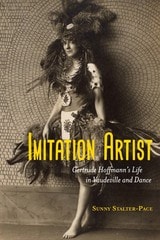
Imitation Artist
Gertrude Hoffmann’s Life in Vaudeville and DanceSunny Stalter-Pace
Northwestern University Press, 2020
Gertrude Hoffmann made her name in the early twentieth century as an imitator, copying highbrow performances staged in Europe and popularizing them for a broader American audience. Born in San Francisco, Hoffmann started working as a ballet girl in pantomime spectacles during the Gay Nineties. She performed through the heyday of vaudeville and later taught dancers and choreographed nightclub revues. After her career ended, she reflected on how vaudeville’s history was represented in film and television.
Drawn from extensive archival research, Imitation Artist shows how Hoffmann’s life intersected with those of central figures in twentieth-century popular culture and dance, including Florenz Ziegfeld, George M. Cohan, Isadora Duncan, and Ruth St. Denis. Sunny Stalter-Pace discusses the ways in which Hoffmann navigated the complexities of performing gender, race, and national identity at the dawn of contemporary celebrity culture. This book is essential reading for those interested in the history of theater and dance, modernism, women’s history, and copyright.
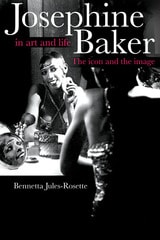
Josephine Baker in Art and Life
THE ICON AND THE IMAGEBennetta Jules-Rosette
University of Illinois Press, 2006
Josephine Baker (1906-1975) was a dancer, singer, actress, author, politician, militant, and philanthropist, whose images and cultural legacy have survived beyond the hundredth anniversary of her birth. Neither an exercise in postmodern deconstruction nor simple biography, Josephine Baker in Art and Life presents a critical cultural study of the life and art of the Franco-American performer whose appearances as the savage dancer Fatou shocked the world.
Although the study remains firmly anchored in Josephine Baker’s life and times, presenting and challenging carefully researched biographical facts, it also offers in-depth analyses of the images that she constructed and advanced. Bennetta Jules-Rosette explores Baker’s far-ranging and dynamic career from a sociological and cultural perspective, using the tools of sociosemiotics to excavate the narratives, images, and representations that trace the story of her life and fit together as a cultural production.
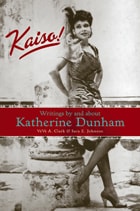
Kaiso!
Writings by and about Katherine DunhamEdited by VeVe A. Clark and Sara E. Johnson
University of Wisconsin Press, 2006
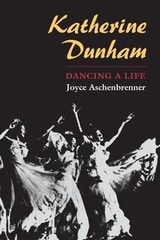
Katherine Dunham
DANCING A LIFEJoyce Aschenbrenner
University of Illinois Press, 2002
Founder of the first self-supporting African American dance company, Dunham relied on her fieldwork as an anthropologist to fundamentally change modern dance. She shaped new dance techniques and introduced other cultures to U.S. and European audiences by fusing Caribbean and African-based movement with ballet and modern dance. Her revolutionary approaches to dance and its greater connection to the world have influenced a generation of dancers, theatrical performers, and scholars. She believes that dance involves the development of an entire person and the rituals and traditions of dance are integral to the study of culture. Throughout her career she has been a living model of the socially responsible artist working to whet cultural appetites and combat social injustice.
Joyce Aschenbrenner's multifaceted portrait blends personal observations based on her own interactions with Dunham, archival documents, and interviews with Dunham's colleagues, students, and members of the Katherine Dunham Dance Company.
Integrating these sources, Aschenbrenner characterizes the social, familial, and cultural environment of Dunham's upbringing and the intellectual and artistic community she embraced at the University of Chicago that laid the groundwork for her development as a dancer, anthropologist, and humanitarian. The book vividly depicts Dunham's and her dancers' touring experiences and includes detailed descriptions of her community cultural and educational programs in East St. Louis.

Kilgore Rangerettes
By O. Rufus Lovett
University of Texas Press, 2008
Whether she knows it or not, every girl who has ever dreamed of taking her place in a line of high-kicking dancers on a football field at halftime has been inspired by the Kilgore College Rangerettes, the world's first precision dance drill team. Founded in Kilgore, Texas, in 1939-1940 by the incomparable Gussie Nell Davis, the Rangerettes have performed for national and international audiences, appearing frequently at events such as the Macy's Thanksgiving Day Parade and major football bowl games across the nation, including the New Year's Cotton Bowl Classic in Dallas each year since 1951.
An icon of Americana, the red-white-and-blue clad Rangerettes have drawn the attention of numerous photographers and writers seeking to understand the enduring appeal of a group that some might view as anachronistic. O. Rufus Lovett, a fine art photographer who has taught at Kilgore College for more than thirty years, began photographing the 'Rettes in 1989. His interpretive photo essay in this book expresses his fascination with "the glamour of the Rangerettes' performances juxtaposed with the small-town atmosphere, football turf, metal bleachers, chain-link fences, and asphalt and concrete environment." In Lovett's masterfully composed photographs, the Rangerette performances captivate with their multiplicity of "shapes, patterns, and designs."
While Lovett treats the 'Rettes as an artistic subject, he also captures the esprit de corps that keeps the girls smiling even when they have to march on icy pavement and prompts their mothers to wear T-shirts that proudly proclaim "Rette Mom." An affectionate, yet unsentimental and occasionally irreverent portrait, Kilgore Rangerettes beautifully conveys the timeless quality of this unique subculture of young American womanhood.
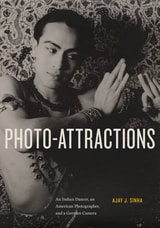
Photo-Attractions
An Indian Dancer, an American Photographer, and a German CameraAjay Sinha
Rutgers University Press, 2022
Art historian Ajay Sinha uses these hitherto unpublished photographs and archival research to raise provocative and important questions about photographic technology, colonial histories, race, sexuality and transcultural desires. Challenging the assumption that Gopal was merely objectified by Van Vechten’s Orientalist gaze, he explores the ways in which the Indian dancer co-authored the photos. In Sinha’s reading, Van Vechten’s New York studio becomes a promiscuous contact zone between world cultures, where a “photo-erotic” triangle is formed between the American photographer, Indian dancer, and German camera.
A groundbreaking study of global modernity, Photo-Attractions brings scholarship on American photography, literature, race and sexual economies into conversation with work on South Asian visual culture, dance, and gender. In these remarkable historical documents, it locates the pleasure taken in cultural difference that still resonates today.

Reginald and Gladys Laubin, American Indian Dancers
Starr West Jones
University of Illinois Press, 2000
Reginald and Gladys Laubin devoted their lives to preserving vanishing Indigenous American cultures. Their authentic Indian dances, costumes, and songs helped white Americans appreciate expressions of Native culture as an art that should be preserved. Native Americans of many peoples praised the Laubins as worthy envoys of their cultures. Audiences in the US, Europe, Israel, and Africa applauded their performances. Starr West Jones provides the historical context for the Laubins’ accomplishments by following their career through their long history of live appearances and discussing their books on American Indian tipis, dances, and archery.

Solitary Song
An AutobiographyPauline Koner
Duke University Press, 1989
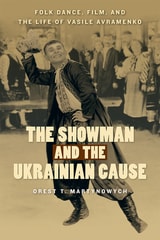
The Showman and the Ukrainian Cause
Folk Dance, Film, and the Life of Vasile AvramenkoOrest T. Martynowych
University of Manitoba Press, 2014
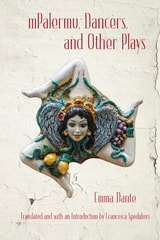
mPalermu, Dancers, and Other Plays
Emma Dante
Swan Isle Press, 2019
This exquisite first English translation of Emma Dante’s work enables English-speaking readers, theatre scholars, and directors alike to encounter character-driven “civic theatre” with its portraits of individuals existing at the fringes of Italy. Ultimately, it allows us to “listen” to those who are not given a voice anywhere else.