Results by title

9 books match the query 'Dante'

cover of Abandoned Women: Rewriting the Classics in Dante, Boccaccio, and Chaucer

Abandoned Women

Rewriting the Classics in Dante, Boccaccio, and Chaucer

Suzanne Hagedorn

University of Michigan Press, 2003

Medievalists have long been interested in the "abandoned woman," a figure historically used to examine the value of traditional male heroism. Moving beyond previous studies which have focused primarily on Virgil's Dido, Suzanne Hagedorn focuses on the vernacular works of Dante, Bocaccio, and Chaucer, arguing that revisiting the classical tradition of the abandoned woman enables one to reconsider ancient epics and myths from a female perspective and question assumptions about gender roles in medieval literature.
 
[more]
cover of Commentary and Ideology: Dante in the Renaissance

Commentary and Ideology

Dante in the Renaissance

Deborah Parker

Duke University Press, 1993

Dante's Divine Comedy played a dual role in its relation to Italian Renaissance culture, actively shaping the fabric of that culture and, at the same time, being shaped by it. This productive relationship is examined in Commentary and Ideology, Deborah Parker's thorough compendium on the reception of Dante's chief work. By studying the social and historical circumstances under which commentaries on Dante were produced, the author clarifies the critical tradition of commentary and explains the ways in which this important body of material can be used in interpreting Dante's poem.
Parker begins by tracing the criticism of Dante commentaries from the nineteenth century to the present and then examines the tradition of commentary from the Middle Ages to the Renaissance. She shows how the civic, institutional, and social commitments of commentators shaped their response to the Comedy, and how commentators tried to use the poem as an authoritative source for various kinds of social legitimation. Parker discusses how different commentators dealt with a deeply political section of the poem: the damnation of Brutus and Cassius.
The scope and importance of Commentary and Ideology will command the attention of a broad group of scholars, including Italian specialists on Dante, late medievalists, students and professionals in early modern European literature, bibliographers, critical theorists, historians of literary criticism and theory, and cultural and intellectual historians.
[more]
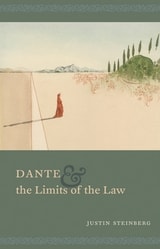
cover of Dante and the Limits of the Law

Dante and the Limits of the Law

Justin Steinberg

University of Chicago Press, 2013

In Dante and the Limits of the Law, Justin Steinberg offers the first comprehensive study of the legal structure essential to Dante’s Divine Comedy. Steinberg reveals how Dante imagines an afterlife dominated by sophisticated laws, hierarchical jurisdictions, and rationalized punishments and rewards. He makes the compelling case that Dante deliberately exploits this highly structured legal system to explore the phenomenon of exceptions to it, crucially introducing Dante to current debates about literature’s relation to law, exceptionality, and sovereignty.

Examining how Dante probes the limits of the law in this juridical otherworld, Steinberg argues that exceptions were vital to the medieval legal order and that Dante’s otherworld represents an ideal “system of exception.” In the real world, Dante saw this system as increasingly threatened by the dual crises of church and empire: the abuses and overreaching of the popes and the absence of an effective Holy Roman Emperor. Steinberg shows that Dante’s imagination of the afterlife seeks to address this gap between the universal validity of Roman law and the lack of a sovereign power to enforce it. Exploring the institutional role of disgrace, the entwined phenomena of judicial discretion and artistic freedom, medieval ideas about privilege and immunity, and the place of judgment in the poem, this cogently argued book brings to life Dante’s sense of justice.
[more]
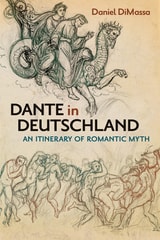
cover of Dante in Deutschland: An Itinerary of Romantic Myth

Dante in Deutschland

An Itinerary of Romantic Myth

Daniel DiMassa

Bucknell University Press, 2022
Around the turn of the nineteenth century, no task seemed more urgent to German Romantics than the creation of a new mythology. It would unite modern poets and grant them common ground, and bring philosophers and the Volk closer together. But what would a new mythology look like? Only one model sufficed, according to Friedrich Schlegel: Dante’s Divine Comedy. Through reading and juxtaposing canonical and obscure texts, Dante in Deutschland shows how Dante’s work shaped the development of German Romanticism; it argues, all the while, that the weight of Dante’s influence induced a Romantic preoccupation with authority: Who was authorized to create a mythology? This question—traced across texts by Schelling, Novalis, and Goethe—begets a Neo-Romantic fixation with Dantean authority in the mythic ventures of Gerhart Hauptmann, Rudolf Borchardt, and Stefan George. Only in Thomas Mann’s novels, DiMassa asserts, is the Romantics’ Dantean project ultimately demythologized.
[more]
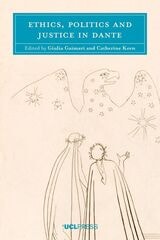
cover of Ethics, Politics and Justice in Dante

Ethics, Politics and Justice in Dante

Edited by Giulia Gaimari and Catherine Keen

University College London, 2019

While Dante Alighieri’s writings engaged with the culture of medieval Florence and Italy, his moral and political thought still speaks compellingly to modern readers today.

Bringing together an international and interdisciplinary group of contributors, ranging across history, philology, classical studies, philosophy, and theology, Ethics, Politics and Justice in Dante presents new research on ethics, politics, and justice in the works of Dante Alighieri, including chapters on Dante’s conception of the afterlife. Contributors scrutinize the Divine Comedy and Dante’s other works in Italian and Latin, showing the evolution of his thought throughout his writing career, with chapters focusing especially on his early philosophical Convivio and on the two “Eclogues” of his final years. Other chapters tackle themes relating to judgment, justice, rhetoric, and literary ethics in the Divine Comedy, as well as the differing public reception and use of Dante’s work in Italy and Britain.
 
[more]
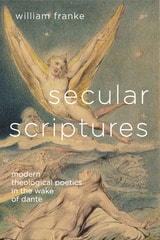
cover of Secular Scriptures: Modern Theological Poetics in the Wake of Dante

Secular Scriptures

Modern Theological Poetics in the Wake of Dante

William Franke

The Ohio State University Press, 2015

With Secular Scriptures: Modern Theological Poetics in the Wake of Dante, William Franke reexamines the role that literature plays in theological revelation. In the modern world, secularism typically means the exclusion of God from the world. Yet Franke, recognizing that secularity itself is built into religion and revelation, argues that theologically sensitive poetry has driven secularization throughout the modern period. The essays in this volume construct a trajectory through modern poetic literature as it struggled with the sense of a loss of the very possibility of theological revelation. Can literature replace religion? Can it do so triumphantly or only mournfully? Is this literary transmogrification of revelation the death of religion or its rebirth in a vital new form?
Secular Scriptures examines, through its own original speculative outlook, some of the most compelling exemplars of religious-poetic revelation in modern Western literature. The essays taken as an ensemble revolve around and are bookended by Dante, but they also explore the work of Chaucer, Shakespeare, Milton, Blake, Leopardi, Baudelaire, Dickinson, and Yeats. Looking both backward and forward from the vantage of Dante, Franke explores the roots of secularized religious vision in antiquity and the Middle Ages, even as he also looks forward toward its fruits in modern poetry and poetics. Ultimately, Franke’s analyses demonstrate the possibilities opened by understanding literature as secularized religious revelation.
[more]
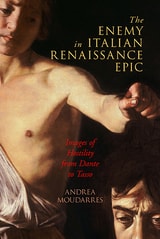
cover of The Enemy in Italian Renaissance Epic: Images of Hostility from Dante to Tasso

The Enemy in Italian Renaissance Epic

Images of Hostility from Dante to Tasso

Andrea Moudarres

University of Delaware Press, 2019

In The Enemy in Italian Renaissance Epic, Andrea Moudarres examines influential works from the literary canon of the Italian Renaissance, arguing that hostility consistently arises from within political or religious entities. In Dante’s Divina Commedia, Luigi Pulci’s Morgante, Ludovico Ariosto’s Orlando Furioso, and Torquato Tasso’s Gerusalemme Liberata, enmity is portrayed as internal, taking the form of tyranny, betrayal, and civil discord. Moudarres reads these works in the context of historical and political patterns, demonstrating that there was little distinction between public and private spheres in Renaissance Italy and, thus, little differentiation between personal and political enemies.

Published by University of Delaware Press. Distributed worldwide by Rutgers University Press.
 
[more]
cover of The Revelation of Imagination: From Homer and the Bible through Virgil and Augustine to Dante

The Revelation of Imagination

From Homer and the Bible through Virgil and Augustine to Dante

William Franke

Northwestern University Press, 2015

In The Revelation of Imagination, William Franke attempts to focus on what is enduring and perennial rather than on what is accommodated to the agenda of the moment. Franke’s book offers re-actualized readings of representative texts from the Bible, Homer, and Virgil to Augustine and Dante. The selections are linked together in such a way as to propose a general interpretation of knowledge. They emphasize, moreover, a way of articulating the connection of humanities knowledge with what may, in various senses, be called divine revelation. This includes the sort of inspiration to which poets since Homer have typically laid claim, as well as that proper to the biblical tradition of revealed religion. The Revelation of Imagination invigorates the ongoing discussion about the value of humanities as a source of enduring knowledge.
[more]
cover of Understanding the Medieval Meditative Ascent: Augustine, Anselm, Boethius and Dante

Understanding the Medieval Meditative Ascent

Augustine, Anselm, Boethius and Dante

Robert McMahon

Catholic University of America Press, 2006

Understanding the Medieval Meditative Ascent uses literary analysis to discover new philosophical meanings in these works. Clearly written in nontechnical language, its account of their literary structures and of the hidden meanings they generate will inform nonspecialist and specialist alike.
[more]