Results by title
5 books match the query 'Dark Times'
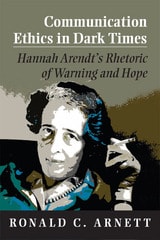
Communication Ethics in Dark Times
Hannah Arendt's Rhetoric of Warning and HopeRonald C. Arnett
Southern Illinois University Press, 2013
Renowned in the disciplines of political theory and philosophy, Hannah Arendt’s searing critiques of modernity continue to resonate in other fields of thought decades after she wrote them. In Communication Ethics in Dark Times: Hannah Arendt’s Rhetoric of Warning and Hope, author Ronald C. Arnett offers a groundbreaking examination of fifteen of Arendt’s major scholarly works, considering the German writer’s contributions to the areas of rhetoric and communication ethics for the first time.
Arnett focuses on Arendt’s use of the phrase “dark times” to describe the mistakes of modernity, defined by Arendt as the post-Enlightenment social conditions, discourses, and processes ruled by principles of efficiency, progress, and individual autonomy. These principles, Arendt argues, have led humanity down a path of folly, banality, and hubris. Throughout his interpretive evaluation, Arnett illuminates the implications of Arendt’s persistent metaphor of “dark times” and engages the question, How might communication ethics counter the tenets of dark times and their consequences? A compelling study of Hannah Arendt’s most noteworthy works and their connections to the fields of rhetoric and communication ethics, Communication Ethics in Dark Times provides an illuminating introduction for students and scholars of communication ethics and rhetoric, and a tool with which experts may discover new insights, connections, and applications to these fields.
Top Book Award for Philosophy of Communication Ethics by Communication Ethics Division of the National Communication Association, 2013
Dreaming in Dark Times
Six Exercises in Political ThoughtSharon Sliwinski
University of Minnesota Press, 2017
What do dreams manage to say—or indeed, show—about human experience that is not legible otherwise? Can the disclosure of our dream-life be understood as a form of political avowal? To what does a dream attest? And to whom?
Blending psychoanalytic theory with the work of such political thinkers as Hannah Arendt and Michel Foucault, Sharon Sliwinski explores how the disclosure of dream-life represents a special kind of communicative gesture—a form of unconscious thinking that can serve as a potent brand of political intervention and a means for resisting sovereign power. Each chapter centers on a specific dream plucked from the historical record, slowly unwinding the significance of this extraordinary disclosure. From Wilfred Owen and Lee Miller to Frantz Fanon and Nelson Mandela, Sliwinski shows how each of these figures grappled with dream-life as a means to conjure up the courage to speak about dark times. Here dreaming is defined as an integral political exercise—a vehicle for otherwise unthinkable thoughts and a wellspring for the freedom of expression.
Dreaming in Dark Times defends the idea that dream-life matters—that attending to this thought-landscape is vital to the life of the individual but also vital to our shared social and political worlds.
Invoking Hope
Theory and Utopia in Dark TimesPhillip E. Wegner
University of Minnesota Press, 2020
An appeal for the importance of theory, utopia, and close consideration of our contemporary dark times
What does any particular theory allow us to do? What is the value of doing so? And who benefits? In Invoking Hope, Phillip E. Wegner argues for the undiminished importance of the practices of theory, utopia, and a deep and critical reading of our current situation of what Bertolt Brecht refers to as finsteren Zeiten, or dark times.
Invoking Hope was written in response to three events that occurred in 2016: the five hundredth anniversary of the publication of Thomas More’s Utopia; the one hundredth anniversary of the founding text in theory, Ferdinand de Saussure’s Course in General Linguistics; and the rise of the right-wing populism that culminated in the election of Donald Trump. Wegner offers original readings of major interventions in theory alongside dazzling utopian imaginaries developed from classical Greece to our global present—from Theodor Adorno, Ernst Bloch, Alain Badiou, Jacques Derrida, Fredric Jameson, Sarah Ahmed, Susan Buck-Morss, and Jacques Lacan to such works as Plato’s Republic, W. E. B. Du Bois’s John Brown, Isak Dinesen’s “Babette’s Feast,” Kim Stanley Robinson’s 2312, and more. Wegner comments on an expansive array of modernist and contemporary literature, film, theory, and popular culture.
With Invoking Hope, Wegner provides an innovative lens for considering the rise of right-wing populism and the current crisis in democracy. He discusses challenges in the humanities and higher education and develops strategies of creative critical reading and hope against the grain of current trends in scholarship.
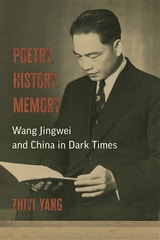
Poetry, History, Memory
Wang Jingwei and China in Dark TimesZhiyi Yang
University of Michigan Press, 2023
Wang Jingwei, poet and politician, patriot and traitor, has always been a figure of major academic and popular interest. Until now, his story has never been properly told, let alone critically investigated. The significance of his biography is evident from an ongoing war on cultural memory: modern mainland China prohibits serious academic research on wartime collaboration in general, and on Wang Jingwei in particular. At this critical juncture, when the recollection of World War II is fading from living memory and transforming into historical memory, this knowledge embargo will undoubtedly affect how China remembers its anti-fascist role in WWII. In Poetry, History, Memory: Wang Jingwei and China in Dark Times, Zhiyi Yang brings us a long overdue reexamination of Wang’s impact on cultural memory of WWII in China.
In this book, Yang brings disparate methodologies into a fruitful dialogue, including sophisticated methods of poetic interpretation. The author argues that Wang’s lyric poetry, as the public performance of a private voice, played a central role in constructing his political identity and heavily influenced the public’s posthumous memory of him. Drawing on archives (in the PRC, Taiwan, Japan, the USA, France, and Germany), memoires, historical journals, newspapers, interviews, and other scholarly works, this book offers the first biography of Wang that addresses his political, literary, and personal life in a critical light and with sympathetic impartiality.
The Politics of Small Things
The Power of the Powerless in Dark TimesJeffrey C. Goldfarb
University of Chicago Press, 2006
In The Politics of Small Things, Jeffrey Goldfarb provides an innovative way for understanding politics, a way of appreciating the significance of politics at the micro level by comparatively analyzing key turning points and institutions in recent history. He presents a sociology of human interactions that lead from small to large: dissent around the old Soviet bloc; life on the streets in Warsaw, Prague, and Bucharest in 1989; the network of terror that spawned 9/11; and the religious and Internet mobilizations that transformed the 2004 presidential election, to name a few. In such pivotal moments, he masterfully shows, political autonomy can be generated, presenting alternatives to the big politics of the global stage and the dominant narratives of terrorism, antiterrorism, and globalization.