Results by title
17 books match the query 'Data Science'
A Matter of Trust
Building Integrity into Data, Statistics and Records to Support the Sustainable Development GoalsEdited by Anne Thurston
University of London Press, 2020
Blockchain Technology for Secure Social Media Computing
Robin Singh Bhadoria
The Institution of Engineering and Technology, 2023
Data as Infrastructure for Smart Cities
Larissa Suzuki
The Institution of Engineering and Technology, 2019
Digital Critical Editions
Edited by Daniel Apollon, Claire Belisle, and Philippe Regnier
University of Illinois Press, 2014
Provocative yet sober, Digital Critical Editions examines how transitioning from print to a digital milieu deeply affects how scholars deal with the work of editing critical texts. On one hand, forces like changing technology and evolving reader expectations lead to the development of specific editorial products, while on the other hand, they threaten traditional forms of knowledge and methods of textual scholarship.
Using the experiences of philologists, text critics, text encoders, scientific editors, and media analysts, Digital Critical Editions ranges from philology in ancient Alexandria to the vision of user-supported online critical editing, from peer-directed texts distributed to a few to community-edited products shaped by the many. The authors discuss the production and accessibility of documents, the emergence of tools used in scholarly work, new editing regimes, and how the readers' expectations evolve as they navigate digital texts. The goal: exploring questions such as, What kind of text is produced? Why is it produced in this particular way?
Digital Critical Editions provides digital editors, researchers, readers, and technological actors with insights for addressing disruptions that arise from the clash of traditional and digital cultures, while also offering a practical roadmap for processing traditional texts and collections with today's state-of-the-art editing and research techniques thus addressing readers' new emerging reading habits.
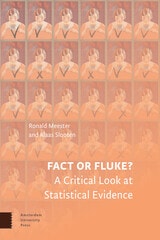
Fact or Fluke?
A Critical Look at Statistical EvidenceRonald Meester
Amsterdam University Press, 2022
Ronald Meester and Klaas Slooten use a variety of examples – from court cases to theoretical physics – to present different views on statistics and provide arguments for what they think is the best point of view. This book is meant for anyone who is in some way concerned with, or interested in, statistical evidence: scientific researchers, students, teachers, mathematicians, philosophers, lawyers, managers, and no doubt many others.
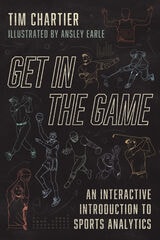
Get in the Game
An Interactive Introduction to Sports AnalyticsTim Chartier
University of Chicago Press, 2022
In 2013, NBA point guard Steph Curry wowed crowds when he sunk 11 out of 13 three-pointers for a game total of 54 points—only seven other players, including Michael Jordan and Kobe Bryant, had scored more in a game at Madison Square Garden. Four years later, the University of Connecticut women’s basketball team won its hundredth straight game, defeating South Carolina 66–55. And in 2010, one forecaster—an octopus named Paul—correctly predicted the outcome of all of Germany’s matches in the FIFA World Cup. These are surprising events—but are they truly improbable?
In Get in the Game, mathematician and sports analytics expert Tim Chartier helps us answer that question—condensing complex mathematics down to coin tosses and dice throws to give readers both an introduction to statistics and a new way to enjoy sporting events. With these accessible tools, Chartier leads us through modeling experiments that develop our intuitive sense of the improbable. For example, to see how likely you are to beat Curry’s three-pointer feat, consider his 45.3 percent three-point shooting average in 2012–13. Take a coin and assume heads is making the shot (slightly better than Curry at a fifty percent chance). Can you imagine getting heads eleven out of thirteen times? With engaging exercises and fun, comic book–style illustrations by Ansley Earle, Chartier’s book encourages all readers—including those who have never encountered formal statistics or data simulations, or even heard of sports analytics, but who enjoy watching sports—to get in the game.
Holographic Reduced Representation
Distributed Representation for Cognitive StructuresTony A. Plate
CSLI, 2003
Holographic Reduced Representations (HRRs) are introduced here to model how the brain distributes each piece of information among thousands of neurons. It had been previously thought that the grammatical structure of a language cannot be encoded practically in a distributed representation, but HRRs can overcome the problems of earlier proposals. Thus this work has implications for psychology, neuroscience, linguistics, and computer science, and engineering.
Introduction to Probability for Data Science
Stanley Chan
Michigan Publishing Services, 2021
- Motivation: In the ocean of mathematical definitions, theorems, and equations, why should we spend our time on this particular topic but not another?
- Intuition: When going through the deviations, is there a geometric interpretation or physics beyond those equations?
- Implication: After we have learned a topic, what new problems can we solve?
Machine Learning and Deep Learning Driven Techniques for Multimodal Data Security in the Internet of Multimedia Things
Sita Rani
The Institution of Engineering and Technology, 2026
Macroanalysis
Digital Methods and Literary HistoryMatthew L. Jockers
University of Illinois Press, 2013
Navigating Artificial Intelligence for Cultural Heritage Organisations
Edited by Lise Jaillant, et al.
University College London, 2025
As artificial intelligence reshapes the cultural heritage sector, libraries, archives, and museums face novel opportunities and pressing ethical challenges. Navigating Artificial Intelligence for Cultural Heritage Organisations brings together leading experts from digital humanities, computer science, and information science to explore how AI-driven technologies transform the management and interpretation of digitized and born-digital records.
Through an examination of real-world case studies from the UK, US, and beyond, this volume provides significant insights into AI’s role in record management and text and data mining, while addressing issues of trust and risk in automated systems. Designed for heritage professionals, researchers, and information specialists, this book offers a timely guide to leveraging AI while also safeguarding the integrity and accessibility of cultural archives for the future.

Neural Network Applications in Control
G.W. Irwin
The Institution of Engineering and Technology, 1995

Open Data in Ancient and Byzantine Studies
Edited by Valeria Vitale and Gabriel Bodard
University of London Press, 2026
Exploring the impact of open-access and openly licensed data and code in classical and Byzantine studies.
Open Data in Ancient and Byzantine Studies shows how openness supports transparency, collaboration, the identification of biases, and new interpretive and data‑driven approaches to ancient sources. Through practical case studies, the book demonstrates how methods such as epigraphic transcription, textual criticism, and archaeological modeling have advanced open data standards and practices.
This book highlights the potential of interoperability, documentation, and open workflows for broader approaches to the ancient world. Bringing together work from classics, Byzantine studies, archaeology, linguistics, and digital humanities, it presents open scholarship as a transformative model for academic knowledge production.
Sleep Fictions
Rest and Its Deprivations in Progressive-Era LiteratureHannah L. Huber
University of Illinois Press, 2023
A turn-of-the-century influx of new technologies and the enormous impact of the electric light transformed not only individual sleeping habits but the ways American culture conceived and valued sleep. Hannah L. Huber analyzes the works of Henry James, Edith Wharton, Charles Chesnutt, and Charlotte Perkins Gilman to examine the literary response to the period’s obsession with wakefulness. As these writers blurred the separation of public and private space, their characters faced exhaustion in a modern world that permeated every moment of their lives with artificial light, traffic noise, and the social pressure to remain active at all hours. The implacable cultural clock and constant stress over physical limitations had an even greater impact on marginalized figures. Huber pays particular attention to how these writers rebutted Americans’ confidence in the body’s ability to conquer sleep with vivid portraits of the devastating consequences of sleep disruption and deprivation.
The author also provides a website and text visualization tool that offers readers an interdisciplinary, deconstructed analysis of the book’s primary texts. The website can be found at: https://sleepfictions.org/sleep/scalar/index
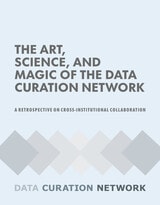
The Art, Science, and Magic of the Data Curation Network
A Retrospective on Cross-Institutional CollaborationJake Carlson
Michigan Publishing Services, 2023
The Art, Science, and Magic of the Data Curation Network: A Retrospective on Cross Institutional Collaboration captures the results of a project retrospective meeting and describes the necessary components of the DCN’s sustained collaboration in the hopes that the insights will be of use to other collaborative efforts. In particular, the authors describe the successes of the community and challenges of launching a cross-institutional network. Additionally, this publication details the administrative, tool-based, and trust-based structures necessary for establishing this community, the “radical collaboration” that is the cornerstone of the DCN, and potential future collaborations to address shared challenges in libraries and research data management. This in-depth case study provides an overview of the critical work of launching a collaborative network and transitioning to sustainability. This publication will be of special interest to research librarians, data curators, and anyone interested in academic community building.

The Burden of Choice
Recommendations, Subversion, and Algorithmic CultureJonathan Cohn
Rutgers University Press, 2019
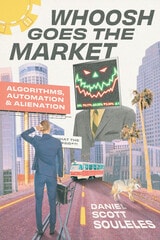
Whoosh Goes the Market
Algorithms, Automation, and AlienationDaniel Scott Souleles
University of Chicago Press, 2024
Markets are messy, and no one knows this better than traders who work tirelessly to predict what they will do next. In Whoosh Goes the Market, Daniel Scott Souleles takes us into the day-to-day experiences of a team at a large trading firm, revealing what it’s actually like to make and lose money on contemporary capital markets.
The traders Souleles shadows have mostly moved out of the pits and now work with automated, glitch-prone computer systems. They remember the days of trading manually, and they are suspicious of algorithmically driven machine-learning systems. Openly musing about their own potential extinction, they spend their time expressing fear and frustration in profanity-laced language. With Souleles as our guide, we learn about everything from betting strategies to inflated valuations, trading swings, and market manipulation. This crash course in contemporary finance vividly reveals the existential anxiety at the evolving front lines of American capitalism.