Results by title
15 books match the query 'Daughter'
Daughter in Retrograde
A MemoirCourtney Kersten
University of Wisconsin Press, 2021
Daughter of Damascus
A MemoirBy Siham Tergeman
University of Texas Press, 1993
Daughter of Damascus presents a personal account of a Syrian woman's youth in the Suq Saruja ("old city") quarter of Damascus in the 1940s. Siham Tergeman wrote this book to preserve the details of a "genuine Arab past" for Syrian young people. In it, she relates the customs pertaining to marriage, birth, circumcision, and death. She writes of Ramadan festivities, family picnics to the orchards of the Ghuta, weekly trips to the public bath, her school experiences, Damascene cooking, peddlers' calls, and proverbs. She includes the well-known dramatic skits, songs, and tales of the Syrian Hakawati storytellers. And, through the words of her father, she describes the difficult period when Syrians were involved in the Balkans War and World War I. All this wealth of ethnographic detail is set in real-life vignettes that make the book lively and entertaining reading.
Little has been published about modern Syrian social life. In this English translation of an Arabic memoir originally published in Syria in 1978, Tergeman appeals to a wide audience. General readers will find a charming story, while scholars can find source material for university courses in anthropology, sociology, family and women's studies, and Middle Eastern area studies. The introduction by anthropologist Andrea Rugh portrays Syrian social life for Western readers and points out some of the nuances that might escape the attention of those unacquainted with Arab culture.
Daughter of the Empire State
The Life of Judge Jane BolinJacqueline A. McLeod
University of Illinois Press, 2016
Bolin was appointed to New York City's domestic relations court in 1939 for the first of four ten-year terms. When she retired in 1978, her career had extended well beyond the courtroom. Drawing on archival materials as well as a meeting with Bolin in 2002, historian Jacqueline A. McLeod reveals how Bolin parlayed her judicial position to impact significant reforms of the legal and social service system in New York.
Beginning with Bolin's childhood and educational experiences at Wellesley and Yale, Daughter of the Empire State chronicles Bolin's relatively quick rise through the ranks of a profession that routinely excluded both women and African Americans. Deftly situating Bolin's experiences within the history of black women lawyers and the historical context of high-achieving black New Englanders, McLeod offers a multi-layered analysis of black women's professionalization in a segregated America.
Linking Bolin's activist leanings and integrationist zeal to her involvement in the NAACP, McLeod analyzes Bolin's involvement at the local level as well as her tenure on the organization's national board of directors. An outspoken critic of the discriminatory practices of New York City's probation department and juvenile placement facilities, Bolin also co-founded, with Eleanor Roosevelt, the Wiltwyck School for boys in upstate New York and campaigned to transform the Domestic Relations Court with her judicial colleagues. McLeod's careful and highly readable account of these accomplishments inscribes Bolin onto the roster of important social reformers and early civil rights trailblazers.
Daughter of the Revolution
The Major Nonfiction Works of Pauline HopkinsDworkin, Ira
Rutgers University Press, 2007
Pauline E. Hopkins (1859–1930) came to prominence in the early years of the twentieth century as an outspoken writer, editor, and critic. Frequently recognized for her first novel, Contending Forces, she is currently one of the most widely read and studied African American novelists from that period.
While nearly all of Hopkins’s fiction remains in print, there is very little of her nonfiction available. This reader brings together dozens of her hard-to-find essays, including longer nonfiction works such as Famous Men of the Negro Race and The Dark Races of the Twentieth Century, some of which are published here for the first time in their entirety.
Through these works, along with two juvenile essays from the 1870s, a personal letter, and two speeches, readers encounter a voice that is committed to constructing an international discourse on race, recovering the militant abolitionist tradition to combat Jim Crow, celebrating black political participation during and after the Reconstruction era, articulating the connections between race and labor, and insisting on equal rights for women. Hopkins’s writing will challenge contemporary scholars to rethink their understanding of black activism and modernity in the early twentieth century.
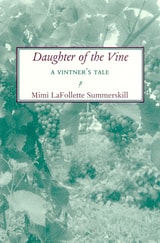
Daughter of the Vine
A Vintner's TaleSummerskill, Mimi LaFollette
Rutgers University Press, 1996
Buy land, girl, buy land. You will never go hungry if you have land, advised Mimi LaFollette Summerskill's grandfather. So she and her husband John purchased a 30Ðacre farm just north of Princeton, New Jersey. After an initial try at cattle farming, the novice farmers decided to try their hands at wine making. Literally. In the spring of 1979, the family planted 2,000 Seyval Blanc seedlings. After months of research, soil testing, charting weather patterns, pruning, fertilizing, picking, pressing, filtering, bottling, and labeling, the LaFollette Vineyard and Winery was born.
Learning the ins and outs of actual wine making turned out to be one of the smaller difficulties the family faced. Until the passage of the Farm Winery Act of 1981, only seven New Jersey farms were licensed to operate a winery. Once that hurdle was passed and the vineyard duly licensed by the state, the federal government stepped in. The Summerskills had to pass inspection by the Bureau of Alcohol and Firearms for a federal license. Then the family had to save their farm from the New Jersey Department of Transportation, who planned to run a major highway right through the vineyard.Learning each and every step along the way, the Summerskills produced success. Today, people around the state enjoy the fruits of the Summerskill's labor.

Daughter, Mother, Grandmother, and Whore
The Story of a Woman Who Decided to be a PutaGabriela Leite
Duke University Press, 2024
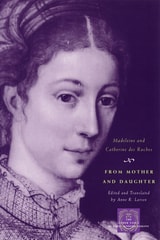
From Mother and Daughter
Poems, Dialogues, and Letters of Les Dames des RochesMadeleine and Catherine des Roches
University of Chicago Press, 2006
Madeleine and Catherine spent their entire lives in civil war–torn Poitiers, where a siege of the city, vandalism, and desecration of churches fueled their political and religious commentary. Members of an elite literary circle that would inspire salon culture during the next century, the Dames des Roches addressed the issues of the day, including the ravages of religious civil wars, the weak monarchy, education for women, marriage and the family, violence against women, and the status of women intellectuals. Through their collaborative engagement in shared public discourse, both mother and daughter were models of moral, political, and literary agency.
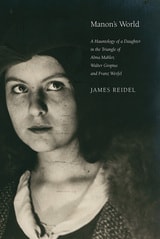
Manon's World
A Hauntology of a Daughter in the Triangle of Alma Mahler, Walter Gropius and Franz WerfelJames Reidel
Seagull Books, 2020
Manon Gropius (1916–1935) was the daughter of Alma Mahler, the widow of Gustav Mahler, and the architect Walter Gropius, the founder of the Bauhaus, and the stepdaughter of the writer Franz Werfel. In Manon’s World, James Reidel explores the life and death of a child at the center of a broken love triangle. The story takes a unique course, describing a peripheral figure but in a context where her significance and centrality in the lives of her famous parents and circles comes into relief. Reidel reveals a neglected and fascinating life in a world gone by—Vienna, Venice, and Berlin of the interwar years.
Not just a narrative biography, Manon’s World is also a medical history of the polio that killed Manon and a personal cultural history of the aspirations projected on her—and seen as lost by such keen observers as Elias Canetti, who devoted two chapters of his Nobel Prize–winning memoirs to his encounters with Manon and her funeral. That event led Alban Berg to dedicate his signature Violin Concerto “to an angel.” Reidel reveals a more complex image of a young woman who desired to be an actress and artist in her own right despite being her mother’s intended protégé, an inspiration to her father who rarely saw her, and her stepfather Franz Werfel, who obsessively wrote her into his novels, beginning with The Forty Days of Musa Dagh and as a revenant in all the books that followed.
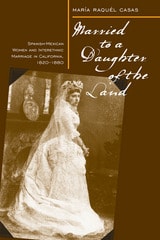
Married To A Daughter Of The Land
Spanish-Mexican Women And Interethnic Marriage In California, 1820-80Maria Raquel Casas
University of Nevada Press, 2009
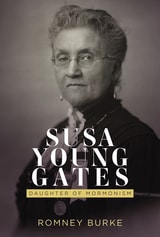
Susa Young Gates
Daughter of MormonismRomney Burke
Signature Books, 2022
After divorcing her first husband, Alma Dunford, the trauma associated with that union was such that she steadfastly refused to mention it ever again. She also lost some of her children over the course of her life and was unable to reconcile her older sister’s departure from the LDS Church and conversion to Catholicism. Yet despite her trials, Susa found fulfillment in her faith through service, as a prolific writer—co-authoring with her daughter Leah Dunford Widtsoe the 1930 biography of her father, Life Story of Brigham Young, founding the Young Women’s Journal in 1889, the Relief Society Magazine in 1915, and in her associations with such prominent women’s advocates such as Susan B. Anthony.
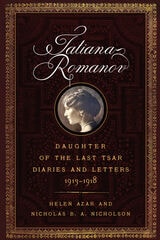
Tatiana Romanov, Daughter of the Last Tsar
Diaries and Letters, 1913–1918Helen Azar
Westholme Publishing, 2016
Grand Duchess Tatiana Nikolaevna of Russia was the second of the four daughters of Tsar Nicholas II and his wife, the Empress Alexandra Feodorovna. Long recognized by historians as the undisputed “beauty” of the family, Tatiana was acknowledged for her poise, her elegance, and her innate dignity within her own family. Helen Azar, translator of the diaries of Olga Romanov, and Nicholas B. A. Nicholson, Russian Imperial historian, have joined together to present a truly comprehensive picture of this extraordinarily gifted, complex, and intelligent woman in her own words. Tatiana Romanov, Daughter of the Last Tsar: Diaries and Letters, 1913–1918, presents translations of material never before published in Russian or in English, as well as materials never published in their entirety in the West.
The brisk, modern prose of Tatiana’s diary entries reveals the character of a young woman who was far more than the sheltered imperial beauty as she previously has been portrayed. While many historians and writers describe her as a cold, haughty, and distant aristocrat, this book shows instead a remarkably down-to-earth and humorous young woman, full of life and compassion. A detail-oriented and observant participant in some of the most important historical events of the early twentieth century, she left firsthand descriptions of the tercentenary celebrations of the House of Romanov, the early years of Russia’s involvement in World War I, and the road to her family’s final days in Siberian exile. Her writings reveal extraordinary details previously unknown or unacknowledged. Lavishly annotated for the benefit of the nonspecialist reader, this book is not only a reevaluation of Tatiana’s role as more than just one of four sisters, but also a valuable reference on Russia, the First World War, the Russian Revolution, and the people closest to the Grand Duchess and her family.
The Christian Religion, as Professed by a Daughter of the Church of England
Mary Astell
Iter Press, 2013
The Daughter as Reader
Encounters between Literature and LifePaula Marantz Cohen
University of Michigan Press, 1996

The Daughter of Man
L. J. Sysko
University of Arkansas Press, 2023
"This whip-smart collection is a playful celebration of feminine power.”
—Publisher’s Weekly
"What a beautiful book.”
—Ross Gay
"With the verve of Alice Fulton and the panache of Gerald Stern, Sysko keens into the canon, a welcome voice. Sing, indeed, heavenly muse.”
—Alan Michael Parker
Finalist for the 2023 Miller Williams Poetry Prize
Selected by Patricia Smith
The Daughter of Man follows its unorthodox heroine as she transforms from maiden to warrior—then to queen, maven, and crone—against the backdrop of suburban America from the 1980s to today. In this bold reframing of the hero’s journey, L. J. Sysko serves up biting social commentary and humorous, unsparing self-critique while enlisting an eccentric cast that includes Betsy Ross as sex worker, Dolly Parton as raptor, and a bemused MILF who exchanges glances with a young man at a gas station. Sysko’s revisions of René Magritte’s modernist icon The Son of Man and the paintings of baroque artist Artemisia Gentileschi, whose extraordinary talent was nearly eclipsed after she took her rapist to trial, loom large in this multifaceted portrait of womanhood. With uncommon force, The Daughter of Man confronts misogyny and violence, even as it bursts with nostalgia, lust, and poignant humor.
The Meaning of Daughter
Nader, Alexia
University of Iowa Press, 2026
After immigrating from Lebanon to Haiti as a young girl, Merjan comes of age in an insular, conservative community, where it seems as though her sole escape is marriage. Striking a bargain with a young art dealer, she marries and dreams of becoming a painter, only to discover her husband’s support tethered with expectations.
In the late 1970s, Merjan’s daughter Yvonne is a young woman on the cusp of a marriage of convenience. Though resentful of her mother, Yvonne dreams of establishing a Haitian art gallery in New York with the help of a well-connected older man—but her time there ends disastrously, creating a deep rift between her and her family.
In the present day, Yvonne’s daughter Eva is a student whose art draws inspiration from her grandmother Merjan’s largely undiscovered work. When Eva becomes unexpectedly pregnant, she moves back to her childhood home in Miami to sort out her ambivalent feelings, where she finds her family upended by feuds. An intimate family saga, The Meaning of Daughter explores questions about maternal ambivalence, ambition, artmaking, and how desire resists gendered expectations.