Results by title

3 books match the query 'Daughters in literature'

cover of Against!: Rebellious Daughters in Black Immigrant Fiction in the United States

Against!

Rebellious Daughters in Black Immigrant Fiction in the United States

Asha Jeffers

The Ohio State University Press, 2025

Against! is the first book-length study of Afro-Caribbean and African immigrant and second-generation writing in the United States. In it, Asha Jeffers evaluates the relationship between Blackness and immigranthood in the US as depicted through the recurring theme of rebellious Black immigrant daughters. Considering the work of Paule Marshall, Edwidge Danticat, Chimamanda Ngozi Adichie, and Taiye Selasi, Jeffers untangles how rebellion is informed by race, gender, ethnicity, and migration status.

Immigrant and second-generation writers mobilize often complicated familial relationships to comment on a variety of political, social, and psychic contexts. Jeffers argues that rather than categorizing Black migrants as either immediately fully integrated into an African American experience or seeing them as another category altogether that is unbound by race, Marshall, Danticat, Adichie, and Selasi identify the unstable position of Black migrants within the American racial landscape. By highlighting the diverse ways Black migrants and their children negotiate this position amid the dual demands of the respectability politics imposed on African Americans and the model-minority myth imposed on immigrants, Jeffers reveals the unsteady nature of US racial categories.
[more]
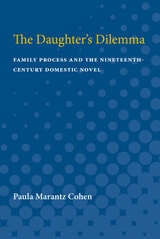
cover of The Daughter's Dilemma: Family Process and the Nineteenth-Century Domestic Novel

The Daughter's Dilemma

Family Process and the Nineteenth-Century Domestic Novel

Paula Marantz Cohen

University of Michigan Press, 1993
The Daughter's Dilemma breaks new ground in literary studies through its application of family systems theory to the analysis of nineteenth-century domestic novels. Cohen argues for structural correspondences between families and novels: as systems seeking closure, they are governed by certain analogous laws. She argues further that the father-daughter dyad is the pivotal structure by which the nuclear family and the domestic novel were able to define themselves as closed systems. The study treats novels by Samuel Richardson, Jane Austen. Emily Bronte, George Eliot, and Henry James and places them in the context of the writers' individual family experiences. Drawing on recent work in literary and feminist criticism, anthropology, history, and psychoanalysis. as well as family systems theory, Cohen seeks to critique the limitations of these theoretical models even as she employs them lo illuminate the texts under discussion. The study's approach leads to insights about the contemporary family and about the present state of literature and literary criticism. Cohen concludes by suggesting that the modern period marked the demise of an ideology favoring closed systems. The result has been both a nostalgia for those systems and a redefinition of experience and relationship as open and subject to endless interpretation. Such an ideological reformulation helps explain the present insistence by literary theorists on the inescapability of the text and the "reality" of representation.
[more]
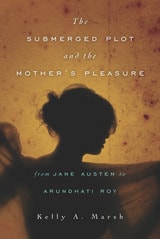
cover of The Submerged Plot and the Mother's Pleasure from Jane Austen to Arundhati Roy

The Submerged Plot and the Mother's Pleasure from Jane Austen to Arundhati Roy

Kelly A. Marsh

The Ohio State University Press, 2016

In The Submerged Plot and the Mother’s Pleasure from Jane Austen to Arundhati Roy, Kelly A. Marsh examines the familiar, overt plot of the motherless daughter growing into maturity and argues that it is accompanied by a covert plot. Marsh’s insightful analyses of nineteenth- and twentieth-century Anglophone novels reveal that these novels are far richer and more complexly layered than the overt plot alone suggests. According to Marsh, as the daughter approaches adulthood and marriage, she seeks validation for her pleasure in her mother’s story. However, because the mother’s pleasure is taboo under patriarchy and is therefore unnarratable, the daughter must seek her mother’s story by repeating it. These repetitions alert us to the ways the two plots are intertwined and alter our perception of the narrative progression.
 
Combining feminist and rhetorical narratological approaches, Marsh’s study offers fresh readings of Persuasion, Jane Eyre, Bleak House, The Woman in White, The House of Mirth, The Last September, The Color Purple, A Thousand Acres, Bastard Out of Carolina, Talking to the Dead, and The God of Small Things. Through these readings, The Submerged Plot and the Mother’s Pleasure explores how the unnarratable can be communicated in fiction and offers a significant contribution to our understanding of narrative progression.
 
[more]