Results by title
5 books match the query 'Davie, Donald'
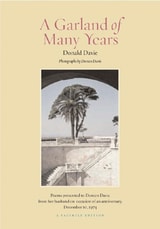
A Garland of Many Years
Donald Davie
Vanderbilt University Press, 2005
To some readers the poems will seem unusual as love poems because they do not idealize love and marriage. Their strength lies in their honesty and intimacy and in the openness to the pain and self-understanding that both ardor and conflict ("We, we throve on friction") can produce. This is a relationship in which each knows the other too well to be assuaged by a sentimental lyricism.
For this special edition, twelve of Doreen's photographs from their travels together have been included, so that her sensibility may be present, too, as an artist in her own right. Donald's handwritten poems are reproduced both in facsimile and in type.
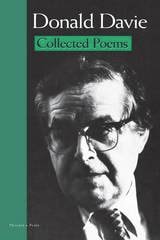
Collected Poems
Donald Davie
University of Chicago Press, 1991
"Davie's voice—judgemental, ironic, epigrammatic, humorous, self-lacerating—speaks always with reference to an unhuman perpendicular standard that itself goes unquestioned. It is not a standard of Beauty or Truth; Davie is a poet of the third member of the Platonic triad, Justice."—Helen Vendler, The New Yorker
"[Davie's poems] are on the quiet side, often casual and musing in mood and tone; determined to resist large gestures of assent or denial. . .Donald Davie may just be the best English poet-critic of our time."—William Pritchard, The New Republic
"Donald Davie's Collected Poems does more than mark the culmination of one of the most distinguished careers in post-war British poetry; it is the autobiographical journey of a living poet at the height of his creative powers and the mastery of his craft. Davie is considered the most important and valuable contemporary link between poetry in England and America."—Sarah E. McNeil, Little Rock Free Press

Slavic Excursions
Essays on Russian and Polish LiteratureDonald Davie
University of Chicago Press, 1991
To Scorch or Freeze
Poems about the SacredDonald Davie
University of Chicago Press, 1988
"Few modern poets have managed to achieve Donald Davie's sense of human worth."—Times Higher Educational Supplement
Under Briggflatts
A History of Poetry in Great Britain, 1960-1988Donald Davie
University of Chicago Press, 1989
Under Briggflatts is organized in three large chapters, one devoted to each decade. In the 1960s, Davie pays particular attention to the work of Austin Clarke, Hugh MacDiarmid, Norman McCaig, Keith Douglas, Edwin Muir, Basil Bunting (the gurus whose prose writings helped catalyze the traumatic events of 1968), Elaine Feinstein, Sylvia Townsend Warner, Philip Larkin, Charles Tomlinson, Thomas Kinsella, and Ted Hughes. The second chapter follows these figures into the new decade and explores the work of (among others) Thom Gunn, C. H. Sisson, R. S. Thomas, John Betjeman, and such themes as women's poetry, translation, poetic theory, and the later impact of T. S. Eliot and of Edward Thomas. Perhaps the most controversial chapter is the third, in which David—without abandoning the poets already introduced—assesses Geoffrey Hill, Tony Harrison, and Seamus Heaney, and looks too at the recovery of Ivor Gurney's poems, at Ted Hughes as Laureate, the posthumous work of Sylvia Townsend Warner, the burgeoning Hardy industry, and the critical writings of Kenneth Cox.