Results by title
3 books match the query 'Davis, Clark'
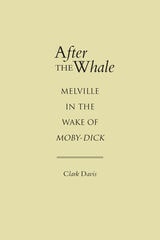
After the Whale
Melville in the Wake of Moby-DickClark Davis
University of Alabama Press, 1995
Beyond Moby-Dick: Reinterpreting Melville's later works through language, embodiment, and literary transformation.
The study focuses on Melville’s vision of the purpose and function of language from Moby-Dick through Billy Budd with a special emphasis on how language—in function and form—follows and depends on the function and form of the body, how Melville’s attitude toward words echoes his attitude toward fish. Davis begins by locating and describing the fundamental dialectic formulated in Moby-Dick in the characters of Ahab and Ishmael. This dialectic produces two visions of bodily reality and two corresponding visions of language: Ahab’s, in which language is both weapon and substitute body, and Ishmael’s, in which language is an extension of the body—a medium of explanation, conversation, and play. These two forms of language provide a key to understanding the difficult relationships and formal changes in Melville’s writings after Moby-Dick.
By following each work’s attitude toward the dialectic, we can see the contours of the later career more clearly and so begin a movement away from weakly contextualized readings of individual novels and short stories to a more complete consideration of Melville’s career. Since the rediscovery of Herman Melville in the early decades of this century, criticism has been limited to the prose in general and to a few major works in particular.
Those who have given significant attention to the short fiction and poetry have done so frequently out of context, that is, in multi-author works devoted exclusively to these genres. The result has been a criticism with large gaps, most especially for works from Melville’s later career. The relative lack of interest in the poetry has left us with little understanding of how Melville’s later voices developed, of how the novels evolved into tales, the tales into poetry, and the poetry back into prose. In short, the development of Melville’s art during the final three decades of his life remains a subject of which we have been afforded only glimpses, rarely a continuous attention. After the Whale provides a new, more comprehensive understanding of Melville’s growth as a writer.
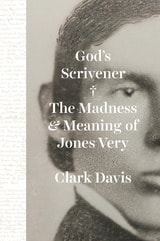
God's Scrivener
The Madness and Meaning of Jones VeryClark Davis
University of Chicago Press, 2023
In September of 1838, a few months after Ralph Waldo Emerson delivered his controversial Divinity School address, a twenty-five-year-old tutor and divinity student at Harvard named Jones Very stood before his beginning Greek class and proclaimed himself “the second coming.” Over the next twenty months, despite a brief confinement in a mental hospital, he would write more than three hundred sonnets, many of them in the voice of a prophet such as John the Baptist or even of Christ himself—all, he was quick to claim, dictated to him by the Holy Spirit.
Befriended by the major figures of the Transcendentalist movement, Very strove to convert, among others, Elizabeth and Sophia Peabody, Bronson Alcott, Nathaniel Hawthorne, and most significantly, Emerson himself. Though shocking to some, his message was simple: by renouncing the individual will, anyone can become a “son of God” and thereby usher in a millennialist heaven on earth. Clark Davis’s masterful biography shows how Very came to embody both the full radicalism of Emersonian ideals and the trap of isolation and emptiness that lay in wait for those who sought complete transcendence.
God’s Scrivener tells the story of Very’s life, work, and influence in depth, recovering the startling story of a forgotten American prophet, a “brave saint” whose life and work are central to the development of poetry and spirituality in America.

It Starts with Trouble
William Goyen and the Life of WritingBy Clark Davis
University of Texas Press, 2015
William Goyen was a writer of startling originality and deep artistic commitment whose work attracted an international audience and the praise of such luminaries as Northrop Frye, Truman Capote, Gaston Bachelard, and Joyce Carol Oates. His subject was the land and language of his native East Texas; his desire, to preserve the narrative music through which he came to know his world. Goyen sought to transform the cherished details of his lost boyhood landscape into lasting, mythic forms. Cut off from his native soil and considering himself an “orphan,” Goyen brought modernist alienation and experimentation to Texas materials. The result was a body of work both sophisticated and handmade—and a voice at once inimitable and unmistakable.
It Starts with Trouble is the first complete account of Goyen’s life and work. It uncovers the sources of his personal and artistic development, from his early years in Trinity, Texas, through his adolescence and college experience in Houston; his Navy service during World War II; and the subsequent growth of his writing career, which saw the publication of five novels, including The House of Breath, nonfiction works such as A Book of Jesus, several short story collections and plays, and a book of poetry. It explores Goyen’s relationships with such legendary figures as Frieda Lawrence, Katherine Anne Porter, Stephen Spender, Anaïs Nin, and Carson McCullers. No other twentieth-century writer attempted so intimate a connection with his readers, and no other writer of his era worked so passionately to recover the spiritual in an age of disabling irony. Goyen’s life and work are a testament to the redemptive power of storytelling and the absolute necessity of narrative art.