Results by title
2 books match the query 'Dawson, Alexander S.'

Bike Lanes Are the End of Us
Alexander S. Dawson
Vanderbilt University Press, 2027
Bike lanes are aspirational projects. They speak to a series of dreams about what North American cities could be, especially in and around an environmentalist and Europhilic vision (the latter having a very long history in the Americas). And yet, cycling infrastructure is built on or alongside the roads and modes of transport that came before it and maps onto preexisting forms of racial and spatial inequality. In many North American communities where social ties have long been fraying, efforts to build bike lanes have replicated the social crises that we see in other spaces.
Amsterdam’s oft-cited bike lanes are integrated within a system of regional trains, buses, and subways, allowing riders to park their bikes and engage in multimodal commuting, and are in turn the product of a social safety net that is among the most robust on the planet. However, in American settings, these projects have been slow to launch and their results have been uneven, in part due to spatial inequality in our cities, and in part because suburbanites and people with means have grown more attached to their private cars, rather than less so, in recent decades.
Recent controversial bike lane initiatives in Mexico City and Vancouver show how such projects not only create uproar among monied urbanites but may actually displace entire modes of transportation used primarily by marginalized residents (especially in the case of Mexico City), when the wish to imitate European models defeats efforts to see a North American city for what it is. In comparing Mexico City and Vancouver, Bike Lanes Are the End of Us traces how bike lane politics collide with distinct racial, spatial, and infrastructural realities to produce “green” reforms that can reinforce existing inequalities just as readily as they promise greater mobility.
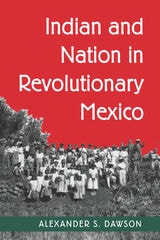
Indian and Nation in Revolutionary Mexico
Alexander S. Dawson
University of Arizona Press, 2004
Traditionally, scholars have seen Indigenismo as an elitist formulation of the "Indian problem." Dawson instead explores the ways that the movement was mediated by both elite and popular pressures over time. By showing how Indigenismo was used by a variety of actors to negotiate the shape of the revolutionary state—from anthropologist Manual Gamio to President Lázaro Cárdenas—he demonstrates how it contributed to a new "pact of domination" between indigenous peoples and the government.
Although the power of the Indigenistas was limited by the face that "Indian" remained a racial slur in Mexico, the indígenas capacitados empowered through Indigenismo played a central role in ensuring seventy years of PRI hegemony. In studying the confluence of state formation, social science, and native activism, Dawson's book offers a new perspective for understanding the processes through which revolutionary hegemony emerged.