Results by title
5 books match the query 'Dawson, Ashley'
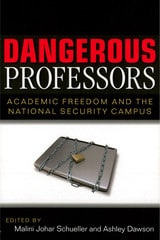
Dangerous Professors
Academic Freedom and the National Security CampusMalini Johar Schueller and Ashley Dawson, Editors
University of Michigan Press, 2009
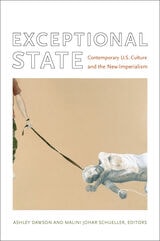
Exceptional State
Contemporary U.S. Culture and the New ImperialismAshley Dawson and Malini Johar Schueller, eds.
Duke University Press, 2007
The contributors address a range of topics, paying particular attention to the dynamics of gender and race. Their essays include a surprising reading of the ostensibly liberal movies Wag the Dog and Three Kings, an exploration of the rhetoric surrounding the plan to remake the military into a high-tech force less dependent on human bodies, a look at the significance of the popular Left Behind series of novels, and an interpretation of the Abu Ghraib prison photos. They scrutinize the national narrative created to justify the US invasions of Afghanistan and Iraq, the ways that women in those countries have responded to the invasions, the contradictions underlying calls for US humanitarian interventions, and the role of Africa in the US imperial imagination. The volume concludes on a hopeful note, with a look at an emerging anti-imperialist public sphere.
Contributors. Omar Dahbour, Ashley Dawson, Cynthia Enloe, Melani McAlister, Christian Parenti, Donald E. Pease, John Carlos Rowe, Malini Johar Schueller, Harilaos Stecopoulos

Global Cities of the South, Volume 22
Ashley Dawson and Brent Hayes Edwards, eds.
Duke University Press, 0
This special issue challenges postcolonial theorists to engage with urban studies and challenges urban analysts to turn their focus to the postcolonial societies where these cities have developed. Gathering well-known scholars in postcolonial theory and urban studies, the collection opens an interdisciplinary exchange through a series of case studies focused on cities in Africa and Asia. One essay argues that the world’s urban spaces are key to the continuance of inequity under capitalist globalization (exemplified by rapidly expanding urban slums), as well as to any possible resistance to that inequity. Another article considers the history and politics of Harlem from the perspective of a well-known academic, activist, and postcolonial theorist whose work here is interwoven with the photographic art of Alice Attie. A third reflects on the politics of representation of Hindu and Muslim populations in Mumbai, evaluating popular media including film and the cosmopolitan fiction of Salman Rushdie.
Contributors. Alice Attie, Mike Davis, Ashley Dawson, Brent Hayes Edwards, Brian Larkin, Rossana Reguillo, Gayatri Chakravorty Spivak, Rashmi Varma, Victor Vich
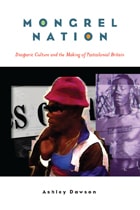
Mongrel Nation
Diasporic Culture and the Making of Postcolonial BritainAshley Dawson
University of Michigan Press, 2007
Mongrel Nation surveys the history of the United Kingdom’s African, Asian, and Caribbean populations from 1948 to the present, working at the juncture of cultural studies, literary criticism, and postcolonial theory. Ashley Dawson argues that during the past fifty years Asian and black intellectuals from Sam Selvon to Zadie Smith have continually challenged the United Kingdom’s exclusionary definitions of citizenship, using innovative forms of cultural expression to reconfigure definitions of belonging in the postcolonial age. By examining popular culture and exploring topics such as the nexus of race and gender, the growth of transnational politics, and the clash between first- and second-generation immigrants, Dawson broadens and enlivens the field of postcolonial studies.
Mongrel Nation gives readers a broad landscape from which to view the shifting currents of politics, literature, and culture in postcolonial Britain. At a time when the contradictions of expansionist braggadocio again dominate the world stage, Mongrel Nation usefully illuminates the legacy of imperialism and suggests that creative voices of resistance can never be silenced.Dawson
“Elegant, eloquent, and full of imaginative insight, Mongrel Nation is a refreshing, engaged, and informative addition to post-colonial and diasporic literary scholarship.”
—Hazel V. Carby, Yale University
“Eloquent and strong, insightful and historically precise, lively and engaging, Mongrel Nation is an expansive history of twentieth-century internationalist encounters that provides a broader landscape from which to understand currents, shifts, and historical junctures that shaped the international postcolonial imagination.”
—May Joseph, Pratt Institute
Ashley Dawson is Associate Professor of English at the City University of New York’s Graduate Center and the College of Staten Island. He is coeditor of the forthcoming Exceptional State: Contemporary U.S. Culture and the New Imperialism.
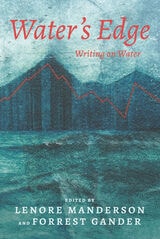
Water's Edge
Writing on WaterEdited by Lenore Manderson and Forrest Gander
Northwestern University Press, 2023
A wide-ranging consideration of water’s plenitude and paucity—and of our relationship to its many forms
Water is quotidian, ubiquitous, precious, and precarious. With their roots in this element, the authors of Water’s Edge reflect on our natural environment: its forms, textures, and stewardship. Born from a colloquium organized by the editors at the Institute at Brown for Environment and Society, the anthology features a diverse group of writers and artists from half a dozen countries, from different fields of scholarship and practice: artists, biologists, geologists, poets, ecocritics, actors, and anthropologists. The contributors explore and celebrate water while reflecting on its disturbances and pollution, and their texts and art play with the boundaries by which we differentiate literary forms.
In the creative nonfiction, poetry, and visual art collected here, water moves from backdrop to subject. Ashley Dawson examines the effects of industrial farming on the health of local ecosystems and economies. Painter Kulvinder Kaur Dhew captures water’s brilliance and multifaceted reflections through a series of charcoal pieces that interlace the collection. Poet Arthur Sze describes the responsibility involved in the careful management of irrigation ditches in New Mexico. Rather than concentrating their thoughts into a singular, overwhelming argument, the authors circulate moments of apprehension, intimation, and felt experience. They are like tributaries, each carrying, in a distinctive style, exigent and often intimate reports concerning a substance upon which all living organisms depend.