Results by title

16 books match the query 'Dawson, Christopher'

cover of A Historian and His World: A Life of Christopher Dawson, 1889-1970

A Historian and His World

A Life of Christopher Dawson, 1889-1970

Christina Scott

Catholic University of America Press, 2023
The English historian of culture Christopher Dawson (1889-1970) was an independent scholar and the author of more than twenty books. He served as assistant lecturer in the History of Culture, University College, Exeter (1925), Forwood Lecturer in the Philosophy of Religion, University of Liverpool (1934), Gifford Lecturer at the University of Edinburgh (1947-1949), and as Professor of Catholic Studies at Harvard University (1958-1962). He was elected Fellow of the British Academy in 1943 and edited the Dublin Review during the Second World War. This biography by Christina Scott, Dawson’s daughter, is a sensitive portrait of a complex and fascinating scholar. Unlike other English Christian converts of the twentieth century who excelled in literature, like G. K. Chesterton or C. S. Lewis, Dawson turned to the social sciences. He drew from the new idea of culture as a common way of life emerging from anthropology at the time of the Great War to shape a new approach to history. His study of the intimate relationship between religion and culture throughout world history shaped his trenchant criticisms of his own times. He wrote in 1955 that, “the first step in the transformation of culture is a change in the pattern of culture within the mind, for this is the seed out of which there spring new forms of life which ultimately change the social way of life and thus create a new culture.” Dawson’s engagement with anthropology and the idea of culture marked an important moment of development in the Catholic intellectual tradition. Christina Scott shows that Dawson is best understood as he himself interpreted his historical subjects—in the context of “the spiritual world in which he lived, the ideas that moved him, and the faith that inspired his action.” Dawson was not a historian of ideas for their own sake; he had a passionate belief in their liberating power. A Historian and His World will be of interest to intellectual historians, historians of religion and culture, and students of modern Catholic thought. The Introduction is written by Dawson scholar Joseph T. Stuart and the book is graced by a postscript by Christopher Dawson reflecting upon the meaning of his work.
[more]
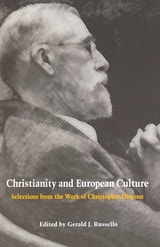
cover of Christianity and European Culture (Selections from the Work of Christopher Dawson)

Christianity and European Culture (Selections from the Work of Christopher Dawson)

Christopher Dawson

Catholic University of America Press, 1998
This book provides a comprehensive introduction to the development of Dawson's thinking on questions that remain of contemporary importance
[more]
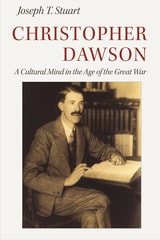
cover of Christopher Dawson: A Cultural Mind in the Age of the Great War

Christopher Dawson

A Cultural Mind in the Age of the Great War

Joseph T. Stuart

Catholic University of America Press, 2022
The English historian Christopher Dawson (1889-1970) was the first Catholic Studies professor at Harvard University and has been described as one of the foremost Catholic thinkers of modern times. His focus on culture prefigured its importance in Catholicism since Vatican Council II and in the rise of mainstream cultural history in the late twentieth century. How did Dawson think about culture and why does it matter? Joseph T. Stuart argues that through Dawson’s study of world cultures, he acquired a “cultural mind” by which he attempted to integrate knowledge according to four implicit rules: intellectual architecture, boundary thinking, intellectual asceticism, and intellectual bridges. Dawson’s multilayered approach to culture, instantiating John Henry Newman’s philosophical habit of mind, is key to his work and its relevance. By it, he responded to the cultural fragmentation he sensed after the Great War (1914-1918). Stuart supports these claims by demonstrating how Dawson formed his cultural mind practicing an interdisciplinary science of culture involving anthropology, sociology, history, and comparative religion. Stuart shows how Dawson applied his cultural thinking to problems in politics and education. This book establishes how Dawson’s simple definition of culture as a “common way of life” reconciles intellectualist and behavioral approaches to culture. In addition, Dawson’s cultural mind provides a synthesis helpful for recognizing the importance of Christian culture in education. It demonstrates principles which construct a more meaningful cultural history. Anyone interested in the idea of culture, the connection of religion to the social sciences, Catholic Studies, or Dawson studies will find this book an engaging and insightful intellectual history.
[more]
cover of Enquiries into Religion and Culture (The Works of Christopher Dawson)

Enquiries into Religion and Culture (The Works of Christopher Dawson)

Christopher Dawson

Catholic University of America Press, 2009
The essays presented in this volume are among the most wide-ranging, intellectually rich, and diverse of Christopher Dawson's reflections on the relations of faith and culture
[more]
cover of Medieval Essays (The Works of Christopher Dawson)

Medieval Essays (The Works of Christopher Dawson)

Christopher Dawson

Catholic University of America Press, 2002
Medieval Essays is the mature reflection of one of the most gifted cultural historians of the twentieth century.
[more]
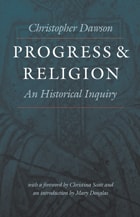
cover of Progress and Religion: An Historical Inquiry (The Works of Christopher Dawson)

Progress and Religion

An Historical Inquiry (The Works of Christopher Dawson)

Christopher Dawson

Catholic University of America Press, 2001
Progress and Religion was perhaps the most influential of all Christopher Dawson's books, establishing him as an interpreter of history and a historian of ideas.
[more]
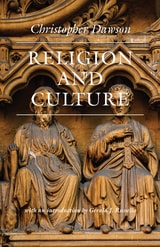
cover of Religion and Culture

Religion and Culture

Christopher Dawson

Catholic University of America Press, 2013
Religion and Culture was first presented by historian Christopher Dawson as part of the prestigious Gifford Lecture series in 1947. It sets out the thesis for which he became famous: religion is the key of history
[more]
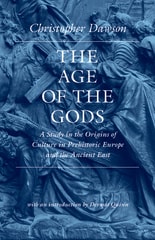
cover of The Age of the Gods

The Age of the Gods

Christopher Dawson

Catholic University of America Press, 2012
When first published in 1928, The Age of the Gods was hailed as the best short account of what is known of pre-historic man and culture. In it, Christopher Dawson synthesized modern scholarship on human cultures in Europe and the East from the Stone Age to the beginnings of the Iron Age.
[more]
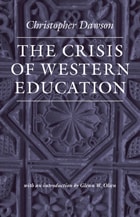
cover of The Crisis of Western Education (The Works of Christopher Dawson)

The Crisis of Western Education (The Works of Christopher Dawson)

Christopher Dawson

Catholic University of America Press, 2010
The Crisis of Western Education, originally published in 1961, served as a capstone of Christopher Dawson's thought on the Western educational system.
[more]
cover of The Dividing of Christendom

The Dividing of Christendom

Christopher Dawson

Catholic University of America Press, 2026
Christopher Dawson, the renowned historian of culture, offered an overarching narrative in two volumes of the rise and fall of Christian unity within Western Civilization in lectures he delivered at Harvard University between 1958 and 1962. Volume 1, The Formation of Christendom, laid out Dawson’s anthropological approach to culture in general and to the formation of Christian culture in particular. Volume 2, The Dividing of Christendom, examines the forces that led to the dissolution of European unity and the rise of a new secular vision of humanity with its hopes set on material progress. Dawson begins the tale of dissolution in the Middle Ages, examining its spiritual, intellectual, and social causes. A Church in desperate need of reform, divided in its allegiance during the Great Western Schism, could not muster the collective will to overcome laxity and corruption. Nominalism and voluntarism unraveled the great intellectual synthesis of scholasticism. Political and economic forces, burdened by feudal restraints, needed only a catalyst to overturn the old order. The Dividing of Christendom highlights the social and cultural forces that shaped the Age of Reformations and its aftermath. While not neglecting the importance of theological claims, Dawson explains how political ambition and consolidation of power played a role just as significant. Furthermore, the distinct theological vision of the different reformations of the sixteenth century created a new culture, focused much more on the individual and an emphasis on industry. The mystical extravagance of the Baroque period, which characterized the Catholic renewal of southern Europe and spread throughout the world, eventually gave way to the more utilitarian values of the ascendant European north. Religious wars resulted in a secularism that prioritized science and economics in the shaping of modern culture. The Enlightenment, in particular, initiated a campaign against throne and altar that paved the way for political revolutions. Successful movements of religious revival occurred simultaneously, as Dawson traces their influence on the American colonies, particularly Puritanism and Methodism. Nevertheless, those bent on material progress as a kind of new religion undermined the spiritual foundations of Christian culture so completely that we must seek to rediscover a new source of internal vigor and unity to overcome our cultural crisis.
[more]
cover of The Gods of Revolution

The Gods of Revolution

Christopher Dawson

Catholic University of America Press, 2015
Please fill in marketing copy
[more]
cover of The Judgment of the Nations

The Judgment of the Nations

Christopher Dawson

Catholic University of America Press, 2011
Christopher Dawson wrote The Judgment of the Nations in 1942, in the midst of the horrors of World War II.
[more]
cover of The Movement of World Revolution

The Movement of World Revolution

Christopher Dawson

Catholic University of America Press, 2013
The Movement of World Revolution, originally published in 1959, explores many of the themes Dawson considered most important in his lifetime: the religious foundation of human culture, the central importance of education for the recovery of Christian humanism, the myth of progress, and the dangers of nationalism and secular ideologies.
[more]
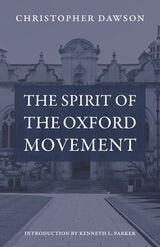
cover of The Spirit of the Oxford Movement

The Spirit of the Oxford Movement

Christopher Dawson

Catholic University of America Press, 2022
“This is the book we have been waiting for… a permanent enrichment of our understanding of the Oxford Movement” proclaimed The Downside Review upon the publication of Christopher Dawson’s masterwork in 1933, exactly 100 years after John Keble’s sermon "National Apostasy" stirred a nation. Dawson himself regarded the book as one of his two greatest intellectual accomplishments. Dawson and John Henry Newman were Oxonians and both were converts to Catholicism; both stood against progressive and liberal movements within society. In both ideologies, Dawson saw a pathway that had once led to the French Revolution. Newman, for Dawson, was a kindred spirit. In The Spirit of the Oxford Movement, Dawson goes beyond a mere retelling of the events of 1833 - 1845. He shows us the prime movers who sought a deeper understanding of the Anglican tradition: the quixotic Hurrell Froude, for instance, who "had none of the English genius for compromise or the Anglican faculty of shutting the eyes to unpleasant facts." It was Froude who brought Newman and Keble together and who helped them understand each other. In many ways, Dawson sees these three as the true embodiment of the Tractarian ethos. Dawson probes deeply, though, to provide a richer, clearer understanding of the intellectual underpinnings of the Oxford Movement, revealing its spiritual raison d’être. We meet a group of gifted like-minded thinkers, albeit with sharp disagreements, who mock outsiders and each other, who pepper their letters with Latin, and forever urge each other on. Newman came to believe, as did Dawson, that the only intellectually coherent bastion against secular culture was religion, and the “on” to which they were urged was the Catholic church. The Spirit of the Oxford Movement provides insights into why Newman, and Dawson, came to this understanding.
[more]
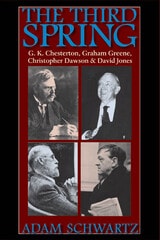
cover of The third spring: G.K. Chesterton, Graham Greene, Christopher Dawson, and David Jones

The third spring

G.K. Chesterton, Graham Greene, Christopher Dawson, and David Jones

Adam Schwartz

Catholic University of America Press, 2005
This book is the first detailed examination of these four authors as part of a Roman Catholic, counter-modern community of discourse. It is informed by extensive research in the writers' works, scholarship on them, and their personal papers.
[more]
cover of Understanding Europe (The Works of Christopher Dawson)

Understanding Europe (The Works of Christopher Dawson)

Christopher Dawson

Catholic University of America Press, 2009

In Understanding Europe, Dawson expresses a desire for Europe to rediscover and renew its foundational Christian sources in order to recover a deeper sense of integrity.
[more]