Results by title
4 books match the query 'De Grazia, Victoria'

How Fascism Ruled Women
Italy, 1922–1945Victoria de Grazia
University of Wisconsin Press, 2027
“Italy has been made; now we need to make the Italians,” goes a familiar Italian saying. Mussolini was the first head of state to include women in this mandate. How the fascist dictatorship defined women’s place in modern Italy and how women experienced the Duce’s rule are the subjects of Victoria de Grazia’s seminal and influential study. De Grazia draws on an array of sources―memoirs and novels; the images, songs, and events of mass culture; and government statistics and archival reports—to craft a broad yet detailed characterization of Italian women’s ambiguous and ambivalent experience of a regime that promised modernity yet denied women emancipation. Now, thirty-five years after its initial publication, de Grazia has thoroughly revised and expanded her work, adding two new chapters specifically focusing on the Fascist regime’s imperial rule in East Africa.

Raritan on War
An AnthologyJackson Lears
Rutgers University Press, 2025
Raritan on War collects some of the finest writing on that troubling subject published in Raritan Quarterly between 2003 and 2022. The editors, Jackson Lears and Karen Parker Lears, have selected work that typifies Raritan's wide-ranging sensibility, focusing on a topic that is aesthetically rich, intellectually challenging, and morally disturbing. Ultimately, Raritan on War reveals the power of art and reflection to sustain humane ways of being in the world, even amid constant global violence.
Contributors: C. Felix Amerasinghe; Andrew J. Bacevich; Victoria De Grazia; Tamas Dobozy; David Ferry; M. Fortuna; Cai Guo-Qiang; Emma Dodge Hanson; Jochen Hellbeck; Karl Kirchwey; Ray Klimek; Peter LaBier; Patrick Lawrence; d. mark levitt; Michael Miller; Lyle Jeremy Rubin; Elizabeth D. Samet; Sherod Santos; Robert Westbrook
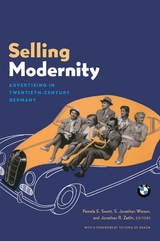
Selling Modernity
Advertising in Twentieth-Century GermanyPamela E. Swett, S. Jonathan Wiesen, and Jonathan R. Zatlin, eds.
Duke University Press, 2007
While the essays are informed by the burgeoning literature on consumer society, Selling Modernity focuses on the actors who had the greatest stake in successful merchandising: company managers, advertising executives, copywriters, graphic artists, market researchers, and salespeople, all of whom helped shape the depiction of a company’s products, reputation, and visions of modern life. The contributors consider topics ranging from critiques of capitalism triggered by the growth of advertising in the 1890s to the racial politics of Coca-Cola’s marketing strategies during the Nazi era, and from the post-1945 career of an erotica entrepreneur to a federal anti-drug campaign in West Germany. Whether analyzing the growing fascination with racialized discourse reflected in early-twentieth-century professional advertising journals or the postwar efforts of Lufthansa to lure holiday and business travelers back to a country associated with mass murder, the contributors reveal advertising’s central role in debates about German culture, business, politics, and society.
Contributors. Shelley Baranowski, Greg Castillo, Victoria de Grazia, Guillaume de Syon, Holm Friebe, Rainer Gries, Elizabeth Heineman, Michael Imort, Anne Kaminsky, Kevin Repp , Corey Ross, Jeff Schutts, Robert P. Stephens, Pamela E. Swett, S. Jonathan Wiesen, Jonathan R. Zatlin

The Nationalization of the Masses
Political Symbolism and Mass Movements in Germany from the Napoleonic Wars Through the Third ReichGeorge L. Mosse
University of Wisconsin Press, 2023