Results by title
2 books match the query 'Deacons'
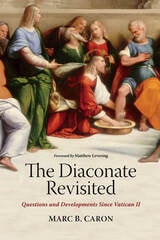
The Diaconate Revisited
Questions and Developments Since Vatican IIMarc B. Caron
Catholic University of America Press, 2026
The sacrament of Holy Orders is the only one of the seven sacraments which exists in three ranks arranged hierarchically, that is, bishops, presbyters, and deacons. Deacons are distinct from both bishops and presbyters, yet united with them in one sacrament. Since the Second Vatican Council, various magisterial documents have limited the priestly dimension of holy orders to bishops and presbyters alone. If deacons do not share in the hierarchical priesthood at all, how are they then related to bishops and to presbyters? In the end, is the diaconate even part of the sacrament of holy orders? This book attempts to show how a ministerial dimension to the character received in ordination to each of the three ranks unites the episcopate, the presbyterate, and the diaconate in a single sacrament. According to the theology of the sacrament of holy orders found in Lumen gentium, the bishop receives the fullness of the sacrament, meaning both its sacerdotal and diaconal or ministerial dimensions. The presbyter then receives a lesser portion than the bishop of both sacerdotal and ministerial dimensions of the sacrament. Finally, the deacon receives an even lesser share than that of the presbyter of the ministerial dimension of holy orders alone. This approach makes clear that the bishop is the greatest servant of the Church as well as its high priest. It challenges presbyters to be of greater service to the Body of Christ than even deacons. The baptismal call to holiness of all the faithful can also be described as having both priestly and ministerial or diaconal dimensions as well. With this understanding, it now becomes clearer how the laity can perform certain functions by delegation which the Church normally entrusts to deacons by ordination. Finally, the unity of the diaconate with the two priestly ranks must inform the current discussions taking place about any possible ordination of women to the sacrament of holy orders in the diaconal rank.
[more]
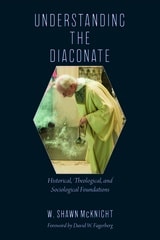
Understanding the Diaconate
Historical, Theological, and Sociological FoundationsW. Shawn McKnight
Catholic University of America Press, 2018
What is a deacon? More than fifty years since the restoration of the permanent diaconate by the Second Vatican Council, the office of deacon is still in need of greater specificity about its purpose and place within the mission and organizational structure of the Church. While the Church is more than a social reality, the Church nonetheless has a social reality. Our understanding of the diaconate therefore benefits from a theological discussion of the divine element of the Church and a sociological examination of the human element. Understanding the Diaconate adds the resources of sociology and anthropology to the theological sources of scripture, liturgy, patristic era texts, theologians, and magisterial teachings to conclude that the deacon can be understood as “social intermediary and symbol of communitas” who serves the participation of the laity in the life and mission of the Church. This research proposes the deacon as a servant of the bond of communion within the Church (facilitating the relationship between the bishop/priest and his people), and between the People of God and the individual in need. Thus authentic diaconal ministry includes a vast array of many concrete contexts of pastoral importance where one does more than simply serve at Mass.
[more]