Results by title
2 books match the query 'Deaf musicians'
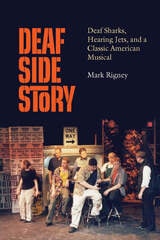
Deaf Side Story
Deaf Sharks, Hearing Jets, and a Classic American MusicalMark Rigney
Gallaudet University Press, 2003
The 1957 classic American musical West Side Story has been staged by countless community and school theater groups, but none more ambitious than the 2000 production by MacMurray College, a small school in Jacksonville, Illinois. Diane Brewer, the new drama head at the college, determined to add an extra element to the usual demands of putting on a show by having deaf students perform half of the parts. Deaf Side Story presents a fascinating narrative of Brewer and the cast’s efforts to mount this challenging play.
Brewer turned to the Illinois School for the Deaf (ISD) to cast the Sharks, the Puerto Rican gang at odds with the Anglo Jets in this musical version of Romeo and Juliet set in the slums of New York. Hearing performers auditioned to be the Jets, and once Brewer had cast her hearing Tony and deaf Maria, then came the challenge of teaching them all to sing/sign and dance the riveting show numbers for which the musical is renowned. She also had to manage a series of sensitive issues, from ensuring the seamless incorporation of American Sign Language into the play to reassuring ISD administrators and students that the production would not be symbolic of any conflict between Deaf and hearing people.
Author Mark Rigney portrays superbly the progress of the production, including the frustrations and triumphs of the leads, the labyrinthine campus and community politics, and the inevitable clashes between the deaf high school cast members and their hearing college counterparts. His representations of the many individuals involved are real and distinguished. The ultimate success of the MacMurray production reverberates in Deaf Side Story as a keen depiction of how several distinct individuals from as many cultures could cooperate to perform a classic American art form brilliantly together.
Music at the Margins of Sense
Jessica A. Holmes
University of Michigan Press, 2026
In Music at the Margins of Sense, Jessica A. Holmes contests prevailing misconceptions associated with deafness and hearing in Western music by turning to the musical experiences of deaf, hard of hearing, and hearing disabled musicians in order to impart a multisensory, multimodal conception of music and musicianship. Through a range of examples drawn from music history, popular music, recent film, and popular science, Holmes reveals that “deafness” is mistakenly understood as a state of total silence and heightened tactile sensation, a stigmatizing trope she calls the “figure of deafness.”
Holmes explores music-making spanning auditory, visual-spatial, vibrotactile, and non-sonorous modalities, including the creative practice of Christine Sun Kim, all-deaf electronic dance music raves, the musical experiences of hearing aid users, and music and musical instruments devised to mitigate tinnitus and hyperacusis. By examining the cultural production of “natural” hearing in the design, branding, and musical programming of digital hearing aids, Holmes offers a reappraisal of hearing that defies naturalized perceptual processes and auditory thresholds, the idealization of sonic fidelity, and biologically driven conceptions of musicality. Music at the Margins of Sense champions an understanding of musicianship that embraces the lived experience of disability as a vital locus of musical creativity and expertise.