Results by title
91 books match the query 'Deaf people' and 8 start with a
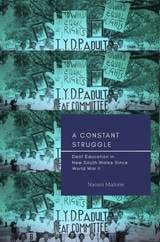
A Constant Struggle
Deaf Education in New South Wales Since World War IINaomi Malone
Gallaudet University Press, 2019

A Fair Chance in the Race of Life
The Role of Gallaudet University in Deaf HistoryBrian H. Greenwald
Gallaudet University Press, 2008
Despite its prominence as a world cultural center and a locus of research on deaf culture, history, education, and language for more than 150 years, Gallaudet University has only infrequently been the focal point of historical study. Eminent historians Brian H. Greenwald and John Vickrey Van Cleve have remedied this scarcity with A Fair Chance in the Race of Life: The Role of Gallaudet University in Deaf History. In this collection, a remarkable cast of scholars examine the university and its various roles through time, many conducting new research in the Gallaudet University Archives, an unsurpassed repository of primary sources of deaf history.
Pulitzer-Prize-winning historian James M. McPherson sets the stage in his essay “A Fair Chance in the Race of Life,” President Abraham Lincoln’s statement when he chartered the first college for deaf students. The papers that follow scrutinize Gallaudet’s long domination by hearing presidents, its struggle to find a place within higher education, its easy acquiescence to racism, its relationship with the federal government, and its role in creating, shaping, and nurturing the deaf community.
These studies do more than simply illuminate the university, however. They also confront broad issues that deal with the struggles of social conformity versus cultural distinctiveness, minority cohesiveness, and gender discrimination. “Deaf” themes, such as the role of English in deaf education, audism, and the paternalism of hearing educators receive analysis as well.
A Mighty Change
An Anthology of Deaf American Writing, 1816 - 1864Christopher Krentz
Gallaudet University Press, 2000
“I need not tell you that a mighty change has taken place within the last half century, a change for the better,” Alphonso Johnson, the president of the Empire State Association of Deaf-Mutes, signed to hundreds of assembled deaf people in 1869. Johnson pointed to an important truth: the first half of the 19th century was a period of transformation for deaf Americans, a time that saw the rise of deaf education and the coalescence of the nation’s deaf community.
This volume contains original writing by deaf people that both directed and reflected this remarkable period of change. It begins with works by Laurent Clerc, the deaf Frenchman who came to the United Sates in 1816 to help found the first permanent school for deaf students in the nation. Partially through is writing, Clerc impressed hearing Americans–most of whom had never met an educated deaf person before–with his intelligence and humanity.
Other deaf writers shared their views with society through the democratic power of print. Included here are selections by James Nack, a deaf poet who surprised readers with his mellifluous verse; John Burnet, who published a book of original essays, fiction, and poetry; Edmund Booth, a frontiersman and journalist; John Carlin, who galvanized the drive for a national college for deaf people; Laura Redden, a high-achieving student who would go on to become an accomplished reporter; and Adele Jewel, a homeless deaf woman living in Michigan.
The final sections contain documents related to deaf events and issues at mid-century: the grand reunion of alumni of the American Asylum for the Deaf in 1850; the dedication of the Thomas Hopkins Gallaudet monument in Hartford; the debate over the viability of a deaf state; and the triumphant inauguration of the National Deaf-Mute College (now Gallaudet University) in 1864, which in many ways culminated this period of change. Taken together, the individual texts in this remarkable collection provide a valuable historical record and a direct glimpse of the experiences, attitudes, and rhetoric of deaf Americans during this time of change.
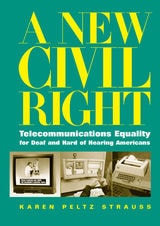
A New Civil Right
Telecommunications Equality for Deaf and Hard of Hearing AmericansKaren Peltz Strauss
Gallaudet University Press, 2006
When three deaf men in the 1960s invented and sold TTYs, the first teletypewriting devices that allowed deaf people to communicate by telephone, they started a telecommunications revolution for deaf people throughout America. A New Civil Right: Telecommunications Equality for Deaf and Hard of Hearing Americans chronicles the history of this movement, which lagged behind new technical developments decades after the advent of TTYs.
In this highly original work, Author Karen Peltz Strauss reveals how the paternalism of the hearing-oriented telecommunications industries slowed support for technology for deaf users. Throughout this comprehensive account, she emphasizes the grassroots efforts behind all of the eventual successes. A New Civil Right recounts each advance in turn, such as the pursuit of special customer premises equipment (SCPE) from telephone companies; the Telecommunications Act of 1982 and the Telecommunications Accessibility Enhancement Act of 1988 and the 1990 Americans with Disabilities Act, which required nationwide relay telephone services for deaf and hard of hearing users.
Strauss painstakingly details how all of these advances occurred incrementally, first on local and state levels, and later through federal law. It took exhaustive campaigning to establish 711 for nationwide relay dialing, while universal access to television captioning required diligent legal and legislative work to pass the Decoder Circuitry Act in 1990. The same persistence resulted in the enactment of the Telecommunications Act of 1996, which required all off-the-shelf communications equipment, including new wireless technology, to be readily accessible to deaf users.
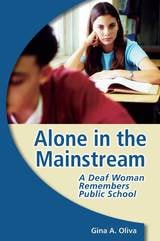
Alone in the Mainstream
A Deaf Woman Remembers Public SchoolGina A. Oliva
Gallaudet University Press, 2004
When Gina Oliva first went to school in 1955, she didn’t know that she was “different.” If the kindergarten teacher played a tune on the piano to signal the next exercise, Oliva didn’t react because she couldn’t hear the music. So began her journey as a “solitary,” her term for being the only deaf child in the entire school. Gina felt alone because she couldn’t communicate easily with her classmates, but also because none of them had a hearing loss like hers. It wasn’t until years later at Gallaudet University that she discovered that she wasn’t alone and that her experience was common among mainstreamed deaf students. Alone in the Mainstream recounts Oliva’s story, as well as those of many other solitaries.
In writing this important book, Oliva combined her personal experiences with responses from the Solitary Mainstream Project, a survey that she conducted of deaf and hard of hearing adults who attended public school. Oliva matched her findings with current research on deaf students in public schools and confirmed that hearing teachers are ill-prepared to teach deaf pupils, they don’t know much about hearing loss, and they frequently underestimate deaf children. The collected memories in Alone in the Mainstream add emotional weight to the conviction that students need to be able to communicate freely, and they also need peers to know they are not alone.
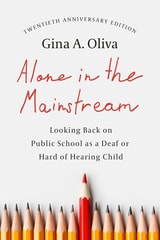
Alone in the Mainstream
Looking Back on Public School as a Deaf or Hard of Hearing ChildGina A. Oliva
Gallaudet University Press, 2024
In Alone in the Mainstream, author Gina A. Oliva documents her experience as a “solitaire,” the only deaf or hard of hearing student in her school. Oliva felt alone because she couldn’t communicate easily with her classmates and because she had no peers who shared a similar experience. As an adult, when she began her career at Gallaudet University, she realized that she wasn’t alone and that her experience was widely shared with other mainstreamed students. She decided to write about this commonality and invited other solitaires to reflect on their own experiences in emails and essays. Collective themes of isolation, low expectations, and low self-esteem emerged. Alone in the Mainstream blends Oliva’s personal narrative with the reflections of sixty other solitaires and makes the case that deaf and hard of hearing children need each other.
This twentieth anniversary edition is a reminder that little has changed for deaf and hard of hearing students in public school settings. Oliva brings this new edition up to date with observations, resources, and discussion questions that accompany her appeal for all deaf and hard of hearing children and their families to have access to sign language, to develop a deaf identity, and to be part of a deaf community.

An Invincible Spirit
The Story of Don FulkDon Fulk, as signed to Janet Allen
Gallaudet University Press, 2019
—Kathleen Kleinman, Executive Director, TRPIL (Transitional Paths to Independent Living)
Profoundly deafened as an infant, Don Fulk didn’t learn his name or go to school until the age of ten. When he was eighteen years old and a budding superstar on his football and basketball teams, he broke his neck in a swimming accident, and became paralyzed. After his injury, he was confined to a bed in his parents’ home for eight years, unable to move and barely able to communicate. After his family could no longer care for him, he spent nine years in a nursing home where he suffered from abuse and neglect.
Yet through a life marred by isolation and frustration, Fulk endured with strength, humor, and grace. He never gave up pursuing his dreams for independence and self-worth, and improving the lives of others. He fought a system that was unfair and discriminatory, and helped pave the way for people with disabilities to live independently. Don Fulk signed his story to author Janet Allen, describing his difficult home life, the incredible friends who changed his life, and his dramatic escape from an abusive nursing home. An Invincible Spirit is a story of hope, empowerment, and the battles people with disabilities have fought—and continue to fight—to improve the quality of their lives.
Assessing Deaf Adults
Critical Issues in Testing and EvaluationJudith L. Mounty
Gallaudet University Press, 2005
Section I frames the contexts facing deaf and hard of hearing individuals and those who test them, including a telling historical perspective. In Section II, chapters explore how deaf and hard of hearing candidates can meet the rigors of test-taking, how to level the playing field with a new approach to assessment, and what to consider to develop fully accessible licensing tests. The final chapter in this part examines the psychometric properties of intellectual assessments when used with deaf and hard of hearing people. Administrative Issues constitute Section III, beginning with legal considerations related to equity testing for deaf adults. An exploration of the potential of sign language interpretation in the testing environment follows.
Section IV provides case studies of deaf and hard of hearing adults from a variety of professions, including certification testing for therapeutic recreation, preparation strategies for university students, and ways to maximize access to licensure for social workers. A separate chapter addresses the impact of recent federal mandates on assessment of deaf and hard of hearing teachers and teaching candidates. The final section summarizes the current situation and presents recommendations to manage it, concluding with an epilogue on directions for the future.