Results by title
5 books match the query 'Dean, Carolyn'
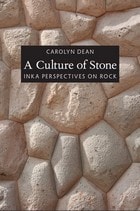
A Culture of Stone
Inka Perspectives on RockCarolyn Dean
Duke University Press, 2010
Art History and Anthropology
Modern Encounters, 1870–1970Peter Probst
J. Paul Getty Trust, The, 2023
While today we are experiencing a revival of world art and the so-called global turn of art history, encounters between art historians and anthropologists remain rare. Even after a century and a half of interactions between these epistemologies, a skeptical distance prevails with respect to the disciplinary other. This volume is a timely exploration of the roots of this complex dialogue, as it emerged worldwide in the colonial and early postcolonial periods, between 1870 and 1970.
Exploring case studies from Australia, Austria, Brazil, France, Germany, and the United States, this volume addresses connections and rejections between art historians and anthropologists—often in the contested arena of “primitive art.” It examines the roles of a range of figures, including the art historian–anthropologist Aby Warburg, the modernist artist Tarsila do Amaral, the curator-impresario Leo Frobenius, and museum directors such as Alfred Barr and René d’Harnoncourt. Entering the current debates on decolonizing the past, this collection of essays prompts reflection on future relations between these two fields.
Indigenous Visual Cultures in Latin America
Seeing, Being, and MeaningEdited by Tamara L. Bray and Carolyn Dean
University of Texas Press, 2026
Reframing the study of Indigenous visual cultures, this volume explores how images and objects generate affect and relation in non-Western contexts, foregrounding alternative modes of material engagement and meaning-making.
While traditional approaches to Indigenous visual cultures have often centered on iconography and representation, this volume turns toward other ways that images and objects act in the world. Indigenous Visual Cultures in Latin America explores how material productions function not merely as signs that point elsewhere but as agents that help shape relationships, environments, and affective experience.
Spanning Mesoamerica, the Andes, and Amazonia from 1500 BCE to the present, the chapters examine how meaning may reside in materials themselves; how making is a form of exchange between maker and matter; and how visual forms participate in configuring relations among humans, ancestors, deities, and place. These works are not passive containers of meaning, but charged presences—generative forces within ongoing worlds. Attuned to Indigenous ways of knowing and being, the volume invites readers to think beyond the frame, beyond the image, and beyond representation itself.
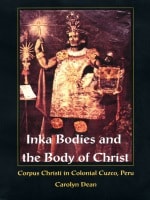
Inka Bodies and the Body of Christ
Corpus Christi in Colonial Cuzco, PeruCarolyn Dean
Duke University Press, 1999
As Dean clearly illustrates, the central rite of the festival—the taking of the Eucharist—symbolized both the acceptance of Christ and the power of the colonizers over the colonized. The most remarkable of Andean celebrants were those who appeared costumed as the vanquished Inka kings of Peru’s pagan past. Despite the subjugation of the indigenous population, Dean shows how these and other Andean nobles used the occasion of Corpus Christi as an opportunity to construct new identities through tinkuy, a native term used to describe the conjoining of opposites. By mediating the chasms between the Andean region and Europe, pagans and Christians, and the past and the present, these Andean elites negotiated a new sense of themselves. Dean moves beyond the colonial period to examine how these hybrid forms of Inka identity are still evident in the festive life of modern Cuzco.
Inka Bodies and the Body of Christ offers the first in-depth analysis of the culture and paintings of colonial Cuzco. This volume will be welcomed by historians of Peruvian culture, art, and politics. It will also interest those engaged in performance studies, religion, and postcolonial and Latin American studies.
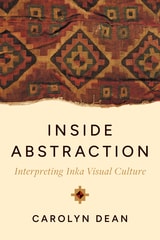
Inside Abstraction
Interpreting Inka Visual CultureCarolyn Dean
University of Texas Press, 2025
2026 PROSE Award for Art History And Criticism, Association of American Publishers
Illuminating the abstract art of the Inka, what it conveys about Inka values, and its relationship to those who view it.
Inka visual culture is unusual in its tendency toward abstraction. Public stonework, vessels used at state feasts, garments worn by the imperial elite—these objects announcing status and power are adorned with geometric designs that refuse figuration. After searching in vain for hidden referents, many scholars have largely given up the search for meaning.
Inside Abstraction develops a novel interpretation. Eminent art historian Carolyn Dean proposes that Inka geometries are neither ornamental nor coded depictions of other objects. Rather, Dean shows that in the Andean world, the designs were functionally self-aware, possessing perspectives of their own, quite literally looking back at and addressing viewers directly. Further, Dean contends that these agent-abstractions were teachers, conveying particular messages concerning social hierarchy: the relations among geometries and colors instructed viewers as to their own proper social relations. Inka designs thereby served imperial aims by wordlessly communicating the state’s values and demands for submission. Extensively illustrated and rigorously argued, Inside Abstraction is a dramatic step forward in our understanding of Inka art and political order.