Results by title
4 books match the query 'Death in art'
American Pietàs
Visions of Race, Death, and the MaternalRuby C. Tapia
University of Minnesota Press, 2010
Tapia explores the implications of this argument for racialized productions of death and the maternal in the context of specific cultural moments: the commemoration of Princess Diana in U.S. magazines; the intertext of Toni Morrison’s and Hollywood’s Beloved; the social and cultural death in teen pregnancy, imaged and regulated in California’s Partnership for Responsible Parenting campaigns; and popular constructions of the “Widows of 9/11” in print and televisual journalism.
Taken together, these various visual media texts function in American Pietàs as cultural artifacts and as visual nodes in a larger network of racialized productions of maternal bodies in contexts of national death and remembering. To engage this network is to ask how and toward what end the racial project of the nation imbues some maternal bodies with resurrecting power and leaves others for dead. In the spaces between these different maternities, says Tapia, U.S. citizen-subjects are born—and reborn.
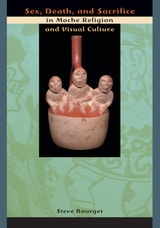
Sex, Death, and Sacrifice in Moche Religion and Visual Culture
By Steve Bourget
University of Texas Press, 2006
The Moche people who inhabited the north coast of Peru between approximately 100 and 800 AD were perhaps the first ancient Andean society to attain state-level social complexity. Although they had no written language, the Moche created the most elaborate system of iconographic representation of any ancient Peruvian culture. Amazingly realistic figures of humans, animals, and beings with supernatural attributes adorn Moche pottery, metal and wooden objects, textiles, and murals. These actors, which may have represented both living individuals and mythological beings, appear in scenes depicting ritual warfare, human sacrifice, the partaking of human blood, funerary rites, and explicit sexual activities.
In this pathfinding book, Steve Bourget raises the analysis of Moche iconography to a new level through an in-depth study of visual representations of rituals involving sex, death, and sacrifice. He begins by drawing connections between the scenes and individuals depicted on Moche pottery and other objects and the archaeological remains of human sacrifice and burial rituals. He then builds a convincing case for Moche iconography recording both actual ritual activities and Moche religious beliefs regarding the worlds of the living, the dead, and the afterlife. Offering a pioneering interpretation of the Moche worldview, Bourget argues that the use of symbolic dualities linking life and death, humans and beings with supernatural attributes, and fertility and social reproduction allowed the Moche to create a complex system of reciprocity between the world of the living and the afterworld. He concludes with an innovative model of how Moche cosmological beliefs played out in the realms of rulership and political authority.
The Great Beyond
Art in the Age of AnnihilationPhilip D. Beidler
University of Alabama Press, 2022
Essays mapping how modern art confronts mortality in an age of war and annihilation.
While much about modernism remains up for debate, there can be no dispute about the connection between modernist art and death. The long modern moment was and is an age of war, genocide, and annihilation. Two world wars killed perhaps as many as 100 million people, through combat, famine, holocaust, and ghastly attacks on civilians. The ongoing COVID-19 pandemic is the fifth global pandemic since 1918, with more than a half-million American deaths and counting.
It can hardly come as a surprise, then, that many of the touchstones of modernism reflect on death and devastation. In Philip D. Beidler’s exploration of the modernist canon, he illuminates how these singular voices looked extinction in the eye and tried to reckon with our finitude—and their own. The Great Beyond: Art in the Age of Annihilation catalogs through lively prose an eclectic selection of artists, writers, and thinkers. In 16 essays, Beidler takes nuanced and surprising approaches to well-studied figures—the haunting sculpture by Saint-Gaudens commissioned by Henry Adams for his late wife; Luchino Visconti’s adaptation of Mann’s Death in Venice; and the author’s own long fascination with Beckett’s Waiting for Godot.
The threads and recurring motifs that emerge through Beidler’s analysis bridge the different media, genres, and timeframes of the works under consideration. Protomodernists Crane and Twain connect with near-contemporary voices like Sebald and Morrison. Robert MacFarlane’s 21st-century nonfiction about what lies underneath the earth echoes the Furerbunker and the poetry of Gertrud Kolmar. Learned but lively, somber but not grim, The Great Beyond is not a comfortable read, but it is in a way comforting. In tracing how his subjects confronted nothingness, be it personal or global, Beidler draws a brilliant map of how we see the end of the road.
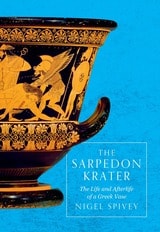
The Sarpedon Krater
The Life and Afterlife of a Greek VaseNigel Spivey
University of Chicago Press, 2019
Spivey takes the reader on a dramatic journey, beginning with the krater’s looting from an Etruscan tomb in 1971 and its acquisition by the Metropolitan Museum of Art, New York, followed by a high-profile lawsuit over its status and its eventual return to Italy. He explains where, how, and why the vase was produced, retrieving what we know about the life and legend of Sarpedon. Spivey also pursues the figural motif of the slain Sarpedon portrayed on the vase and traces how this motif became a standard way of representing the dead and dying in Western art, especially during the Renaissance.
Fascinating and informative, The Sarpedon Krater is a multifaceted introduction to the enduring influence of Greek art on the world.