Results by title
11 books match the query 'Debts, External'
Developing Country Debt and Economic Performance, Volume 1
The International Financial SystemEdited by Jeffrey D. Sachs
University of Chicago Press, 1988
This project on developing country debt, undertaken by the National Bureau of Economic Research, provides a detailed analysis of the ongoing developing country debt crisis. The project focuses on the middle-income developing countries, particularly those in Latin America and East Asia, although many lessons of the study should apply as well to other, poorer debtor countries. The project analyzes the crisis from two perspectives, that of the international financial system as a whole (volume 1) and that of individual debtor countries (volumes 2 and 3).
Developing Country Debt and Economic Performance, Volume 2
Country Studies--Argentina, Bolivia, Brazil, MexicoEdited by Jeffrey D. Sachs
University of Chicago Press, 1990
This project on developing country debt, undertaken by the National Bureau of Economic Research, provides a detailed analysis of the ongoing developing country debt crisis. The project focuses on the middle-income developing countries, particularly those in Latin America and East Asia, although many lessons of the study should apply as well to other, poorer debtor countries. The project analyzes the crisis from two perspectives, that of the international financial system as a whole (volume 1) and that of individual debtor countries (volumes 2 and 3).
This second volume contains lengthy and detailed case studies of four Latin American nations—Argentina, Bolivia, Brazil, and Mexico—providing a wealth of comparative data and new statistics on the general economic development of each nation. The authors explore the various factors that contributed to the debt crisis in each country and analyze how the crisis was managed once it had taken hold. Trenchant economic analyses are enchanced by assessments of the stark political realities behind the policy choices facing each nation.
Developing Country Debt and Economic Performance, Volume 3
Country Studies--Indonesia, Korea, Philippines, TurkeyEdited by Jeffrey D. Sachs and Susan M. Collins
University of Chicago Press, 1990
This project on developing country debt, undertaken by the National Bureau of Economic Research, provides a detailed analysis of the ongoing developing country debt crisis. The project focuses on the middle-income developing countries, particularly those in Latin America and East Asia, although many lessons of the study should apply as well to other, poorer debtor countries. The project analyzes the crisis from two perspectives, that of the international financial system as a whole (volume 1) and that of individual debtor countries (volumes 2 and 3).
This third volume contains lengthy and detailed case studies of four very different Asian countries—Turkey, Indonesia, Korea, and the Philippines.
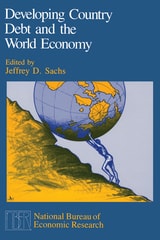
Developing Country Debt and the World Economy
Edited by Jeffrey D. Sachs
University of Chicago Press, 1989
Developing Country Debt and the World Economy contains nontechnical versions of papers prepared under the auspices of the project on developing country debt, sponsored by the National Bureau of Economic Research. The project focuses on the middle-income developing countries, particularly those in Latin America and East Asia, although many lessons of the study should apply as well to other, poorer debtor countries. The contributors analyze the crisis from two perspectives, that of the international financial system as a whole and that of individual debtor countries.
Studies of eight countries—Argentina, Bolivia, Brazil, Indonesia, Mexico, the Philippines, South Korea, and Turkey—explore the question of why some countries succumbed to serious financial crises while other did not. Each study was prepared by a team of two authors—a U.S.-based research and an economist from the country under study. An additional eight papers approach the problem of developing country debt from a global or "systemic" perspective. The topics they cover include the history of international sovereign lending and previous debt crises, the political factors that contribute to poor economic policies in many debtor nations, the role of commercial banks and the International Monetary Fund during the current crisis, the links between debt in developing countries and economic policies in the industrialized nations, and possible new approaches to the global management of the crisis.
Financial Policies and the World Capital Market
The Problem of Latin American CountriesEdited by Pedro Aspe Armella, Rudiger Dornbusch, and Maurice Obstfeld
University of Chicago Press, 1983
The essays brought together in this volume share a common objective: To bring a unifying methodological approach to the analysis of financial problems in developing, open economies. While the primary focus is on contemporary Latin America, the methods employed and the lessons learned are of wider applicability. The papers address the financial integration issue from three different perspectives. In some cases, a country study is the vehicle for an econometric investigation of a particular external linkage. In other cases, an individual country's experience suggests an economic model in which the stylized facts may be analyzed and developed. A third direction is unabashedly theoretical and formulates more general principles which are broadly applicable rather than country-specific.
From the Local to the Global, Third Edition
Key Issues in Development StudiesEdited by Gerard McCann and Stephen McCloskey
Pluto Press, 2015
This completely revised third edition takes stock of the international development environment as it embarks on new policy frameworks to confront new challenges, ensuring that From the Local to the Global will continue to serve as an indispensable introduction to key development issues such as aid, debt, trade, migration, security, gender, and climate change.
Gambling Debt
Iceland's Rise and Fall in the Global EconomyE. Paul Durrenberger
University Press of Colorado, 2014
Gambling Debt is a game-changing contribution to the discussion of economic crises and neoliberal financial systems and strategies. Iceland’s 2008 financial collapse was the first case in a series of meltdowns, a warning of danger in the global order. This full-scale anthropology of financialization and the economic crisis broadly discusses this momentous bubble and burst and places it in theoretical, anthropological, and global historical context through descriptions of the complex developments leading to it and the larger social and cultural implications and consequences.
Chapters from anthropologists, sociologists, historians, economists, and key local participants focus on the neoliberal policies—mainly the privatization of banks and fishery resources—that concentrated wealth among a select few, skewed the distribution of capital in a way that Iceland had never experienced before, and plunged the country into a full-scale economic crisis. Gambling Debt significantly raises the level of understanding and debate on the issues relevant to financial crises, painting a portrait of the meltdown from many points of view—from bankers to schoolchildren, from fishers in coastal villages to the urban poor and immigrants, and from artists to philosophers and other intellectuals.
This book is for anyone interested in financial troubles and neoliberal politics as well as students and scholars of anthropology, sociology, economics, philosophy, political science, business, and ethics.
Publication supported in part by the National Science Foundation.
Contributors:
Vilhjálmur Árnason, Ásmundur Ásmundsson, Jón Gunnar Bernburg, James Carrier, Sigurlína Davíðsdóttir, Dimitra Doukas, Níels Einarsson, Einar Mar Guðmundsson, Tinna Grétarsdóttir, Birna Gunnlaugsdóttir, Guðný S. Guðbjörnsdóttir, Pamela Joan Innes, Guðni Th. Jóhannesson, Örn D. Jónsson, Hannes Lárusson, Kristín Loftsdóttir, James Maguire, Már Wolfgang Mixa, Evelyn Pinkerton, Hulda Proppé, James G. Rice, Rögnvaldur J. Sæmundsson, Unnur Dís Skaptadóttir, Margaret Willson

Global Governance in Question
Empire, Class and the New Common Sense in Managing North-South RelationsSusanne Soederberg
Pluto Press, 2006
William I. Robinson, University of California-Santa Barbara
"[An] acute and revealing examination of the economic difficulties facing the American empire."
Ronnie D. Lipschutz, Professor of Politics, University of California, Santa Cruz
"Indispensable for students of international polical economy and a must for political activists." Professor Elmar Altvater, Department of Political Science, Free University, Berlin
Like many buzzwords, 'global governance' is as poorly understood as it is popular. In contrast to most mainstream accounts, this book examines global economic governance as an integral moment of contemporary capitalism -- presenting a critical insight into its real nature and the interests that it serves.
This book begins by asking what has not been discussed in the mainstream debates and why. Drawing on a Marxist perspective, Soederberg explores neglected issues including transnational debt and the increasingly coercive nature of US aid to so-called Œfailed states'. Soederberg argues that mainstream understandings fail to engage with the wider contradictions that characterise global capitalism. In consequence, there is no explanation of the changing nature of American empire and capitalist power in the world. Furthermore, Soederberg argues that global governance acts to normalise and legitimise increasingly austere forms of capitalist expansion, which may be regarded as a deepening and broadening of neoliberalism.
Susanne Soederberg is a Canada Research Chair in Global Political Economy and Associate Professor in International Development Studies at Queen's University, Kingston, Canada. She is author of The Politics of the New International Financial Architecture: Reimposing Neoliberal Domination in the Global South (Zed, 2005).

Odd Man Out
Readings of the Work and Reputation of Edgar DegasCarol M. Armstrong
University of Chicago Press, 1991
By reading several groups of the artist's images through the lens of a sequence of critical texts, Armstrong shows how our critical and popular expectations of Degas are overturned and subverted. Each of these groups of images is matched to different interpretive moves, each highlighting distinct themes: economics and vocation; narrative and semiotics; gender and corporeality; and the author and self. Armstrong's provocative analysis celebrates the tantalizing qualities of the artist's elusive career: the pluralism of his work, its conflation of positivistic and negational tactics, the modern and the traditional, the abstract and the representational.
"A lucid and searching study. . . . Armstrong has produced one of the most elegant and persuasive examples of the historian's use of 19th-century art criticism. In the process, she has achieved a reading of the artist which makes a difference to the way we understand the difference of Degas himself."—Neil McWilliam, Times Higher Education Supplement
"This is a brilliant, original, and beautifully articulated study. Carol Armstrong's scholarship is impressive in its richness, ambition, and sophistication: Degas's works have rarely been given such detailed, penetrating, and suggestive readings as those offered in this book."—Linda Nochlin, Yale University
"With brilliant insight and incisive analytical intelligence, Carol Armstrong introduces new ways to conceptualize the structural ambiguities of Degas's work. Her subtle and probing readings clarify the fundamental contrariness of Degas's images—their disturbing negativity, their anti-modern modernism. Odd Man Out catapults the criticism of Degas from the hinterlands of traditional art history to the foreground of contemporary critical theory in both literature and the visual arts."—Charles Bernheimer, University of Pennsylvania
Other People's Money
Debt Denomination and Financial Instability in Emerging Market EconomiesEdited by Barry Eichengreen and Ricardo Hausmann
University of Chicago Press, 2005
Presenting evidence that even emerging markets with strong policies and institutions experience this problem, Other People's Money recognizes that the situation must be attributed to more than ignorance. Instead, the contributors suggest that the problem is linked to the operation of international financial markets, which prevent countries from borrowing in their own currencies. A comprehensive analysis of the sources of this problem and its consequences, Other People's Money takes the study one step further, proposing a solution that would involve having the World Bank and regional development banks themselves borrow and lend in emerging market currencies.
The International Monetary Fund and Latin America
The Argentine Puzzle in ContextClaudia Kedar
Temple University Press, 2013
The International Monetary Fund (IMF) has played a critical role in the global economy since the postwar era. But, claims Claudia Kedar, behind the strictly economic aspects of the IMF’s intervention, there are influential interactions between IMF technocrats and local economists—even when countries are not borrowing money.
In The International Monetary Fund and Latin America, Kedar seeks to expose the motivations and constraints of the operations of both the IMF and borrowers. With access to never-before-seen archive materials, Kedar reveals both the routine and behind-the-scenes practices that have depicted International Monetary Fund–Latin American relations in general and the asymmetrical IMF-Argentina relations in particular.
Kedar also analyzes the “routine of dependency” that characterizes IMF-borrower relations with several Latin American countries such as Chile, Peru, and Brazil. The International Monetary Fund and Latin America shows how debtor countries have adopted IMF’s policies during past decades and why Latin American leaders today largely refrain from knocking at the IMF’s doors again.