Results by title

8 books match the query 'Debts, Public'
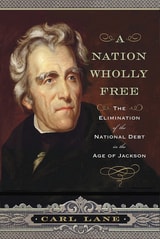
cover of A Nation Wholly Free: The Elimination of the National Debt in the Age of Jackson

A Nation Wholly Free

The Elimination of the National Debt in the Age of Jackson

Carl Lane

Westholme Publishing, 2014

The Only Time America Was Free of Debt—and How It Led to the Two-Party Political System
“An engaging treatment of a topic of perennial concern and frequent misunderstanding, this lucid tale of the brief moment when the United States was debt-free should be on every Congress member’s bedside table.”—Peter J.Woolley, Professor of Comparative Politics, Fairleigh Dickinson University
When President James Monroe announced in his 1824 message to Congress that, barring an emergency, the large public debt inherited from the War for Independence, the Louisiana Purchase, and the War of 1812 would be extinguished on January 1, 1835, Congress responded by crafting legislation to transform that prediction into reality. Yet John Quincy Adams,Monroe’s successor, seemed not to share the commitment to debt freedom, resulting in the rise of opposition to his administration and his defeat for reelection in the bitter presidential campaign of 1828. The new president, Andrew Jackson, was thoroughly committed to debt freedom, and when it was achieved, it became the only time in American history when the country carried no national debt. In A Nation Wholly Free: The Elimination of the National Debt in the Age of Jackson, award-winning economic historian Carl Lane shows that the great and disparate issues that confronted Jackson, such as internal improvements, the “war” against the Second Bank of the United States, and the crisis surrounding South Carolina’s refusal to pay federal tariffs, become unified when debt freedom is understood as a core element of Jacksonian Democracy.
The era of debt freedom lasted only two years and ten months. As the government accumulated a surplus, a fully developed opposition party emerged—the beginning of our familiar two-party system—over rancor about how to allocate the newfound money. Not only did government move into an oppositional party system at this time, the debate about the size and role of government distinguished the parties in a pattern that has become familiar to Americans. The partisan debate over national debt and expenditures led to poorly thought out legislation, forcing the government to resume borrowing. As a result, after Jackson left office in 1837, the country fell into a major depression. Today we confront a debt that exceeds $17 trillion. Indeed, we have been borrowing ever since that brief time we freed ourselves from an oversized debt. A thoughtful, engaging account with strong relevance to today, A Nation Wholly Free is the fascinating story of an achievement that now seems fanciful.

[more]
cover of Colonial Debts: The Case of Puerto Rico

Colonial Debts

The Case of Puerto Rico

Rocío Zambrana

Duke University Press, 2021
With the largest municipal debt in US history and a major hurricane that destroyed much of the archipelago's infrastructure, Puerto Rico has emerged as a key site for the exploration of neoliberalism and disaster capitalism. In Colonial Debts Rocío Zambrana develops the concept of neoliberal coloniality in light of Puerto Rico's debt crisis. Drawing on decolonial thought and praxis, Zambrana shows how debt functions as an apparatus of predation that transforms how neoliberalism operates. Debt functions as a form of coloniality, intensifying race, gender, and class hierarchies in ways that strengthen the colonial relationship between Puerto Rico and the United States. Zambrana also examines the transformation of protest in Puerto Rico. From La Colectiva Feminista en Construcción's actions, long-standing land rescue/occupation in the territory, to the July 2019 protests that ousted former governor Ricardo “Ricky” Rosselló, protests pursue variations of decolonial praxis that subvert the positions of power that debt installs. As Zambrana demonstrates, debt reinstalls the colonial condition and adapts the racial/gender order essential to it, thereby emerging as a key site for political-economic subversion and social rearticulation.
[more]
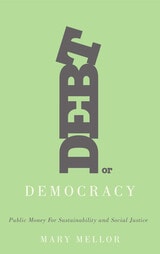
cover of Debt or Democracy: Public Money for Sustainability and Social Justice

Debt or Democracy

Public Money for Sustainability and Social Justice

Mary Mellor

Pluto Press, 2015

In the wake of the global financial crisis, most of the discussion has been focused on questions of debt. And the response, almost uniformly, has been austerity and privatization: cuts to services that have been painted as forms of reckless spending by a bloated public sector. In Debt or Democracy, Mary Mellor turns the whole conversation upside down, showing that the important question is not who owes what, but who controls the creation and circulation of money in the first place. When the problem is examined from that angle, it becomes clear that privatization, far from being the answer to our problem, is the very source of it—the subordination of public finance to private interest.
 
A direct challenge to conventional economic thinking, Debt or Democracy offers a bracing new analysis of our economic crisis and offers cogent, radical alternatives to create a more just and sustainable economic future.

[more]
cover of Deficit and Debt in Transition: The Political Economy of Public Finances in Central and Eastern Europe

Deficit and Debt in Transition

The Political Economy of Public Finances in Central and Eastern Europe

Istvan Benczes

Central European University Press, 2014
The adjustment problems of public finance in countries of Central and Eastern Europe (CEE) are often misunderstood and misinterpreted by western scholars. This book contributes to the bridging of the gap between what is being thought by external observers and what the actual public finance reality is, as described by competent local scholars. Popular political economy research has remained biased towards advanced countries and has neglected developing and transition economies. Publications on CEE countries' public finances seem to be reluctant to apply the conceptual framework of standard political economy to these countries because of the assumption that CEE economies are different from their Western peers. But is this really the case? Are CEE economies so much different that none of the well-known "Western" political economy concepts or models can be applied to the analysis of fiscal performance in the region? Benczes demonstrates that they can be safely applied in the context of CEE economies as well. He sees no need to develop a separate or unique theory designed for the study and understanding of (one-time) transition economies.
[more]
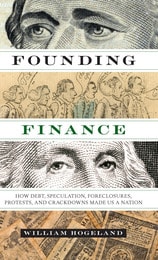
cover of Founding Finance: How Debt, Speculation, Foreclosures, Protests, and Crackdowns Made Us a Nation

Founding Finance

How Debt, Speculation, Foreclosures, Protests, and Crackdowns Made Us a Nation

By William Hogeland

University of Texas Press, 2014

Recent movements such as the Tea Party and anti-tax “constitutional conservatism” lay claim to the finance and taxation ideas of America’s founders, but how much do we really know about the dramatic clashes over finance and economics that marked the founding of America? Dissenting from both right-wing claims and certain liberal preconceptions, Founding Finance brings to life the violent conflicts over economics, class, and finance that played directly, and in many ways ironically, into the hardball politics of forming the nation and ratifying the Constitution—conflicts that still continue to affect our politics, legislation, and debate today.

Mixing lively narrative with fresh views of America’s founders, William Hogeland offers a new perspective on America’s economic infancy: foreclosure crises that make our current one look mild; investment bubbles in land and securities that drove rich men to high-risk borrowing and mad displays of ostentation before dropping them into debtors’ prisons; depressions longer and deeper than the great one of the twentieth century; crony mercantilism, war profiteering, and government corruption that undermine any nostalgia for a virtuous early republic; and predatory lending of scarce cash at exorbitant, unregulated rates, which forced people into bankruptcy, landlessness, and working in the factories and on the commercial farms of their creditors. This story exposes and corrects a perpetual historical denial—by movements across the political spectrum—of America’s all-important founding economic clashes, a denial that weakens and cheapens public discourse on American finance just when we need it most.
[more]
cover of In the Red: The Politics of Public Debt Accumulation in Developed Countries

In the Red

The Politics of Public Debt Accumulation in Developed Countries

Zsófia Barta

University of Michigan Press, 2018

Why do rich countries flirt with fiscal disaster? Between the 1970s and the 2000s, during times of peace and prosperity, affluent countries—like Belgium, Greece, Italy, and Japan—accumulated so much debt that they became vulnerable and exposed themselves to the risk of default. In the past three decades, an extensive scholarly consensus emerged that these problems were created by fiscal indiscipline, the lack of sufficient concern for budgetary constraints from policy makers as they try to please voters. This approach formed the foundation for the fiscal surveillance system that attempted to bring borrowing in European countries under control via a set of fiscal rules. In the Red demonstrates that the problem of sustained, large-scale debt accumulation is an adjustment issue rather than a governance failure. Irrespective of whether the original impetus for borrowing arose from exogenous changes or irresponsible decision making, policy makers invariably initiate spending cuts and/or tax increases when debt grows at an alarming rate for several years in a row. Zsófia Barta argues that explaining why some countries accumulate substantial amounts of debt for decades hinges on understanding the conditions required to allow policy makers to successfully put into place painful adjustment measures.
[more]
cover of Settler Garrison: Debt Imperialism, Militarism, and Transpacific Imaginaries

Settler Garrison

Debt Imperialism, Militarism, and Transpacific Imaginaries

Jodi Kim

Duke University Press, 2022

In Settler Garrison Jodi Kim theorizes how the United States extends its sovereignty across Asia and the Pacific in the post-World War II era through a militarist settler imperialism that is leveraged on debt as a manifold economic and cultural relation undergirded by asymmetries of power. Kim demonstrates that despite being the largest debtor nation in the world, the United States positions itself as an imperial creditor that imposes financial and affective indebtedness alongside a disciplinary payback temporality even as it evades repayment of its own debts. This debt imperialism is violently reproduced in juridically ambiguous spaces Kim calls the “settler garrison”: a colonial archipelago of distinct yet linked military camptowns, bases, POW camps, and unincorporated territories situated across the Pacific from South Korea to Okinawa to Guam. Kim reveals this process through an analysis of how a wide array of transpacific cultural productions creates antimilitarist and decolonial imaginaries that diagnose US militarist settler imperialism while envisioning alternatives to it.
[more]
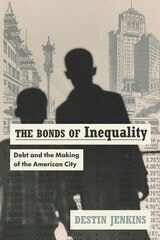
cover of The Bonds of Inequality: Debt and the Making of the American City

The Bonds of Inequality

Debt and the Making of the American City

Destin Jenkins

University of Chicago Press, 2021

Indebtedness, like inequality, has become a ubiquitous condition in the United States. Yet few have probed American cities’ dependence on municipal debt or how the terms of municipal finance structure racial privileges, entrench spatial neglect, elide democratic input, and distribute wealth and power.

In this passionate and deeply researched book, Destin Jenkins shows in vivid detail how, beyond the borrowing decisions of American cities and beneath their quotidian infrastructure, there lurks a world of politics and finance that is rarely seen, let alone understood. Focusing on San Francisco, The Bonds of Inequality offers a singular view of the postwar city, one where the dynamics that drove its creation encompassed not only local politicians but also banks, credit rating firms, insurance companies, and the national municipal bond market. Moving between the local and the national, The Bonds of Inequality uncovers how racial inequalities in San Francisco were intrinsically tied to municipal finance arrangements and how these arrangements were central in determining the distribution of resources in the city. By homing in on financing and its imperatives, Jenkins boldly rewrites the history of modern American cities, revealing the hidden strings that bind debt and power, race and inequity, democracy and capitalism.
 
[more]