Results by title
114 books match the query 'Decision Making' and 5 start with a

A Starter's Guide for Academic Library Leaders
Advice in ConversationAmanda Clay Powers
American Library Association, 2019
The path towards leadership starts with you. But you don’t have to go it alone. For this book, the authors sat down with many of the library leaders they most admire for a series of conversations about the aspects of the job that they find the most fascinating (and challenging). Much like the chats you might have over coffee at a conference or with a mentor, these frank discussions will nourish you with nuts-and-bolts wisdom on a diverse range of academic library management issues. Among the topics and situations broached are
- balancing personal values against the common refrain “you don’t get to be who you want to be in positions like ours”;
- five questions to ask that reveal much about organizational culture and climate;
- creating a culture of change, including why a newly promoted director chose to make the most drastic changes in the first 100 days;
- forming a “dean team” to help frame responses with consideration to institutional culture;
- the value of demystifying the budget for the entire library staff;
- using tools such as a personal “learning journal” to fuel professional development;
- cultivating a personal network by setting up meetings at local libraries during conferences;
- the risks that result from jumping into a situation too fast and boxing yourself into a corner;
- lessons learned from failed initiatives;
- examples of navigating controversies, such as a director’s response to a WPA mural with a racist message; and
- managing facilities, with an example of how injecting a previously ignored library voice into a building project led to a tripling of the space.
Between these covers you’ll find guidance, ideas, and inspiration as you continue your leadership journey.
AUTHORIZING POLICY
Thad Hall
The Ohio State University Press, 2004
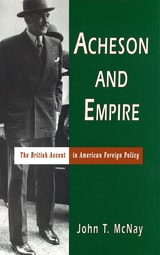
Acheson and Empire
The British Accent in American Foreign PolicyJohn T. McNay
University of Missouri Press, 2001
Acheson and Empire offers a compelling reassessment of Dean Acheson's policies toward the former colonial world during his period as secretary of state from 1949 to 1953. John T. McNay argues that Acheson inherited through his own personal history a way of understanding the world that encouraged imperial-style international relationships. This worldview represented a well-developed belief system rooted in his Ulster Protestant heritage that remained consistent throughout his life.
By exploring relationships of the United States with Britain and countries formerly or then controlled by Britain, such as India, Ireland, Iran, and Egypt, McNay shows the significance of Acheson's beliefs. McNay argues that Acheson's support of existing imperial relationships was so steadfast that it often led other nations to perceive that the United States was nothing more than a front for British interests. He believes this approach to foreign policy damaged American relations with emerging countries and misled the British regarding possibilities of an Anglo-American partnership.
Acheson and Empire contends that the widely accepted view of Acheson as a foreign policy realist is misleading and that historians should acknowledge that his affinity for the British Empire went beyond his clothing and mannerisms. McNay maintains that the widely accepted view of Acheson as one of a group of "wise men" who shaped the Cold War world by basing their decisions on cold calculation of American interests should be reconsidered.
Drawing from extensive research in archival sources, including the Truman Library, the National Archives, the Public Record Office in London, and Acheson's personal papers at Yale, Acheson and Empire offers a fresh look at Dean Acheson that runs counter to previous biographies and many histories of the Cold War.

Augmented Exploitation
Artificial Intelligence, Automation and WorkPhoebe Moore
Pluto Press, 2021

Avoiding Losses/Taking Risks
Prospect Theory and International ConflictBarbara Farnham, Editor
University of Michigan Press, 1995
This volume is a comprehensive examination of the benefits and potential pitfalls of employing prospect theory---a leading alternative to expected utility as a theory of decision under risk---to understand and explain political behavior. The collection brings together both theoretical and empirical studies, thus grounding the conclusions about prospect theory's potential for enriching political analyses in an assessment of its performance in explaining actual cases.
The theoretical chapters provide an overview of the main hypotheses of prospect theory: people frame risk-taking decisions around a reference point, they tend to accept greater risk to prevent losses than to make gains, and they often perceive the devastation of a loss as greater than the benefit of a gain. The three case studies---Roosevelt's decision-making during the Munich crisis of 1938, Carter's April 1980 decision to rescue the American hostages in Iran, and Soviet behavior toward Syria in 1966-67---generally support these hypotheses. Nevertheless, the authors are frank about potentially difficult conceptual and methodological problems, making explicit reference to alternative explanations, such as the rational actor model, which posits the maximization of expected value.
Contributors to the volume include Jack Levy, Robert Jervis, Barbara Farnham, Rose McDermott, Audrey McInerney, and Eldar Shafir.