Results by title
3 books match the query 'Decision-making'
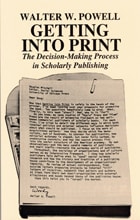
Getting into Print
The Decision-Making Process in Scholarly PublishingWalter W. Powell
University of Chicago Press, 1985
Based on extensive fieldwork at two well-known commercial publishers of scholarly books, Walter W. Powell details the different ways in which both internal politics and external networks influence decisions about what should be published. Powell focuses on the work of acquisitions editors: how they decide which few manuscripts, out of hundreds, to sponsor for publication; how editorial autonomy is shaped, but never fully curbed, by unobtrusive controls; and how the search process fits into the social structure of the American academy. Powell's observations—and the many candid remarks of publishers and their staffs—recreate the workaday world of publishing.
Throughout, the sociology of organizations and of culture serves as Powell's interpretive framework. Powell shows how scholarly publishers help define what is "good" social science research and how the history and tradition of a publishing house contribute to the development of an organizational identity. Powell's review of actual correspondence, from outside letters proposing projects to internal "kill" letters of rejection, suggests that editors and authors at times form their own quasi-organization with external allegiances and bonds beyond those of the publishing house.
"This is a welcome addition to the literature on the life of the organizations that produce our science and our culture. Powell's intimate look at two scholarly publishing companies has an insider's appreciation of the book business and an outsider's eye for questions the editors are not asking themselves."—Michael Schudson, University of California at San Diego
"Getting Into Print will long be the book about how academic editors choose the titles they sponsor. Even experienced editors and authors will find new insights here and revealing comparisons with decision-making in other kinds of organizations."—Edward Tenner, Los Angeles Times Book Review
"Getting Into Print is an unusually outstanding ethnographic study in that it reflects the evocative richness of detail associated with the ethnographic approach while simultaneously maintaining a clear-headed, analytical distance from the subject that allows for a meaningful theoretical contribution. Powell is an astute ethnographer who presents a vital and compelling 'insider's view' of the decision-making process in scholarly publishing, making this book fascinating reading for all those involved in the 'publish-or-perish' syndrome."—Barbara Levitt, American Journal of Sociology
[more]
Politics and Economics in the Eighties
Edited by Alberto Alesina and Geoffrey Carliner
University of Chicago Press, 1991
Is the federal budget deficit a result of congressional deadlocks, gross miscalculation of economic trends, or a Republican strategy to tie the budgetary hands of future Democratic leadership? To what extend does the partisan split between Congress and the executive branch constrain the president's agenda? In this volume, political scientists and economists tackle these and many other contentious issues, offering a variety of analytical perspectives.
Certain to provoke controversy, this interdisciplinary volume brings together policy experts to provide a coherent analysis of the most important economic policy changes of the 1980s. Through a detailed examination of voting patterns, monetary and fiscal policies, welfare spending, tax reform, minimum wage legislation, the savings and loan collapse, and international trade policy, the authors explore how politics can influence the direction of economic policymaking.
Certain to provoke controversy, this interdisciplinary volume brings together policy experts to provide a coherent analysis of the most important economic policy changes of the 1980s. Through a detailed examination of voting patterns, monetary and fiscal policies, welfare spending, tax reform, minimum wage legislation, the savings and loan collapse, and international trade policy, the authors explore how politics can influence the direction of economic policymaking.
[more]

Special Care
Medical Decisions at the Beginning of LifeFred M. Frohock
University of Chicago Press, 1986
Intensive care medicine today is as close to the miraculous as most of us are likely to see in our lifetime. Nowhere is this magic more effectively practiced than in neonatal nurseries. Infants who are born prematurely at twenty-four weeks gestation and who weigh less than a pound can now be treated successfully. No other type of medicine has a more dramatic payoff, for the infants who survive can look forward to seventy or more years of life.
But there is a dark underside to the exercise of these skills. A growing number of babies live only to be tethered to life-support systems, unconscious or suffering incessant pain for years and sometimes for the duration of their lives. The ethical issues raised by these children are among the most difficult in our society. Should life be maintained no matter what its quality? Or is there a point at which treatment should be stopped on humane grounds? Who is to make decisions on continuing or ending therapy for damaged children? Is the law a suitable instrument for regulating medical decisions in intensive care nurseries? Should the growing cost of intensive care influence therapy decisions?
Special Care explores the moral and legal issues in neonatal intensive care. Fred M. Frohock spent four months in a special care nursery, observing the daily actions of doctors and nurses and interviewing staff and parents of patients. This engaging, human drama is told through the author's own journal entries interspersed with generous excerpts from taped interviews that display the practical reasoning of staff and parents as they address the moral problems raised by intensive care medicine. Several case studies of infants highlight the often contradictory directions in which medical staffs are pulled and the painful decisions that doctors and parents together are often called upon to make. The result is a book that reconstructs the ordinary life of a neonatal nursery and presents the moral views of those who are most intimately involved in therapy decisions.
This book is an urgently needed entry in the current discussions of treatment for badly damaged babies. Frohock argues that our tradition of rights language, which rests on the premise that we know what a human being is, is inappropriate when dealing with the paradoxes of decision making in neonatal nurseries. Calling for a new moral vocabulary better adapted to the world of medicine, he introduces the notion of harm in place of rights, a concept drawn from medicine's Hippocratic oath that pledges to "do no harm," as a way to begin framing questions and making decisions. Special Care will interest anyone who wants to understand medical decisions at the margins of human life.
[more]