Results by title
104 books match the query 'Deconstruction' and 6 start with a

A Blessed Rage for Order
Deconstruction, Evolution, and ChaosAlexander J. Argyros
University of Michigan Press, 1992

After Poststructuralism
Transitions and TransformationsEdited by Rosi Braidotti
University of Chicago Press, 2010
From Kant to Kierkegaard, from Hegel to Heidegger, continental philosophers have indelibly shaped the trajectory of Western thought since the eighteenth century. Although much has been written about these monumental thinkers, students and scholars lack a definitive guide to the entire scope of the continental tradition. The most comprehensive reference work to date, this eight-volume History of Continental Philosophy will both encapsulate the subject and reorient our understanding of it. Beginning with an overview of Kant’s philosophy and its initial reception, the History traces the evolution of continental philosophy through major figures as well as movements such as existentialism, phenomenology, hermeneutics, and poststructuralism. The final volume outlines the current state of the field, bringing the work of both historical and modern thinkers to bear on such contemporary topics as feminism, globalization, and the environment. Throughout, the volumes examine important philosophical figures and developments in their historical, political, and cultural contexts.
The first reference of its kind, A History of Continental Philosophy has been written and edited by internationally recognized experts with a commitment to explaining complex thinkers, texts, and movements in rigorous yet jargon-free essays suitable for both undergraduates and seasoned specialists. These volumes also elucidate ongoing debates about the nature of continental and analytic philosophy, surveying the distinctive, sometimes overlapping characteristics and approaches of each tradition. Featuring helpful overviews of major topics and plotting road maps to their underlying contexts, A History of Continental Philosophy is destined to be the resource of first and last resort for students and scholars alike.
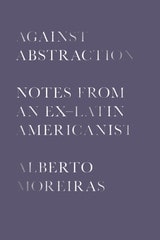
Against Abstraction
Notes from an Ex-Latin AmericanistBy Alberto Moreiras
University of Texas Press, 2020
In 2015, members of the philosophy department at the University of Madrid conducted an interview with Alberto Moreiras for the university’s digital archive. The resulting dialogues and the Spanish edition of this work, Marranismo e inscripción, o el abandono de la conciencia desdichada, are the basis for Against Abstraction, supplemented with an interview conducted for the Chilean journal Papel máquina. In these landmark conversations, Moreiras describes how, though he was initially committed to Latin American literary studies, he eventually transitioned to become an eminent scholar of critical theory, existential philosophy, and ultimately infrapolitics and posthegemony.
Blending intellectual autobiography with a survey of Hispanism as practiced in universities in the United States (including the schisms in Latin American subaltern studies that eventually led to Moreiras’s departure from Duke University), these narratives read like a picaresque and a polemic on the symbolic power of scholars. Drawing on the concept of marranism (originally a term for Iberian Jews and Muslims forced to convert to Christianity during the Middle Ages) to consider the situations and allegiances he has navigated over the years, Moreiras has produced a multifaceted self-portrait that will surely spark further discourse.

Archive Fever
A Freudian ImpressionJacques Derrida
University of Chicago Press, 1996
"Judaic mythos, Freudian psychoanalysis, and e-mail all get fused into another staggeringly dense, brilliant slab of scholarship and suggestion."—The Guardian
"[Derrida] convincingly argues that, although the archive is a public entity, it nevertheless is the repository of the private and personal, including even intimate details."—Choice
"Beautifully written and clear."—Jeremy Barris, Philosophy in Review
"Translator Prenowitz has managed valiantly to bring into English a difficult but inspiring text that relies on Greek, German, and their translations into French."—Library Journal

Archive Fever
A Freudian ImpressionJacques Derrida
University of Chicago Press, 1996
"Judaic mythos, Freudian psychoanalysis, and e-mail all get fused into another staggeringly dense, brilliant slab of scholarship and suggestion."—The Guardian
"[Derrida] convincingly argues that, although the archive is a public entity, it nevertheless is the repository of the private and personal, including even intimate details."—Choice
"Beautifully written and clear."—Jeremy Barris, Philosophy in Review
"Translator Prenowitz has managed valiantly to bring into English a difficult but inspiring text that relies on Greek, German, and their translations into French."—Library Journal
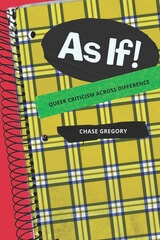
As If!
Queer Criticism Across DifferenceChase Gregory
Duke University Press, 2025