Results by title
8 books match the query 'Deep Time'
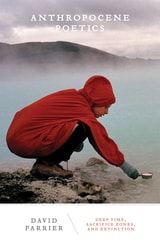
Anthropocene Poetics
Deep Time, Sacrifice Zones, and ExtinctionDavid Farrier
University of Minnesota Press, 2019
How poetry can help us think about and live in the Anthropocene by reframing our intimate relationship with geological time
The Anthropocene describes how humanity has radically intruded into deep time, the vast timescales that shape the Earth system and all life-forms that it supports. The challenge it poses—how to live in our present moment alongside deep pasts and futures—brings into sharp focus the importance of grasping the nature of our intimate relationship with geological time. In Anthropocene Poetics, David Farrier shows how contemporary poetry by Elizabeth Bishop, Seamus Heaney, Evelyn Reilly, and Christian Bök, among others, provides us with frameworks for thinking about this uncanny sense of time.
Looking at a diverse array of lyric and avant-garde poetry from three interrelated perspectives—the Anthropocene and the “material turn” in environmental philosophy; the Plantationocene and the role of global capitalism in environmental crisis; and the emergence of multispecies ethics and extinction studies—Farrier rethinks the environmental humanities from a literary critical perspective. Anthropocene Poetics puts a concern with deep time at the center, defining a new poetics for thinking through humanity’s role as geological agents, the devastation caused by resource extraction, and the looming extinction crisis.
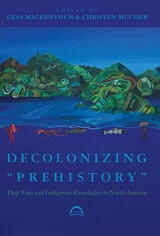
Decolonizing “Prehistory”
Deep Time and Indigenous Knowledges in North AmericaEdited by Gesa Mackenthun and Christen Mucher
University of Arizona Press, 2021
Constructions of America’s ancient past—or the invention of American “prehistory”—occur in national and international political frameworks, which are characterized by struggles over racial and ethnic identities, access to resources and environmental stewardship, the commodification of culture for touristic purposes, and the exploitation of Indigenous knowledges and histories by industries ranging from education to film and fashion. The past’s ongoing appeal reveals the relevance of these narratives to current-day concerns about individual and collective identities and pursuits of sovereignty and self-determination, as well as to questions of the origin—and destiny—of humanity. Decolonizing “Prehistory” critically examines and challenges the paradoxical role that modern scholarship plays in adding legitimacy to, but also delegitimizing, contemporary colonialist practices.
Contributors: Rick Budhwa, Keith Thor Carlson, Kirsten Matoy Carlson, Jessica Christie, Philip J. Deloria, Melissa Gniadek, Annette Kolodny, Gesa Mackenthun, Christen Mucher, Naxaxalhts’i (aka Sonny McHalsie), Jeff Oliver, Mathieu Picas, Daniel Lord Smail, Coll Thrush
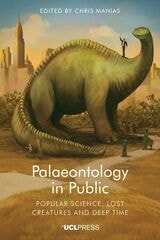
Palaeontology in Public
Popular Science, Lost Creatures and Deep TimeEdited by Chris Manias
University College London, 2025
From towering dinosaurs to early human ancestors, paleontology has long captured the public imagination, yet its scientific standing has often been precarious. Palaeontology in Public studies how paleontology’s public presence has shaped both the field itself and broader cultural understandings of science and nature. Through case studies spanning two centuries, this book explores the deep entanglement between vertebrate paleontology and popular culture, from early fossil discoveries to modern cinematic depictions.
Dinosaurs naturally take center stage, taking Spinosaurus, Jurassic Park, and Winsor McCay’s Gertie the Dinosaur, for instance. However, equally important are the stories of Glyptodons, Mesozoic mammals, and early human fossils like Neanderthals and Australopithecus. The book draws from history, art, literature, archaeology, and science communication to depict how public fascination has fueled scientific discovery while also shaping our collective vision of life’s ancient past.
A compelling read for historians of science, paleontologists, and those with a special interest in prehistoric creatures, Palaeontology in Public highlights the enduring power of fossils also as cultural icons that continue to inspire and spark debate.
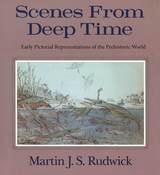
Scenes from Deep Time
Early Pictorial Representations of the Prehistoric WorldMartin J. S. Rudwick
University of Chicago Press, 1992
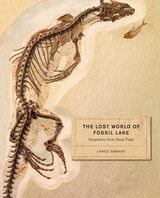
The Lost World of Fossil Lake
Snapshots from Deep TimeLance Grande
University of Chicago Press, 2013
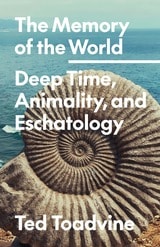
The Memory of the World
Deep Time, Animality, and EschatologyTed Toadvine
University of Minnesota Press, 2024
Advancing a phenomenological approach to deep time
Our imagination today is dominated by the end of the world, from sci-fi and climate fiction to actual predictions of biodiversity collapse, climate disruption, and the emergence of the Anthropocene. This obsession with the world’s precarity, The Memory of the World contends, relies on a flawed understanding of time that neglects the past and present with the goal of managing the future. Not only does this mislead sustainability efforts, it diminishes our encounters with the world and with human and nonhuman others.
Here, Ted Toadvine takes a phenomenological approach to deep time to show how our apocalyptic imagination forgets the sublime and uncanny dimensions of the geological past and far future. Guided by original readings of Maurice Merleau-Ponty, Emmanuel Levinas, Jacques Derrida, Jean-Luc Nancy, and others, he suggests that reconciling our embodied lives with the memory of the earth transforms our relationship with materiality, other forms of life, and the unprecedented future.
Integrating insights from phenomenology, deconstruction, critical animal studies, and new materialism, The Memory of the World argues for a new philosophy of time that takes seriously the multiple, pleated, and entangled temporal events spanning cosmic, geological, evolutionary, and human durations.
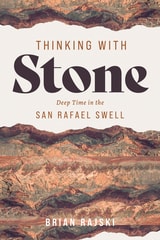
Thinking with Stone
Deep Time in the San Rafael SwellBrian Rajski
University of Utah Press, 2026
An intellectual journey through 250 million years of stone
In the San Rafael Swell, geologic forces have tilted and exposed the strata so that over 250 million years of geologic history can be observed simply by traveling across the rocky landscape, with its dramatic variety of colors and forms. Largely neglected by visitors to the state’s national parks and monuments and overlooked by many nature writers of the Colorado Plateau, the exceptional “Swell” offers a unique opportunity to think about people’s connections to the layers of earth beneath our feet.
Thinking with Stone takes readers on an intellectual journey across the Swell, moving from the youngest rocks at its edges to the oldest near its center and guiding readers through the features and histories of each geological layer. Drawing on personal experience and scientific research, Brian Rajski explores how creatively engaging with geology by using rocks as the foundation for thinking can generate new ideas about art, ethics, and the environment. Ultimately, the book reimagines the relationships between history and deep time, humanity and geology, and the individual and the stories told by stone.
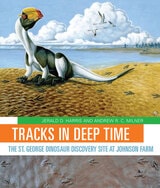
Tracks in Deep Time
The St. George Dinosaur Discovery Site at Johnson FarmJerald D. Harris and Andrew R. Milner
University of Utah Press, 2015
Tracks in Deep Time presents, for the first time, an engaging, thoroughly readable account of the history, geology, and paleontology of this important site. Two hundred million years ago, Lake Dixie covered the site. Within its waters and along its shores, a diverse ecosystem of dinosaurs, early crocodylians, fishes, plants, and other organisms thrived, leaving behind thousands of footprints and other fossils preserved in layers of rock. Unusual fossils found here include the world’s largest collection of tracks left by swimming dinosaurs and one of only six traces known to have been made by a sitting, meat-eating dinosaur. With approachable text and lavish, full-color photographs and illustrations, Jerald Harris and Andrew Milner describe how geologists and paleontologists have painstakingly reconstructed a vivid “snapshot” of life from the Early Jurassic epoch.