Results by title
2 books match the query 'Deep learning (Machine learning)'
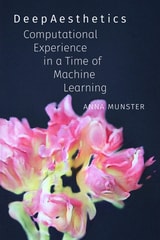
DeepAesthetics
Computational Experience in a Time of Machine LearningAnna Munster
Duke University Press, 2025
Computation has now been reconfigured by machine learning: those technical processes and operations that yoke together statistics and computer science to create artificial intelligence (AI) by furnishing vast datasets to learn tasks and predict outcomes. In DeepAesthetics, Anna Munster examines the range of more-than-human experiences this transformation has engendered and considers how those experiences can be qualitative as well as quantitative. Drawing on process philosophy, Munster approaches computational experience through its relations and operations. She combines deep learning—the subfield of machine learning that uses neural network architectures—and aesthetics to offer a way to understand the insensible and frequently imperceptible forms of nonlinear and continuously modulating statistical function. Attending to the domains and operations of image production, statistical racialization, AI conversational agents, and critical AI art, Munster analyzes how machine learning is operationally entangled with racialized, neurotypical, and cognitivist modes of producing knowledge and experience. She approaches machine learning as events through which a different sensibility registers, one in which AI is populated by oddness, disjunctions, and surprises, and where artful engagement with machine learning fosters indeterminate futures.
[more]

Probabilistic Approaches to Linguistic Theory
Edited by Jean-Philippe Bernardy, Rasmus Blanck, Stergios Chatzikyriakidis, Shalom Lappin, and Aleksandre Maskharashvili
CSLI, 2022
A textbook exploring predictive modes of linguistic development and analysis.
During the last two decades, computational linguists, in concert with other researchers in AI, have turned to machine learning and statistical techniques to capture features of natural language and aspects of the learning process that are not easily accommodated in classical algebraic frameworks. These developments are producing a revolution in linguistics in which traditional symbolic systems are giving way to probabilistic and deep learning approaches. This collection features articles that provide background to these approaches, and their application in syntax, semantics, pragmatics, morphology, psycholinguistics, neurolinguistics, and dialogue modeling. Each chapter provides a self-contained introduction to the topic that it covers, making this volume accessible to graduate students and researchers in linguistics, NLP, AI, and cognitive science.
During the last two decades, computational linguists, in concert with other researchers in AI, have turned to machine learning and statistical techniques to capture features of natural language and aspects of the learning process that are not easily accommodated in classical algebraic frameworks. These developments are producing a revolution in linguistics in which traditional symbolic systems are giving way to probabilistic and deep learning approaches. This collection features articles that provide background to these approaches, and their application in syntax, semantics, pragmatics, morphology, psycholinguistics, neurolinguistics, and dialogue modeling. Each chapter provides a self-contained introduction to the topic that it covers, making this volume accessible to graduate students and researchers in linguistics, NLP, AI, and cognitive science.
[more]