Results by title

10 books match the query 'Deindustrialization'
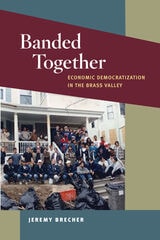
cover of Banded Together: Economic Democratization in the Brass Valley

Banded Together

Economic Democratization in the Brass Valley

Jeremy Brecher

University of Illinois Press, 2011
Providing incisive commentary on the historical and contemporary American working class experience, Banded Together: Economic Democratization in the Brass Valley documents a community's efforts to rebuild and revitalize itself in the aftermath of deindustrialization. Through powerful oral histories and other primary sources, Jeremy Brecher tells the story of a group of average Americans--factory workers, housewives, parishioners, and organizers--who tried to create a democratic alternative to the economic powerlessness caused by the closing of factories in the Connecticut Naugatuck Valley region during the 1970s and 1980s. This volume focuses on grassroots organization, democratically controlled enterprises, and supportive public policies, providing examples from the Naugatuck Valley Project community-alliance that remain relevant to the economic problems of today and tomorrow. Drawing on more than a hundred interviews with Project leaders, staff, and other knowledgeable members of the local community, Brecher illustrates how the Naugatuck Valley Project served as a vehicle for community members to establish greater control over their economic lives.
[more]
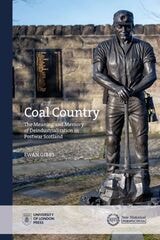
cover of Coal Country: The Meaning and Memory of Deindustrialization in Postwar Scotland

Coal Country

The Meaning and Memory of Deindustrialization in Postwar Scotland

Ewan Gibbs

University of London Press, 2022

The flooding and subsequent closure of Scotland’s last deep coal mine in 2002 was a milestone event in the nation’s deindustrialization. Villages and towns across the densely populated Central Belt of Scotland owe their existence to coal mining’s expansion during the nineteenth century and its maturation in the twentieth. Colliery closures and job losses were not just experienced in economic terms: they also had profound social, cultural, and political implications. Coal Country documents this process of deindustrialization and its effects, drawing on archival records from the UK government, the nationalized coal industry, trade unions, and transcripts from an extensive oral history project. Deindustrialization, we learn, progressed slowly but powerfully across the second half of the twentieth century. Coal Country explains the deep roots of economic changes and their political reverberations, which continue to be felt to this day.
[more]
cover of Exit Zero: Family and Class in Postindustrial Chicago

Exit Zero

Family and Class in Postindustrial Chicago

Christine J. Walley

University of Chicago Press, 2012

Winner of CLR James Book Prize from the Working Class Studies Association and 2nd Place for the Victor Turner Prize in Ethnographic Writing. 

In 1980, Christine J. Walley’s world was turned upside down when the steel mill in Southeast Chicago where her father worked abruptly closed. In the ensuing years, ninety thousand other area residents would also lose their jobs in the mills—just one example of the vast scale of deindustrialization occurring across the United States. The disruption of this event propelled Walley into a career as a cultural anthropologist, and now, in Exit Zero, she brings her anthropological perspective home, examining the fate of her family and that of blue-collar America at large.
 
Interweaving personal narratives and family photos with a nuanced assessment of the social impacts of deindustrialization, Exit Zero is one part memoir and one part ethnography— providing a much-needed female and familial perspective on cultures of labor and their decline. Through vivid accounts of her family’s struggles and her own upward mobility, Walley reveals the social landscapes of America’s industrial fallout, navigating complex tensions among class, labor, economy, and environment. Unsatisfied with the notion that her family’s turmoil was inevitable in the ever-forward progress of the United States, she provides a fresh and important counternarrative that gives a new voice to the many Americans whose distress resulting from deindustrialization has too often been ignored.

This book is part of a project that also includes a documentary film.
[more]
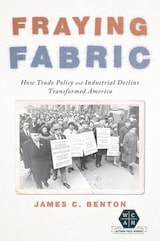
cover of Fraying Fabric: How Trade Policy and Industrial Decline Transformed America

Fraying Fabric

How Trade Policy and Industrial Decline Transformed America

James C. Benton

University of Illinois Press, 2022
The decline of the U.S. textile and apparel industries between the 1940s and 1970s helped lay the groundwork for the twenty-first century's potent economic populism in America. James C. Benton looks at how shortsighted trade and economic policy by labor, business, and government undermined an employment sector that once employed millions and supported countless communities. Starting in the 1930s, Benton examines how the New Deal combined promoting trade with weakening worker rights. He then moves to the ineffective attempts to aid textile and apparel workers even as imports surged, the 1974 pivot by policymakers and big business to institute lowered trade barriers, and the deindustrialization and economic devastation that followed. Throughout, Benton provides the often-overlooked views of workers, executives, and federal officials who instituted the United States’ policy framework in the 1930s and guided it through the ensuing decades. Compelling and comprehensive, Fraying Fabric explains what happened to textile and apparel manufacturing and how it played a role in today's politics of anger.
[more]
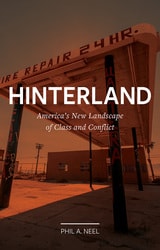
cover of Hinterland: America's New Landscape of Class and Conflict

Hinterland

America's New Landscape of Class and Conflict

Phil A. Neel

Reaktion Books, 2018

Over the last forty years, the human landscape of the United States has been fundamentally transformed. The metamorphosis is partially visible in the ascendance of glittering, coastal hubs for finance, infotech, and the so-called creative class. But this is only the tip of an economic iceberg, the bulk of which lies in the darkness of the declining heartland or on the dimly lit fringe of sprawling cities. This is America’s hinterland, populated by towering grain threshers and hunched farmworkers, where laborers drawn from every corner of the world crowd into factories and “fulfillment centers” and where cold storage trailers are filled with fentanyl-bloated corpses when the morgues cannot contain the dead.

Urgent and unsparing, this book opens our eyes to America’s new heart of darkness. Driven by an ever-expanding socioeconomic crisis, America’s class structure is recomposing itself in new geographies of race, poverty, and production. The center has fallen. Riots ricochet from city to city led by no one in particular. Anarchists smash financial centers as a resurgent far right builds power in the countryside. Drawing on his direct experience of recent popular unrest, from the Occupy movement to the wave of riots and blockades that began in Ferguson, Missouri, Phil A. Neel provides a close-up view of this landscape in all its grim but captivating detail. Inaugurating the new Field Notes series, published in association with the Brooklyn Rail, Neel’s book tells the intimate story of a life lived within America’s hinterland.
[more]
cover of SynergiCity: Reinventing the Postindustrial City

SynergiCity

Reinventing the Postindustrial City

Edited by Paul Hardin Kapp and Paul J. Armstrong

University of Illinois Press, 2012
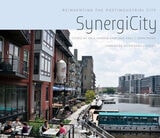
SynergiCity: Reinventing the Postindustrial City proposes a new and invigorating vision of urbanism, architectural design, and urban revitalization in twenty-first-century America. Culling transformative ideas from the realms of historic preservation, sustainability, ecological urbanism, and the innovation economy, Paul Hardin Kapp and Paul J. Armstrong present a holistic vision for restoring industrial cities suffering from population decline back into stimulating and productive places to live and work.
 
With a particular emphasis on the Rust Belt of the American Midwest, SynergiCity argues that cities such as Detroit, St. Louis, and Peoria must redefine themselves to be globally competitive. This revitalization is possible through environmentally and economically sustainable restoration of industrial areas and warehouse districts for commercial, research, light industrial, and residential uses. The volume's expert researchers, urban planners, and architects draw on the redevelopment successes of other major cities--such as the American Tobacco District in Durham, North Carolina, and the Milwaukee River Greenway--to set guidelines and goals for reinventing and revitalizing the postindustrial landscape.
 
Contributors are Paul J. Armstrong, Donald K. Carter, Lynne M. Dearborn, Norman W. Garrick, Mark Gillem, Robert Greenstreet, Craig Harlan Hullinger, Paul Hardin Kapp, Ray Lees, Emil Malizia, John O. Norquist, Christine Scott Thomson, and James Wasley.
[more]
cover of The Half-Life of Deindustrialization: Working-Class Writing about Economic Restructuring

The Half-Life of Deindustrialization

Working-Class Writing about Economic Restructuring

Sherry Lee Linkon

University of Michigan Press, 2018

Starting in the late 1970s, tens of thousands of American industrial workers lost jobs in factories and mines. Deindustrialization had dramatic effects on those workers and their communities, but its longterm effects continue to ripple through working-class culture. Economic restructuring changed the experience of work, disrupted people’s sense of self, reshaped local landscapes, and redefined community identities and expectations. Through it all, working-class writers have told stories that reflect the importance of memory and the struggle to imagine a different future. These stories make clear that the social costs of deindustrialization affect not only those who lost their jobs but also their children, their communities, and American culture.

Through analysis of poetry, fiction, creative nonfiction, film, and drama, The Half-Life of Deindustrialization shows why people and communities cannot simply “get over” the losses of economic restructuring. The past provides inspiration and strength for working-class people, even as the contrast between past and present highlights what has been lost in the service economy. The memory of productive labor and stable, proud working-class communities shapes how people respond to contemporary economic, social, and political issues. These stories can help us understand the resentment, frustration, pride, and persistence of the American working class.
[more]
cover of The Lowell Experiment: Public History in a Postindustrial City

The Lowell Experiment

Public History in a Postindustrial City

Cathy Stanton

University of Massachusetts Press, 2006

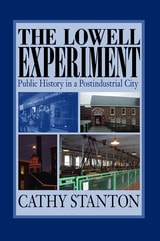
In the early nineteenth century, Lowell, Massachusetts, was widely studied and emulated as a model for capitalist industrial development. One of the first cities in the United States to experience the ravages of deindustrialization, it was also among the first places in the world to turn to its own industrial and ethnic history as a tool for reinventing itself in the emerging postindustrial economy. The Lowell Experiment explores how history and culture have been used to remake Lowell and how historians have played a crucial yet ambiguous role in that process.

The book focuses on Lowell National Historical Park, the flagship project of Lowell's new cultural economy. When it was created in 1978, the park broke new ground with its sweeping reinterpretations of labor, immigrant, and women's history. It served as a test site for the ideas of practitioners in the new field of public history—a field that links the work of professionally trained historians with many different kinds of projects in the public realm. 

The Lowell Experiment takes an anthropological approach to public history in Lowell, showing it as a complex cultural performance shaped by local memory, the imperatives of economic redevelopment, and tourist rituals—all serving to locate the park's audiences and workers more securely within a changing and uncertain new economy characterized by growing inequalities and new exclusions. 

The paradoxical dual role of Lowell's public historians as both interpreters of and contributors to that new economy raises important questions about the challenges and limitations facing academically trained scholars in contemporary American culture. As a long-standing and well-known example of “culture-led re-development,” Lowell offers an outstanding site for exploring questions of concern to those in the fields of public and urban history, urban planning, and tourism studies.
[more]
cover of The Problem of Jobs: Liberalism, Race, and Deindustrialization in Philadelphia

The Problem of Jobs

Liberalism, Race, and Deindustrialization in Philadelphia

Guian A. McKee

University of Chicago Press, 2008

Contesting claims that postwar American liberalism retreated from fights against unemployment and economic inequality, The Problem of Jobs reveals that such efforts did not collapse after the New Deal but instead began to flourish at the local, rather than the national, level.

With a focus on Philadelphia, this volume illuminates the central role of these local political and policy struggles in shaping the fortunes of city and citizen alike. In the process, it tells the remarkable story of how Philadelphia’s policymakers and community activists energetically worked to challenge deindustrialization through an innovative series of job retention initiatives, training programs, inner-city business development projects, and early affirmative action programs. Without ignoring the failure of Philadelphians to combat institutionalized racism, Guian McKee's account of their surprising success draws a portrait of American liberalism that evinces a potency not usually associated with the postwar era. Ultimately interpreting economic decline as an arena for intervention rather than a historical inevitability, The Problem of Jobs serves as a timely reminder of policy’s potential to combat injustice.
 
[more]
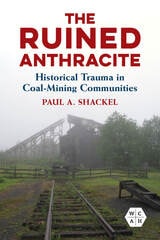
cover of The Ruined Anthracite: Historical Trauma in Coal-Mining Communities

The Ruined Anthracite

Historical Trauma in Coal-Mining Communities

Paul A. Shackel

University of Illinois Press, 2023

Once a busy if impoverished center for the anthracite coal industry, northeastern Pennsylvania exists today as a region suffering inexorable decline--racked by economic hardship and rampant opioid abuse, abandoned by young people, and steeped in xenophobic fear. Paul A. Shackel merges analysis with oral history to document the devastating effects of a lifetime of structural violence on the people who have stayed behind. Heroic stories of workers facing the dangers of underground mining stand beside accounts of people living their lives in a toxic environment and battling deprivation and starvation by foraging, bartering, and relying on the good will of neighbors. As Shackel reveals the effects of these long-term traumas, he sheds light on people’s poor health and lack of well-being. The result is a valuable on-the-ground perspective that expands our understanding of the social fracturing, economic decay, and anger afflicting many communities across the United States.

Insightful and dramatic, The Ruined Anthracite combines archaeology, documentary research, and oral history to render the ongoing human cost of environmental devastation and unchecked capitalism.

[more]