Results by title

4 books match the query 'Demands'
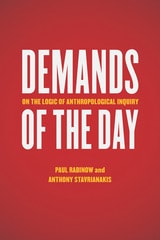
cover of Demands of the Day: On the Logic of Anthropological Inquiry

Demands of the Day

On the Logic of Anthropological Inquiry

Paul Rabinow and Anthony Stavrianakis

University of Chicago Press, 2013

Demands of the Day asks about the logical standards and forms that should guide ethical and experimental anthropology in the twenty-first century. Anthropologists Paul Rabinow and Anthony Stavrianakis do so by taking up Max Weber’s notion of the “demands of the day.” Just as the demand of the day for anthropology decades ago consisted of thinking about fieldwork, today, they argue, the demand is to examine what happens after, how the experiences of fieldwork are gathered, curated, narrated, and ultimately made available for an anthropological practice that moves beyond mere ethnographic description.
 
Rabinow and Stavrianakis draw on experiences from an innovative set of anthropological experiments that investigated how and whether the human and biological sciences could be brought into a mutually enriching relationship. Conceptualizing the anthropological and philosophic ramifications of these inquiries, they offer a bold challenge to contemporary anthropology to undertake a more rigorous examination of its own practices, blind spots, and capacities, in order to meet the demands of our day.
[more]
cover of Demands of the Dead: Executions, Storytelling, and Activism in the United States

Demands of the Dead

Executions, Storytelling, and Activism in the United States

Katy Ryan

University of Iowa Press, 2012

The first work to combine literary criticism with other forms of death penalty–abolitionist writing, Demands of the Dead demonstrates the active importance of literature and literary criticism to the struggle for greater justice in the United States. Gathering personal essays, scholarly articles, and creative writings on the death penalty in American culture, this striking collection brings human voices and literary perspectives to a subject that is often overburdened by statistics and angry polemics. Contributors include death-row prisoners, playwrights, poets, activists, and literary scholars.

Highlighting collaborations between writers inside and outside prison, all within the context of the history of state killing laws and foundational concepts that perpetuate a culture of violent death, Demands of the Dead opens with a pamphlet dictated by Willie Francis, a teenager who survived a first execution attempt in Louisiana’s electric chair before he was subsequently killed by the state in 1947.

Writers are a conspicuous part of U.S. death-penalty history, composing a vibrant literary record of resistance to state killing. This multigenre collection both recalls and contributes to this tradition through discussions of such writers as Walt Whitman, Herman Melville, Gertrude Atherton, Ernest Gaines, Sonia Sanchez, Kia Corthron, and Sherman Alexie. A major contribution to literary studies and American prison studies, Demands of the Dead asserts the relevance of storytelling to ethical questions and matters of public policy.

 
Contributors
Sherman Alexie
John Cyril Barton
Steve Champion
Kia Corthron
Thomas Dutoit
Willie Francis
H. Bruce Franklin
Tom Kerr
David Kieran
Jennifer Leigh Lieberman
Jill McDonough
Anthony Ross
Katy Ryan
Elizabeth Ann Stein
Rick Stetter
Matthew Stratton
Jason Stupp
Delbert Tibbs
[more]
cover of Sensible Ecstasy: Mysticism, Sexual Difference, and the Demands of History

Sensible Ecstasy

Mysticism, Sexual Difference, and the Demands of History

Amy Hollywood

University of Chicago Press, 2001

Sensible Ecstasy investigates the attraction to excessive forms of mysticism among twentieth-century French intellectuals and demonstrates the work that the figure of the mystic does for these thinkers. With special attention to Georges Bataille, Simone de Beauvoir, Jacques Lacan, and Luce Irigaray, Amy Hollywood asks why resolutely secular, even anti-Christian intellectuals are drawn to affective, bodily, and widely denigrated forms of mysticism.

What is particular to these thinkers, Hollywood reveals, is their attention to forms of mysticism associated with women. They regard mystics such as Angela of Foligno, Hadewijch, and Teresa of Avila not as emotionally excessive or escapist, but as unique in their ability to think outside of the restrictive oppositions that continue to afflict our understanding of subjectivity, the body, and sexual difference. Mystics such as these, like their twentieth-century descendants, bridge the gaps between action and contemplation, emotion and reason, and body and soul, offering new ways of thinking about language and the limits of representation.
[more]
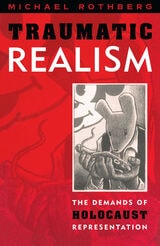
cover of Traumatic Realism: The Demands of Holocaust Representation

Traumatic Realism

The Demands of Holocaust Representation

Michael Rothberg

University of Minnesota Press, 2000

How to approach the Holocaust and its relationship to late twentieth-century society? While some stress the impossibility of comprehending this event, others attempt representations in forms as different as the nonfiction novel (and Hollywood blockbuster) Schindler’s List, the documentary Shoah, and the comic book Maus. This problem is at the center of Michael Rothberg’s book, a focused account of the psychic, intellectual, and cultural aftermath of the Holocaust. Drawing on a wide range of texts, Michael Rothberg puts forth an overarching framework for understanding representations of the Holocaust. Through close readings of such writers and thinkers as Theodor Adorno, Maurice Blanchot, Ruth Klüger, Charlotte Delbo, Art Spiegelman, and Philip Roth and an examination of films by Steven Spielberg and Claude Lanzmann, Rothberg demonstrates how the Holocaust as a traumatic event makes three fundamental demands on representation: a demand for documentation, a demand for reflection on the limits of representation, and a demand for engagement with the public sphere and commodity culture. As it establishes new grounding for Holocaust studies, his book provides a new understanding of realism, modernism, and postmodernism as responses to the demands of history. 
[more]