Results by title
3 books match the query 'Democracy and architecture'
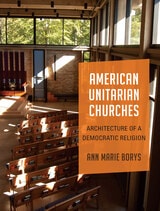
American Unitarian Churches
Architecture of a Democratic ReligionAnn Marie Borys
University of Massachusetts Press, 2021
In American Unitarian Churches, Ann Marie Borys argues that the progressive values and identity of the Unitarian religion are intimately intertwined with ideals of American democracy and visibly expressed in the architecture of its churches. Over time, church architecture has continued to evolve in response to developments within the faith, and many contemporary projects are built to serve religious, practical, and civic functions simultaneously. Focusing primarily on churches of the nineteenth and twentieth centuries, including Frank Lloyd Wright's Unity Temple and Louis Kahn's First Unitarian Church, Borys explores building histories, biographies of leaders, and broader sociohistorical contexts. As this essential study makes clear, to examine Unitarianism through its churches is to see American architecture anew, and to find an authentic architectural expression of American democratic identity.
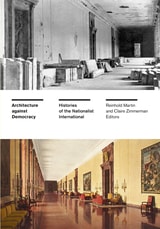
Architecture against Democracy
Histories of the Nationalist InternationalReinhold Martin
University of Minnesota Press, 2024
Examining architecture’s foundational role in the repression of democracy
Reinhold Martin and Claire Zimmerman bring together essays from an array of scholars exploring the troubled relationship between architecture and antidemocratic politics. Comprising detailed case studies throughout the world spanning from the early nineteenth century to the present, Architecture against Democracy analyzes crucial occasions when the built environment has been harnessed as an instrument of authoritarian power.
Alongside chapters focusing on paradigmatic episodes from twentieth-century German and Italian fascism, the contributors examine historic and contemporary events and subjects that are organized thematically, including the founding of the Smithsonian Institution, Ellis Island infrastructure, the aftermath of the Paris Commune, Cold War West Germany and Iraq, Frank Lloyd Wright’s domestic architecture, and Istanbul’s Taksim Square. Through the range and depth of these accounts, Architecture against Democracy presents a selective overview of antidemocratic processes as they unfold in the built environment throughout Western modernity, offering an architectural history of the recent “nationalist international.”
As new forms of nationalism and authoritarian rule proliferate across the globe, this timely collection offers fresh understandings of the role of architecture in the opposition to democracy.
Contributors: Esra Akcan, Cornell U; Can Bilsel, U of San Diego; José H. Bortoluci, Getulio Vargas Foundation; Charles L. Davis II, U of Texas at Austin; Laura diZerega; Eve Duffy, Duke U; María González Pendás, Cornell U; Paul B. Jaskot, Duke U; Ana María León, Harvard U; Ruth W. Lo, Hamilton College; Peter Minosh, Northeastern U; Itohan Osayimwese, Brown U; Kishwar Rizvi, Yale U; Naomi Vaughan; Nader Vossoughian, New York Institute of Technology and Columbia U; Mabel O. Wilson, Columbia U.
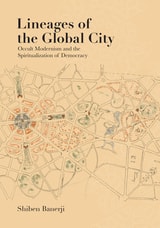
Lineages of the Global City
Occult Modernism and the Spiritualization of DemocracyShiben Banerji
University of Texas Press, 2025
2026 PROSE Award in Architecture & Urban Planning, Association of American Publishers (AAP)
2026 Book Prize Shortlist, Modernist Studies Association (MSA)
The forgotten history of the occult foundations of the early twentieth-century global city.
War, revolution, genocide, rebellion, slump. The economic and political turmoil of the early twentieth century seemed destined to rip asunder the ties that bound colonizers and the colonized to one another. The upheaval represented an opportunity, and not just to nationalists who imagined new homelands or to socialists who dreamed of international brotherhood. For modernists in the orbit of various occultisms, the crisis of empire also represented an opportunity to reveal humanity’s fundamental unity and common fate.
Lineages of the Global City recounts a continuous, if also contentious, transnational exchange among modernists and occultists across the Americas, Europe, South Asia, and Australia between 1905 and 1949. At stake were the feelings and affect of a new global subject who would perceive themselves as belonging to humanity as a unified whole, and the urban environment that would foster their subjectivity. The interventions in this debate, which drew in the period’s most renowned modernists, took the form of a succession of plans for cities, suburbs, and communes, as well as experiments in building, drawing, printmaking, filmmaking, and writing. Weaving together postcolonial, feminist, and Marxist insight on subject formation, Shiben Banerji advances a new way of understanding modernist urban space as the design of subjective effects.