Results by title
5 books match the query 'Democrats'

Dixiecrats and Democrats
Alabama PoliticsWilliam D. Barnard
University of Alabama Press, 1984
A pivotal in the study of history and politics, not only in Alabama but in the other states of the South
Barnard’s account is elegantly concise, the labor of conspicuous scholarship. In an effort to analyze Alabama’s political bedrock, the author has tapped virtually every source. What results is a cogent and harmonious theme.

The Constitution in Congress
Democrats and Whigs, 1829-1861David P. Currie
University of Chicago Press, 2005
Like its predecessors, The Constitution in Congress: Democrats and Whigs will be an invaluable reference for legal scholars and constitutional historians alike.

The Democrats
From Jefferson to ClintonRobert Allen Rutland, Foreword by Jimmy Carter
University of Missouri Press, 1995
Interlacing humor into his ongoing narrative, Robert Allen Rutland provides in The Democrats a readable, balanced account of how the Democratic party was founded, evolved, nearly died, and came back in the twentieth century, flourishing as a political melting pot despite numerous setbacks. This updated version of Rutland's much-heralded The Democrats: From Jefferson to Carter provides new insight into the long hiatus in the Democrats' presence in the White House between Carter and Clinton. In additon to analyzing Carter's successes and failures as president, Rutland also examines the forces that went into the Democratic defeats and Republican victories in 1980, 1984, and 1988, concluding with the election of another Jeffersonian Democrat, William Jefferson Clinton. The book ends with an examination of the dramatic results of the 1994 congressional elections that began to alert President Clinton to the challenge he would face in winning reelection in 1996.
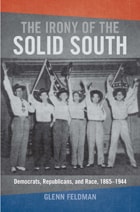
The Irony of the Solid South
Democrats, Republicans, and Race, 1865–1944Glenn Feldman
University of Alabama Press, 2013
Race, Politics, and the Making of the Modern South.
The Irony of the Solid South examines how the south became the “Solid South” for the Democratic Party and how that solidarity began to crack with the advent of American involvement in World War II. Relying on a sophisticated analysis of secondary research—as well as a wealth of deep research in primary sources such as letters, diaries, interviews, court cases, newspapers, and other archival materials—Glenn Feldman argues in The Irony of the Solid South that the history of the solid Democratic south is actually marked by several ironies that involve a concern with the fundamental nature of southern society and culture and the central place that race and allied types of cultural conservatism have played in ensuring regional distinctiveness and continuity across time and various partisan labels. Along the way, this account has much to say about the quality and nature of the New Deal in Dixie, southern liberalism, and its fatal shortcomings.
Feldman focuses primarily on Alabama and race but also considers at length circumstances in the other southern states as well as insights into the uses of emotional issues other than race that have been used time and again to distract whites from their economic and material interests. Feldman explains how conservative political forces (Bourbon Democrats, Dixiecrats, Wallace, independents, and eventually the modern GOP) ingeniously fused white supremacy with economic conservatism based on the common glue of animus to the federal government. A second great melding is exposed, one that joined economic fundamentalism to the religious kind along the shared axis of antidemocratic impulses.
Feldman’s study has much to say about southern and American conservatism, the enduring power of cultural and emotional issues, and the modern south’s path to becoming solidly Republican.
What's Left of the Left
Democrats and Social Democrats in Challenging TimesJames Cronin, George Ross, and James Shoch, eds.
Duke University Press, 2011
Contributors. Sheri Berman, James Cronin, Jean-Michel de Waele, Arthur Goldhammer, Christopher Howard, Jane Jenson, Gerassimos Moschonas, Sofia Pérez, Jonas Pontusson, George Ross, James Shoch, Sorina Soare, Ruy Teixeira