Results by title

5 books match the query 'Demon'

cover of Demon in the Box: Jews, Arabs, Politics, and Culture in the Making of Israeli Television

Demon in the Box

Jews, Arabs, Politics, and Culture in the Making of Israeli Television

Oren, Tasha G

Rutgers University Press, 2004

What does a country's television programming say about its deep character, beliefs, dreams, and fears? In Demon in the Box, Tasha G. Oren recounts the volatile history of Israeli television and thereby reveals the history of the nation itself.

Initially rejected as a corrupting influence on "the people of the book," television became the object of fantasies and anxieties that went to the heart of Israel's most pressing concerns: Arab-Israeli relations, immigration, and the forging of a modern Israeli culture. Television broadcasting was aimed toward external relations-the flow of messages across borders, Arab-Israeli conflict, and the shaping of public opinion worldwide-as much as it was toward internal needs and interests. Through archival research and analysis of public scandals and early programs, Oren traces Israeli television's transformation from a feared agent of decadence to a powerful national communication tool, and eventually, to a vastly popular entertainment medium.

[more]
cover of Demon of the Lost Cause: Sherman and Civil War History

Demon of the Lost Cause

Sherman and Civil War History

Wesley Moody

University of Missouri Press, 2011
 
At the end of the Civil War, Union general William Tecumseh Sherman was surprisingly more popular in the newly defeated South than he was in the North. Yet, only thirty years later, his name was synonymous with evil and destruction in the South, particularly as the creator and enactor of the “total war” policy. In Demon of the Lost Cause, Wesley Moody examines these perplexing contradictions and how they and others function in past and present myths about Sherman.
            Throughout this fascinating study of Sherman’s reputation, from his first public servant role as the major general for the state of California until his death in 1891, Moody explores why Sherman remains one of the most controversial figures in American history. Using contemporary newspaper accounts, Sherman’s letters and memoirs, as well as biographies of Sherman and histories of his times, Moody reveals that Sherman’s shifting reputation was formed by whoever controlled the message, whether it was the Lost Cause historians of the South, Sherman’s enemies in the North, or Sherman himself.
With his famous “March to the Sea” in Georgia, the general became known for inventing a brutal warfare where the conflict is brought to the civilian population. In fact, many of Sherman’s actions were official tactics to be employed when dealing with guerrilla forces, yet Sherman never put an end to the talk of his innovative tactics and even added to the stories himself. Sherman knew he had enemies in the Union army and within the Republican elite who could and would jeopardize his position for their own gain. In fact, these were the same people who spread the word that Sherman was a Southern sympathizer following the war, helping to place the general in the South’s good graces. That all changed, however, when the Lost Cause historians began formulating revisions to the Civil War, as Sherman’s actions were the perfect explanation for why the South had lost.
 Demon of the Lost Cause reveals the machinations behind the Sherman myth and the reasons behind the acceptance of such myths, no matter who invented them. In the case of Sherman’s own mythmaking, Moody postulates that his motivation was to secure a military position to support his wife and children. For the other Sherman mythmakers, personal or political gain was typically the rationale behind the stories they told and believed.  In tracing Sherman’s ever-changing reputation, Moody sheds light on current and past understanding of the Civil War through the lens of one of its most controversial figures.
[more]
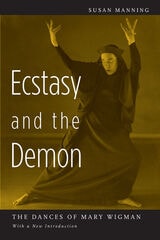
cover of Ecstasy and the Demon: The Dances of Mary Wigman

Ecstasy and the Demon

The Dances of Mary Wigman

Susan Manning

University of Minnesota Press, 2006

Mary Wigman, Germany’s premier dancer between the two world wars, envisioned the performer in the thrall of ecstatic and demonic forces. Widely hailed as an innovator of dance modernism, she never acknowledged her complex relationship with National Socialism. In Ecstasy and the Demon, Susan Manning advances a sociological explanation for the collaboration between German modern dancers and National Socialism. She models methods for dance studies that contextualize choreography in relation to changing sociopolitical conditions, bringing dance scholarship into conversation with intellectual trends across the humanities.The introduction to this second edition brings Manning’s groundbreaking work to bear on dance studies today and reconsiders Wigman’s career from the perspective of queer theory and globalization, further illuminating the interplay of dance and politics in the twentieth century.Susan Manning is professor of English, theater, and performance studies at Northwestern University.
[more]
cover of The Demon and the Damozel: Dynamics of Desire in the Works of Christina Rossetti and Dante Gabriel Rossetti

The Demon and the Damozel

Dynamics of Desire in the Works of Christina Rossetti and Dante Gabriel Rossetti

Suzanne M. Waldman

Ohio University Press, 2008
Developing a perspective on Victorian culture as the breeding ground for early theories of the unconscious and the divided psyche, The Demon and the Damozel: Dynamics of Desire in the Works of Christina Rossetti and Dante Gabriel Rossetti offers a new reading of these eminent Victorian siblings’ literature and visual arts. Suzanne M. Waldman views well-known poems and artworks such as Christina Rossetti’s Goblin Market and Dante Gabriel Rossetti’s The Blessed Damozel and Venus Verticordia in new ways that expose their authors’ savvy anticipation of concepts that would come to be known as narcissism, fetishism, and the symbolic and imaginary orders, among many others. Waldman makes a strong case for the particular psychoanalytic importance of the Rossettis by looking at how the two Rossetti siblings’ own psyches were divided by conflicts between the period’s religious scruples and its taste for gothic sensationalism. The Demon and the Damozel is a close and contextualized reading of their writings and artwork that displays, for the first time, continuity between the medieval cosmologies these Pre-Raphaelites drew upon and the psychoanalytic theories they looked ahead to—and locates the intricate patterns of proto-psychoanalytic understanding in the rich tapestry of Pre-Raphaelite aestheticism.
[more]
cover of The Demon in the Machine: How Hidden Webs of Information Are Solving the Mystery of Life

The Demon in the Machine

How Hidden Webs of Information Are Solving the Mystery of Life

Paul Davies

University of Chicago Press, 1991

Physics World Book of the Year

A Financial Times, Sunday Times, and Telegraph Best Science Book of the Year


What is life? For generations, scientists have struggled to make sense of this fundamental question, for life really does look like magic: even a humble bacterium accomplishes things so dazzling that no human engineer can match it. Huge advances in molecular biology over the past few decades have served only to deepen the mystery.

In this penetrating and wide-ranging book, world-renowned physicist and science communicator Paul Davies searches for answers in a field so new and fast-moving that it lacks a name; it is a domain where biology, computing, logic, chemistry, quantum physics, and nanotechnology intersect. At the heart of these diverse fields, Davies explains, is the concept of information: a quantity which has the power to unify biology with physics, transform technology and medicine, and force us to fundamentally reconsider what it means to be alive—even illuminating the age-old question of whether we are alone in the universe.

From life’s murky origins to the microscopic engines that run the cells of our bodies, The Demon in the Machine journeys across an astounding landscape of cutting-edge science. Weaving together cancer and consciousness, two-headed worms and bird navigation, Davies reveals how biological organisms garner and process information to conjure order out of chaos, opening a window onto the secret of life itself.
[more]